How Wikipedia errors spread into AI search results
▼ Summary
– Wikipedia was once considered unreliable but is now treated as credible due to citations and collaborative editing, and it is a primary source for AI search systems like ChatGPT and Google.
– Negative or outdated information often persists on Wikipedia for months or years, which AI systems then relay to users, creating a feedback loop that amplifies these narratives.
– Wikipedia prioritizes verifiability from sources like news outlets over pure accuracy, and its decentralized volunteer editors often avoid removing disputed content due to consensus and risk aversion.
– AI search platforms condense Wikipedia content into summaries, and roughly 40% of users do not fact-check these results, allowing outdated claims to shape perceptions instantly.
– To address negative Wikipedia content, perform an audit, compare it to current coverage, and strengthen positive citations from reputable outlets, as direct editing is discouraged due to conflict of interest policies.
The days when Wikipedia was dismissed as an unreliable source are largely behind us. Today, it functions as a cornerstone of digital credibility, thanks to its rigorous citation standards and a collaborative editing system. This transformation has made it a primary data source for AI search systems like ChatGPT and Google AI Overviews, which also lean heavily on platforms like Reddit.
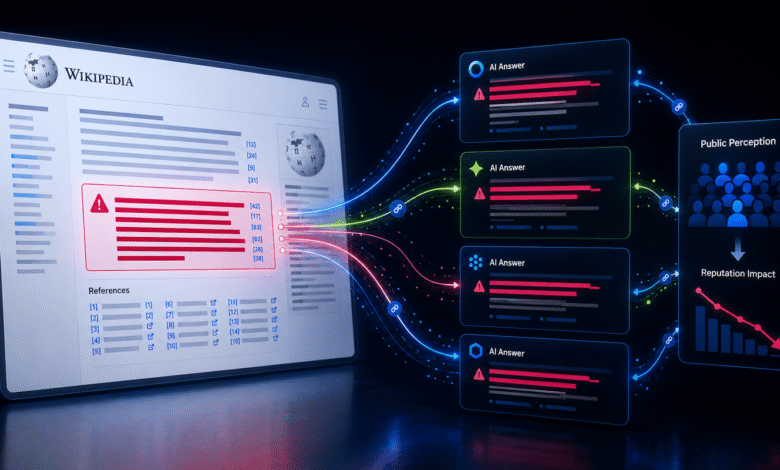
However, this reliance creates a significant vulnerability. Wikipedia is not infallible. Outdated or negative information can linger on specific pages for extended periods, sometimes years. When AI search engines ingest this data, they create a feedback loop, recycling stale or disputed claims and amplifying their reach. This grants outdated narratives a dangerous level of long-term visibility and false credibility across the digital landscape. So, what can you do when negative content about you or your brand takes root on Wikipedia?
How Content Lands on Wikipedia
The platform’s core principle is verifiability, not necessarily pure accuracy. Content is often sourced from respected third-party outlets like news organizations and scientific journals, making them de facto gatekeepers. This system prioritizes a source’s reputation over the absolute correctness of the information, and media outlets themselves are not immune to error.
Compounding this is Wikipedia’s decentralized structure. Its editors are volunteer-based and often reach decisions by general consensus. There is no central authority to quickly correct disputed content. Wikipedia itself acknowledges this, maintaining a dedicated page documenting its many controversies. Negative or outdated information often persists because it originated from a single, high-profile news story or legal issue that continues to be cited long after the situation has evolved.
Why Negative Content Sticks
Several structural factors make it difficult to remove problematic information:
- Citations have extreme permanence. Once information is backed by a “reputable” source, removal becomes extremely difficult, even if that information has since been disproven.
Wikipedia’s Role in AI Search
Generative AI platforms have given Wikipedia’s content an added layer of authority. ChatGPT and Google AI Overviews condense information from Wikipedia, Reddit, and news outlets into simplified narratives. This means outdated controversies or disputed claims can spread to massive audiences almost instantly.
The problem is compounded by user behavior. Many people now rely on AI-generated summaries without clicking through to verify the facts. Some estimates suggest that roughly 40% of users do not fact-check AI search results. When AI systems surface negative Wikipedia content, it can shape public perception in a matter of seconds.
A Case Study: Wikipedia and AI Disrupted a Social Media Company
My online reputation management firm recently worked with a prominent marketing company, which we will call Organization Z for privacy. Nearly a decade ago, Organization Z faced plagiarism claims that were eventually cleared and dismissed. However, the allegations remained on their Wikipedia page, labeled as a “controversy.”
Wikipedia placed far more emphasis on the apparent controversy than on the fact that the company’s name was later cleared. AI search engines then began pulling this outdated information directly from Wikipedia. When users searched for the brand, they saw terms like “controversy” and “plagiarism,” despite all claims having been dismissed years prior. The issue continued to resurface online long after it was resolved.
How to Navigate Negative Wikipedia Content
First, understand what does not work. Editing your own Wikipedia page creates a clear conflict of interest and is closely monitored. You also cannot remove content without a strong, policy-based justification. With those constraints in mind, here is a practical framework for addressing negative or outdated content:
- Perform an audit. Identify the claims on Wikipedia and the sources used. Outline any outdated references or integrity gaps. Determine if the information is still relevant and if the coverage is fair.
- Compare Wikipedia to current coverage. Analyze how the brand, person, or issue is represented online today. Identify missing context, outdated information, or overemphasized points. This is essentially an AI narrative audit.
- Address the citations. You are not altering Wikipedia itself; you are altering what Wikipedia cites. Publish factual, positive content that reflects the current reality. Prioritize third-party mentions on reputable media outlets or in academic journals.
- Strengthen positive, balanced coverage. Build your brand image online by highlighting achievements and industry recognition. Establish yourself as a reputable voice, and Wikipedia will soon reflect that shift.
AI Search Raises the Stakes
Wikipedia remains a powerful source of information, but its reliance on citations and consensus can allow outdated or negative narratives to persist. This becomes far more consequential when AI search engines amplify those narratives in their generated answers. While brands cannot directly control what appears on Wikipedia, they can influence the sources that shape it. The key is to strengthen accurate, balanced coverage across reputable outlets and to regularly audit how your brand appears online.
(Source: Search Engine Land)