Russia’s Missile Fails Again, Undermining Deterrence
▼ Summary
– Russian officials, including President Putin, have publicly promoted the Sarmat (RS-28/Satan II) ICBM as a unique and formidable strategic weapon.
– The Sarmat missile program has experienced multiple consecutive failures, including a catastrophic 2024 explosion that destroyed its primary test silo.
– The Sarmat is intended to replace Russia’s aging R-36M2 ICBM fleet, and a recent test failure is widely analyzed to have involved the new missile.
– This failure delays the Sarmat’s deployment, jeopardizing the replacement of older missiles that carry a significant portion of Russia’s strategic warheads.
– The incident creates uncertainty about the readiness of Russia’s nuclear arsenal, raising concerns about either new system failures or the decay of existing hardware.
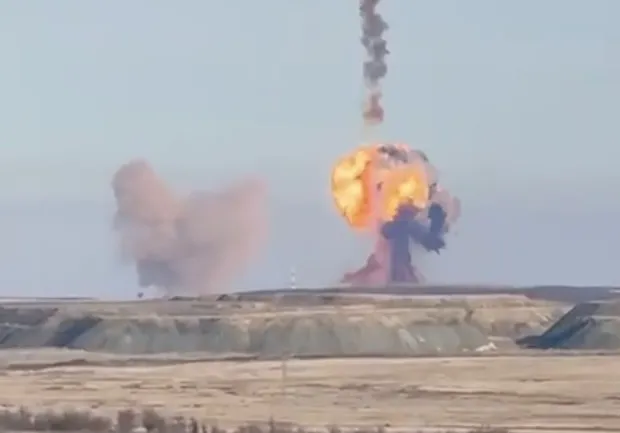
The reliability of Russia’s strategic nuclear deterrent faces mounting scrutiny following another suspected test failure of its advanced Sarmat intercontinental ballistic missile (ICBM). This latest incident, captured in a low-resolution video from a launch site last week, casts a long shadow over Moscow’s efforts to modernize its aging nuclear triad. While analysts cannot definitively confirm the missile type from the footage, the evidence strongly points to the troubled Sarmat program, a weapon system Russian President Vladimir Putin has previously hailed as “truly unique.”
Official Russian rhetoric has consistently portrayed the RS-28 Sarmat, nicknamed “Satan II” by NATO, as a formidable superweapon. Putin himself has suggested it would give potential adversaries serious pause. The reality of the program’s development, however, tells a different story. After an apparently successful initial test flight in 2022, the project has been plagued by consecutive failures. The most dramatic of these was a catastrophic explosion last year that destroyed a dedicated underground silo in northern Russia.
This new missile is intended to replace the Soviet-era R-36M2 ICBMs, a critical component of Russia’s strategic arsenal that was originally manufactured in Ukraine. The Russian Ministry of Defense emphasizes that the Sarmat is a purely domestic product, a point of pride and strategic necessity. The timing and location of the recent test lend credence to the theory that it involved the newer system. The launch silo at the Dombarovsky site had undergone what analysts describe as an “urgent renovation” beginning in the spring of 2025, likely to accommodate Sarmat testing after the loss of the northern facility.
Etienne Marcuz, an analyst at the French Foundation for Strategic Research, noted that this renovation supports the hypothesis of a Sarmat failure. He explained that testing the decades-old R-36M2, last launched over ten years ago, is highly improbable for Russia’s strategic rocket forces. “If this is indeed another Sarmat failure, it would be highly detrimental to the medium-term future of Russian deterrence,” Marcuz stated. The consequence is a dangerous delay. The aging missiles, which carry a substantial portion of Russia’s nuclear warheads, will remain in service longer while their maintenance, once handled by Ukraine, grows increasingly uncertain.
Independent researcher Pavel Podvig, who runs the Russian Nuclear Forces project, concurs with this assessment. With the old missiles nearing retirement, the logical candidate for any test is the Sarmat. This pattern of setbacks creates a dual dilemma for Russian military planners. If the failed launch was an older ICBM, it signals alarming issues with hardware decay in the existing stockpile. If it was the Sarmat, as seems more likely, it represents the latest in a string of problems that have stalled its operational deployment since its originally planned service entry.
Ultimately, each failed test injects fresh uncertainty into the readiness and modernization of Russia’s nuclear forces. While the political messaging around the Sarmat projects overwhelming strength, its technical development reveals significant vulnerabilities that could undermine the very deterrent capability it is meant to ensure.
(Source: Ars Technica)