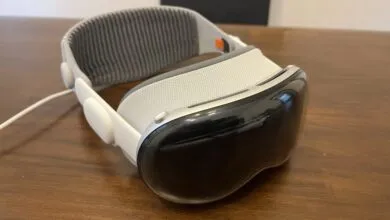
Apple Quietly Launches Second-Gen Vision Pro
▼ Summary
– Apple is upgrading the Vision Pro headset with an M5 chip and introducing a new Dual Knit Band for improved comfort.
– The M5 chip enhances performance by rendering 10% more pixels, increasing refresh rates to 120Hz, and speeding up AI features by up to 50%.
– Battery life improves to 2.5 hours for general use and 3 hours for video playback, with the M5 model launching on October 22nd at $3,499.
– The Dual Knit Band, available for $99 in three sizes, is compatible with the original M2 Vision Pro and features an adjustable dial for fit.
– This update coincides with Apple’s expansion into immersive sports and competitive pressure from Samsung’s upcoming Project Moohan launch on October 21st.
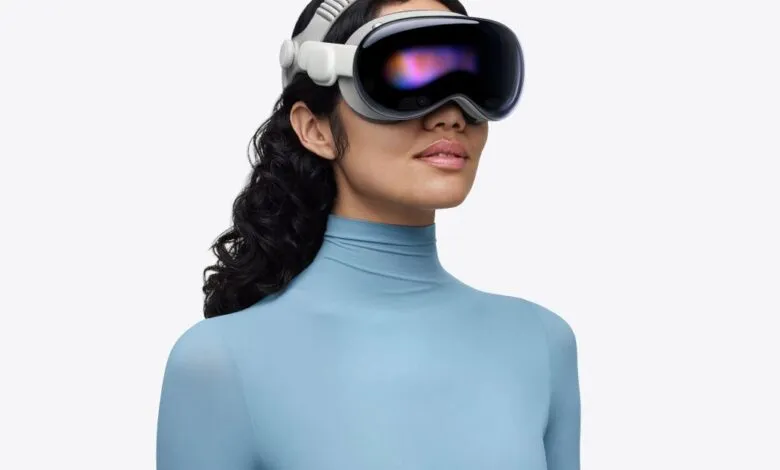
Apple’s latest hardware refresh didn’t come with a keynote or cinematic reveal , just a quiet update on its website. The second-generation Vision Pro has arrived, and it’s less about spectacle and more about substance. Priced at the same $3,499, it’s still a premium device reserved for early adopters, developers, and professionals testing the limits of Apple’s spatial computing ambitions.
Pre-orders opened immediately, with shipments starting October 22, confirming that this isn’t a reimagining of the Vision Pro, but a calculated refinement. Apple seems content to iterate rather than reinvent, using this release to polish performance, extend usability, and signal where its mixed-reality ambitions are heading.
Under the Hood: The M5 Shift
The centerpiece of this update is the M5 chip, replacing the original M2 that powered the debut model earlier this year. The move brings the headset in line with Apple’s broader silicon roadmap and delivers a clear leap in performance. The M5’s CPU and GPU offer faster throughput and improved energy efficiency, while 32GB of RAM ensures demanding applications , from immersive 3D environments to real-time rendering , run without a hitch.
The performance gains go beyond raw power. The M5 enables the Vision Pro’s twin OLED displays to render 10% more pixels and raise the maximum refresh rate from 100Hz to 120Hz. The effect is immediate: smoother visuals, lower latency, and a level of responsiveness that makes digital interactions feel more physical.
Apple says AI-driven tasks like creating a “Persona” or processing spatial photos now complete up to 50% faster, which suggests the headset is inching closer to handling more advanced real-time generative features , an area Apple is expected to expand heavily in upcoming visionOS updates. Battery life also gets a bump, reaching 2.5 hours for general use and 3 hours for video playback, about half an hour more than before.
In short, Apple’s focus here isn’t to redefine the Vision Pro , it’s to make it more capable of what it already does, and better prepared for what’s coming next.
Comfort, Competition, and the Road Ahead
The other visible change is one you wear: the new Dual Knit Band. Apple has learned from early user feedback about comfort, offering a strap that blends the flexibility of the Solo Knit Band with the support of the Dual Loop design. Available in three sizes (small, medium, large) and featuring an adjustment dial, it aims for a personalized fit. The accessory costs $99 and, notably, works with the original Vision Pro , a small but meaningful nod to existing users.
The timing of this refresh is telling. Apple’s announcement lands just one day before Samsung is expected to unveil its competing “Project Moohan” headset , an indication that Apple wants to remind the market who set the bar for mixed reality before rivals make their pitch. It also aligns with reports that Apple is gradually shifting its long-term strategy toward lightweight AR glasses, a more practical and wearable vision of spatial computing that could one day replace , or at least complement , the bulkier headset format.
For now, the Vision Pro remains a statement device. Its price, specs, and positioning keep it out of mainstream reach, but it continues to anchor Apple’s spatial ecosystem. This new model doesn’t break ground , it tightens screws, sharpens performance, and quietly readies the platform for what’s next.
Whether that “next” is lighter smart glasses or a more affordable Vision model, Apple’s approach here is clear: build patiently, iterate intelligently, and let the technology mature before widening the circle.
(Source: The Verge)