Fruit Fly Brain Fully Mapped for First Time
▼ Summary
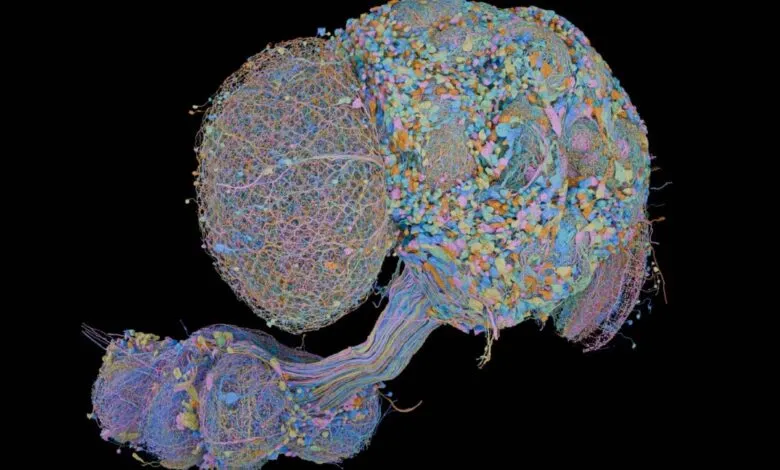
– Researchers have completed a detailed map of every neuron in the brain of a male fruit fly, known as a connectome.
– This achievement builds upon an earlier female Drosophila connectome and serves as a tool to accelerate neurobiology research.
– The project required a collaboration between biologists from the Howard Hughes Medical Institute and computer scientists from Google.
– Mapping hundreds of millions of synapses is too complex for humans alone, necessitating advanced imaging and computational interpretation skills.
– The team expects this work will refine tools applicable to more complex nervous systems, including those of vertebrates.
A Complete Neural Blueprint
Scientists have successfully mapped the complete connectome of a male fruit fly’s brain, marking a historic milestone in neuroscience. This comprehensive diagram details every neuron and synaptic connection within the organism, offering a powerful new resource for biological research. While a female Drosophila connectome was published earlier this year, the addition of the male map allows researchers to compare neural structures across sexes and refine analytical tools. These advancements are expected to pave the way for mapping increasingly complex nervous systems, potentially including those of vertebrates.
The project required a unique partnership between biologists at the Howard Hughes Medical Institute’s Janelia Research Campus and computer scientists at Google. Both groups emphasized that their respective expertise was indispensable to the endeavor. Preparing a whole brain for imaging at the necessary resolution demands specialized biological skills, while interpreting the resulting data requires advanced computational power. The sheer volume of hundreds of millions of synapses makes manual analysis impossible within a reasonable timeframe, necessitating this interdisciplinary collaboration.
Understanding Neural Processing
The primary value of a connectome lies in its ability to reveal how information flows through the brain. Human interaction with the environment starts with sensory input, where neurons detect stimuli such as sound, light, and touch. These signals are then processed through networks of communicating neurons, which transform raw data into interpretable commands. This communication routes information to specific processing centers and generates outputs ranging from memory formation to muscle movement.
The structure of these connections dictates all cognitive and physical functions. For instance, the visual system performs initial recognition tasks before sending results to higher-level processing areas. If an object is identified as text, the brain utilizes specific neural pathways to engage language centers for interpretation. By mapping these precise connections, researchers can better understand the underlying mechanisms of behavior and cognition.
(Source: Ars Technica)