Claude voice mode now available for Opus and Sonnet
▼ Summary
– Anthropic expanded its voice mode from only the Haiku model to include the more powerful Opus and Sonnet models, with integration into apps like Gmail and Slack.
– Users initially used voice mode for quick questions, but shifted to solving complex business problems, which Haiku’s design couldn’t support deeply.
– Sonnet and Opus models enable complex problem-solving, analysis, and actions like generating a pitch or adjusting calendar appointments.
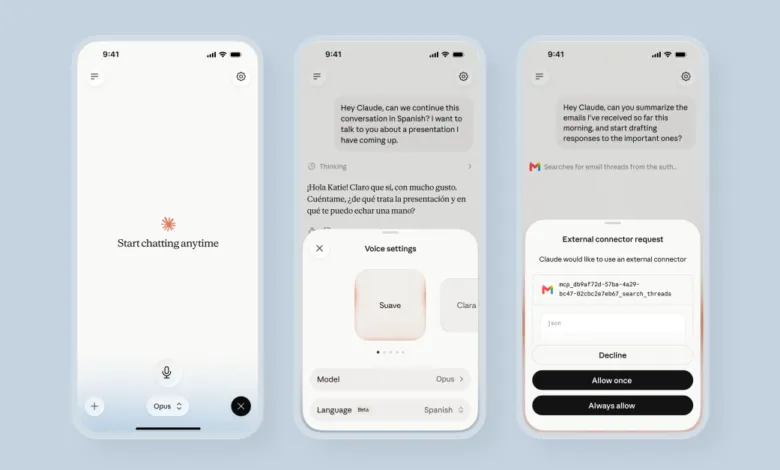
– Users can switch between text and voice modes or change models (e.g., from Haiku to Opus) mid-conversation.
– Voice mode now supports French, German, Spanish, Hindi, Indonesian, Italian, Japanese, Korean, and Portuguese, moving beyond English-only beta.
Anthropic is expanding its voice mode capabilities, now bringing the feature to its more advanced Opus and Sonnet models. Previously, voice interaction was limited to Claude Haiku, the company’s faster but less powerful option. This upgrade also extends voice functionality into popular apps like Gmail, Slack, and Canva, giving users a more integrated experience.
When voice mode first launched in 2025, Anthropic designed it for quick, straightforward answers. However, the company quickly noticed a shift in user behavior. In a recent blog post, Anthropic explained that people weren’t just using it for casual questions. Instead, they were tackling “real business problems” with the tool, a task Haiku wasn’t built to handle. That model “kept conversations quick, but not always deep,” according to the company.
Sonnet and Opus, by contrast, are engineered for “hard problem-solving.” They can handle more complex responses, perform detailed analysis, and even take direct actions on your behalf. Imagine turning a brainstorming session into a polished one-page pitch, or automatically rescheduling your calendar when your train is running late. These models make such tasks possible.
A key feature of this rollout is flexibility. Users can switch between text and voice mode mid-conversation without losing context. You can also change models on the fly. For example, a fast exchange with Haiku might spark a deeper idea, and you can seamlessly transition to Opus to explore it further.
Anthropic is also broadening its language support. Previously, non-English voice mode was only available in beta. Now, it officially supports French, German, Spanish, Hindi, Indonesian, Italian, Japanese, Korean, and Portuguese, alongside English. This update marks a significant step toward making Claude a more versatile, multilingual assistant for both quick queries and deep, problem-solving conversations.
(Source: The Verge)