Why AI startups need a founding designer from day one
▼ Summary
– AI has greatly accelerated software development, making it easier to turn ideas into working products.
– Stanford’s report shows AI performance on a key coding benchmark rose from 60% to nearly 100% in one year.
– Organizational AI adoption reached 88%, according to the same Stanford report.
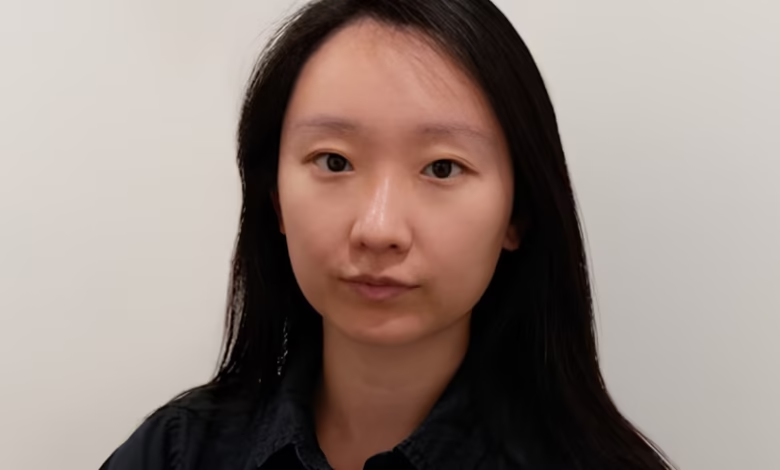
– Tingyu Su thinks the main challenge now is no longer about AI capabilities expanding.
– The article focuses on Tingyu Su’s role as a founding designer for AI startups and strategic hiring.
Artificial intelligence has transformed the speed of software development, allowing ideas to become fully functional products faster than ever before. A recent report from Stanford highlights that AI performance on a key coding benchmark surged from 60% to nearly 100% in just one year, while organizational adoption of AI now stands at 88%. As these capabilities keep expanding, Tingyu Su argues that the real bottleneck is no longer technical execution.
Instead, Su contends that the defining advantage for AI startups lies in strategic design thinking from the very beginning. In a landscape where code can be generated in minutes, the difference between a forgettable product and a market leader often comes down to user experience, intentional interface choices, and cohesive brand identity. That is why Su advocates for every AI startup to bring a founding designer on board from day one, not as an afterthought but as a core strategic hire.
A founding designer does more than create wireframes or pick color palettes. They help shape the product’s vision, ensure that technical capabilities translate into intuitive interactions, and prevent costly pivots later. When AI can handle much of the heavy lifting in development, the human-centered elements of design become the primary differentiator. Without a designer embedded early, startups risk building powerful tools that nobody enjoys using.
Su emphasizes that this approach is not about slowing down innovation; it is about directing it more effectively. A founding designer can spot usability gaps, align product features with real user needs, and create a consistent experience that builds trust and loyalty. In an era where AI tools are proliferating rapidly, the startups that invest in design from the outset are the ones most likely to stand out and sustain growth.
(Source: The Next Web)