UN AI Summit Showcases Robot Dogs, Teslas, and Rescue Helicopters
▼ Summary
– The AI for Good Summit, organized by the UN’s ITU, focuses on using AI to solve global problems like hunger and disease, contrasting with risk-focused debates in Washington.
– Critics like Giulio Coppi warn that overreliance on big tech, funded by opaque public deals, has eroded trust, stating “we should be out of the age of innocence.”
– Pro-Palestine activists disrupted a keynote by Amazon’s CTO, accusing the company’s technology of being used against Palestinians in Israel.
– Harvard professor Vijay Janapa Reddi argues that “good” is too vague for engineering, as AI often fails in practical deployment despite the hype.
– Access to AI compute and models is a central issue, with speakers noting it is a development problem that can leave poorer countries dependent on foreign infrastructure and English-dominated systems.
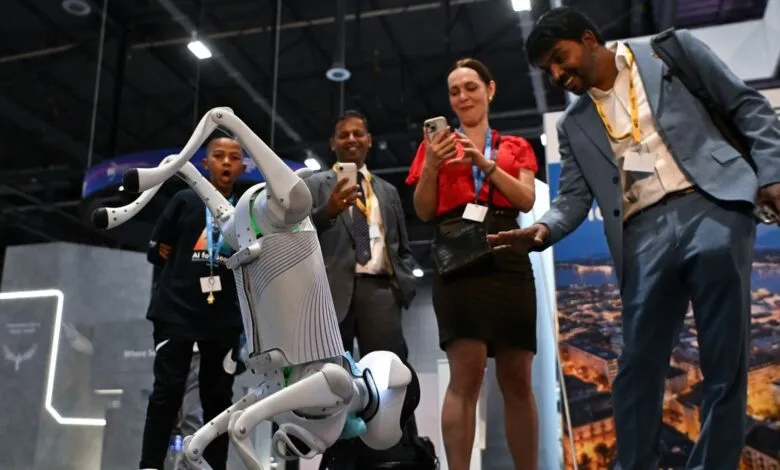
Dodge past the live coding marathons, AI crash courses, a sprawling obstacle course of blinking gadgets, and attendees wandering around with glowing green silent-disco headphones piping UN panel chatter directly into their ears, and you might finally catch your breath. But if you land in the Networking Zone, you’ll encounter UFOTECH: a rotating seating contraption that resembles a giant lazy Susan from a Chinese restaurant more than the collaborative bench it’s meant to be.
This is the AI for Good summit, organized by the United Nations’ International Telecommunication Union (ITU). Here, representatives from the private and public sectors wrestle with how to steer artificial intelligence toward benefiting humanity rather than harming it.
While Silicon Valley executives and AI lab leaders testify before Washington lawmakers about the existential risks of superintelligence, and the White House imposes chip export controls, the UN AI for Good Summit,now in its 10th year,focuses on far more aspirational goals.
“Our conviction that artificial intelligence, deployed responsibly, could help solve humanity’s most pressing problems,from hunger to disease to a warming planet,” Doreen Bogdan-Martin, secretary-general of the ITU, declared in her keynote on the main stage. “Today, that idea is being tested, including by the challenges AI itself is bringing, even as we strive to use it for good.”
What “good” actually means,and what tangible benefit it delivers to humanity,was a question woven through every session across the massive 106,000-square-meter convention center on the outskirts of Geneva’s airport district. A persistent undercurrent of anxiety ran through the conference: that indifferent deployment by unchecked corporate monopolies is already hardwiring global inequality and eroding human rights.
For some on the front lines, the tech industry’s utopian sheen has already tarnished. Giulio Coppi, senior humanitarian officer at campaign group Access Now, spoke on the sidelines and called out the humanitarian and public sectors’ overreliance on big tech. “We should be out of the age of innocence,” Coppi said, demanding organizations stop treating tech companies “as your best friends.” He pointed to a decade of opaque, multimillion-dollar deals funded by public money. “You can’t even explain what’s inside your tech stack, because it has kept changing,” he warned.
Coppi’s criticism was mild compared to some. Pro-Palestine activists stormed the stage during a keynote by Amazon chief technology officer Werner Vogels, alleging the company’s technology is being used by Israel against Palestinians, before being escorted out.
“When we’re talking about AI, we love the hype, we get excited about it,” says Vijay Janapa Reddi, an engineering professor at Harvard University, speaking over the din of competing sessions. “The damn thing never actually lands in practice.” The real problem, he argues, is that “good” is too vague a standard to engineer against. “When you’re an engineer, good means nothing. I can’t build you something that is good. A plane that flies for five minutes ain’t no good.”
Much of the global debate around AI now revolves around access: who can use the models, who can buy the chips, and who is excluded from the compute economy. This is why the Trump administration implemented, then lifted, export controls on leading frontier AI models, and why China is reportedly considering making its open-weight models less open. Tightening access and cutting out poorer countries can leave them dependent on foreign infrastructure platforms and standards.
In a session on AI hardware and the widening digital divide, speakers argued that compute is no longer just a technology problem,it’s a development problem. “If we mean AI for good, meaning compute for all, we must recognize that this is [about] development infrastructure, not just technology,” says Syed Munir Khasru, chairman of the Institute for Policy, Advocacy, and Governance. Others pointed out that most large language models remain structured around English, making smaller, local LLMs running on cheaper hardware essential if AI is to serve communities beyond the richest markets.
(Source: Wired)