India’s payments chief: AI will push UPI to 1 billion daily transactions
▼ Summary
– NPCI CEO Dilip Asbe says AI will drive UPI to a billion daily transactions through fraud detection, credit distribution, and multilingual voice onboarding.
– Voice-based payments launched in 2023 have low adoption, and Asbe says voice models need better accuracy before becoming critical.
– Asbe sees an opportunity for Indian companies to create small, specific language models using UPI’s rich data set, such as NPCI’s FIMI model for dispute resolution.
– PhonePe and Google Pay control over 80% of UPI market share; a 30% cap per app is set for December 2026 unless NPCI defers.
– NPCI’s BHIM app holds about 1% market share and is intended as a sovereign, secure alternative as India’s digital economy expands.
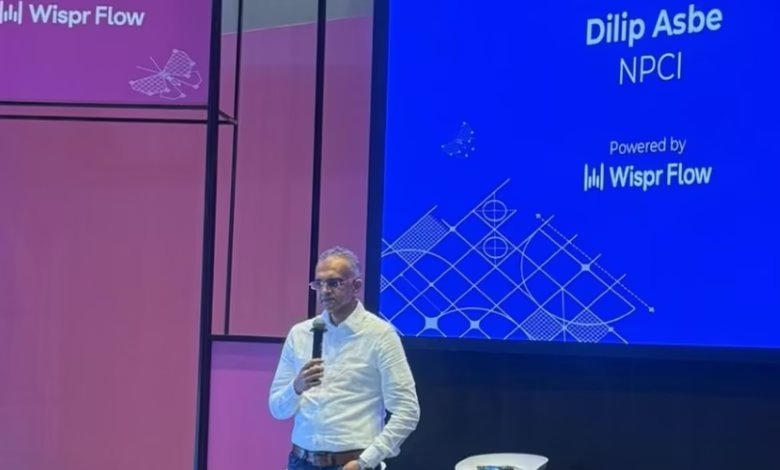
India’s Unified Payment Interface now processes over 750 million daily transactions, and the chief of the governing body believes artificial intelligence will be the key to reaching the billion-transaction milestone. Dilip Asbe, Managing Director and CEO of the National Payments Corporation of India, shared his insights during Mumbai Tech Week, explaining that AI can unlock the next half billion users through fraud prevention, credit distribution, and multilingual voice onboarding.
“AI will be used very effectively when we look at the next wave of UPI, and that includes all aspects, including reaching new users,” Asbe stated. “We must use AI effectively to protect our current citizens, to find fraud, and to find mules. AI must also be used to provide credit to all the users and merchants who have digital footprints.”
NPCI introduced a voice assistant-based payment system in 2023, but Asbe acknowledged that adoption has been slow. He emphasized that voice models need to achieve higher accuracy before they can become a critical pillar of the payments ecosystem. India’s debate over AI sovereignty has intensified recently, with proposals for a $5 billion annual sovereign AI fund and calls to develop small language models tailored to local languages and use cases.
Asbe sees a clear opportunity in this space. “We have a very rich data set in our ecosystem,” he said. “I think there is a big opportunity for Indian companies, the banks, FinTechs, and the ecosystem, to create small language models which are sharp, specific, and as deterministic as possible.” NPCI has already launched a model called FIMI to resolve user disputes, which now serves over a million users for cancelling mandates and resolving issues.
On the regulatory front, Asbe believes India can adopt AI-powered finance with the right safeguards. He wants systems that can trace the instructions and consent a user gave to an AI agent if something goes wrong. NPCI demonstrated agentic commerce and payments with Razorpay last year, but a broader rollout has not yet materialized.
The UPI market remains heavily concentrated. PhonePe and Google Pay control over 80% of transaction share. A regulatory cap limiting any single app to 30% is set to take effect on December 31, 2026, unless NPCI defers the deadline again. Asbe noted that switching costs between apps are low and that the concentration reflects the absence of a viable commercial model for newer entrants. “The moment we see the commercial model being available to the ecosystem, I believe newer players will start investing very heavily,” he said.
NPCI’s own app, BHIM, holds roughly 1% market share despite growing transaction volumes. Asbe said there is no specific share target for BHIM, but as India’s digital economy scales toward its largest-ever tech IPOs and $110 billion AI infrastructure plans, NPCI wants BHIM to serve as a sovereign and secure alternative.
(Source: The Next Web)