Valve Quietly Backs Away From Steam Machine 4K 60 FPS Promise
▼ Summary
– The Steam Machine can achieve 4K at 60 fps on older or less demanding games, but struggles with modern AAA titles due to its RTX 3060/4060-class GPU.
– Valve’s advertising focuses on 4K gaming because many popular Steam games, like Terraria and Stardew Valley, are from 2010-2020 and run well at that resolution.
– The system’s portability and set-top nature are stronger selling points than raw performance, especially for use under a TV with wireless controllers.
– Critics argue the Steam Machine lacks the CPU cores, system RAM, and GPU power needed for demanding games, which require larger cooling solutions.
– The author suggests pairing the Steam Machine with a 34-inch ultrawide OLED monitor for a better gaming experience rather than a standard 4K TV.
For a moment, it seemed like Valve was ready to promise the moon: a tiny cube capable of pushing 4K resolution at 60 FPS in modern gaming. But as reality sets in, the company has quietly backed away from that bold claim, and honestly, it was only a matter of time.
If you’re playing a game old enough to buy a drink, sure, that Steam Machine might handle 8K at 60 frames per second. But visually, it won’t look much different than 1080p. The original advertisement was always a bit of a reach. Anyone who follows PC gaming knows that even the most powerful rigs can buckle under the weight of today’s AAA titles. Expecting a system packed into a six-inch cube to do the same was optimistic at best.
Valve would have been smarter to emphasize the machine’s extreme portability and set-top box appeal, features that might have actually helped it find a niche, particularly in markets like Japan. But describing gaming performance with the kind of user data Valve possesses is no easy task. The hard truth is undeniable: the Steam Machine cannot deliver native 4K at 60 FPS in the latest blockbusters, and relying on FSR to bridge the gap is a trade-off many gamers won’t accept.
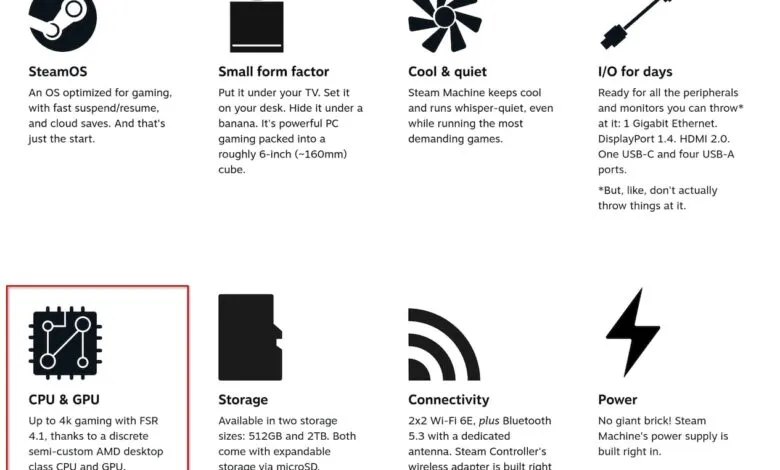
Look at Valve’s own hardware survey. The average gaming PC today features a 6-core/12-thread CPU, 16GB of system RAM, and a GPU with 8GB of VRAM in the class of an RTX 3060 or 4060. That’s the baseline most people are working with, and those machines still struggle with 4K 60 in modern AAA games. So expecting a smaller, less powerful console to succeed where those systems fail was always a stretch.
But here’s the nuance: some of the most popular games on Steam right now are either older titles from 2010 to 2020 or newer indie games that are far less demanding. Valve isn’t entirely wrong when they say this little cube can deliver a 4K 60 experience on many of the top 100 most played games on Steam. You could play Terraria (2011) or Stardew Valley (2016) in 4K without breaking a sweat. Even The Sims 4 pulls nearly 10,000 more daily peak players than a demanding new MMO like Crimson Desert. For a huge chunk of the Steam audience, 4K 60 is perfectly achievable.
So it’s hard to blame anyone. Some gamers will call this a 4K gaming machine because they only play older or indie titles, and for them, it absolutely is. Others will dismiss it as a failure because their favorite games require at least 8 CPU cores, 48GB of system RAM, and a GPU with a power budget of 550 to 750 watts plus a heatsink the size of the console itself. Both perspectives are valid, depending on the library.
Ultimately, 4K is a silly metric to hinge a console’s reputation on. You can get just as good, if not better, gaming experiences at lower resolutions. But if Valve truly sees this machine living under a TV for wireless controller gaming, then advertising native resolution on a 4K screen makes a certain kind of sense. Personally, I’d rather pair it with a decent 34-inch ultrawide OLED in a small gaming corner. My 4K TV is for movies in a dark room, not for gaming. But Valve’s quiet retreat from that promise suggests they’re learning the same lesson many gamers already know: specs on paper don’t always translate to real-world performance.
(Source: Techpowerup.com)