Midjourney evolves from cat pics to full-body ultrasound scans
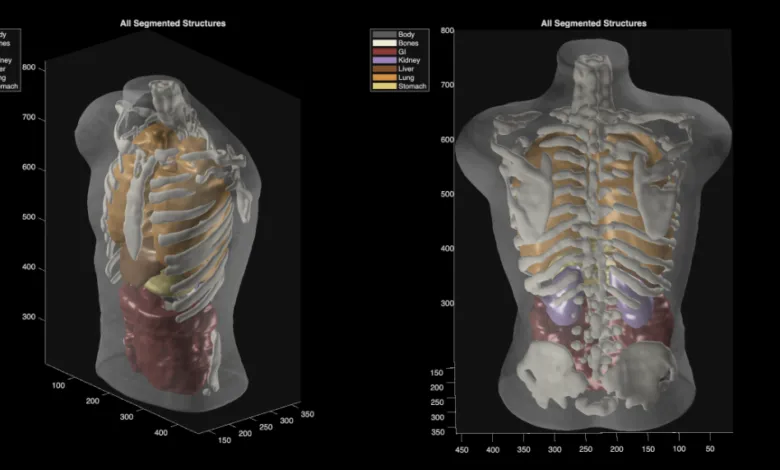
▼ Summary
– Midjourney CEO David Holz unveiled the Midjourney Scanner, an ultrasound-based full-body scanner that uses a ring of sensors to create detailed 3D images of muscle, fat, bone, and organs.
– The scanner was developed in partnership with Butterfly Network, using 40 of its ultrasound-on-chip imaging modules per system.
– The scanning process involves stepping onto a platform that descends into water through a ring of transducers, taking about 60 seconds to complete.
– Holz plans to open a Midjourney Spa in San Francisco’s Union Square by the end of 2027, featuring 10 scanners, a gym, saunas, and cold plunges.
– Midjourney Medical currently offers “body composition maps” that do not require FDA clearance, with plans to allow users to share scan libraries with doctors and AI health tools.
Midjourney CEO David Holz has unveiled the company’s first hardware product, a surprising pivot from its well-known AI image generator. Alongside this reveal, he announced plans for a San Francisco spa, acknowledging the shift feels far removed from generating “cat pictures.” The device, called The Midjourney Scanner, is an ultrasound-based full-body scanner that uses a ring of sensors to capture vertical slices of the body, analyzing muscle, fat, bone, and organ composition. Holz envisions users undergoing scans annually or even daily, as the system “aims for image quality comparable to MRI in many ways.”
Holz shared a personal use case: tracking how his body responds to diet and exercise changes. “I’m not the most measured man on Earth yet, you know, but maybe I want to have that daily [measurable information],” he said. Job listings for the project describe its goal as building “the world’s first full-body ultrasound CT scanner,” with an aim to “bring safe, fast, and high fidelity preventative scanning to billions via a magical spa experience.”
The scanner was developed in collaboration with Butterfly Network, an ultrasound tech company that supplies “40 Butterfly Ultrasound-on-Chip imaging modules per system.” The scanning process begins when a user steps onto a platform that descends into water on rails, passing through a ring of thousands of transducers generating ultrasonic waves. These waves record ripples through the body, creating detailed 3D images. The scan takes about 60 seconds, and Holz noted roughly a dozen people have been scanned so far.
The experience starts with stepping into a shallow pool of golden light, then descending into water while a ring of underwater sensors acts like echolocating dolphins. These sensors send ultrasonic sound waves from every angle, and with enough data, the system forms an internal image of the body. It combines these sensors with two petaflops of processing power. However, after watching the livestreamed reveal, it remains unclear how Midjourney’s AI image generation technology directly ties into the Midjourney Medical effort, beyond potentially repurposing unused AI compute.
Holz plans to install 10 scanners at a Midjourney Spa in San Francisco’s Union Square, targeting an opening before the end of 2027. The spa will feature a gym, saunas, and cold plunges, alongside hot tub-equipped scanning rooms where visitors enter the water. At the launch event, he offered to scan attendees’ hands.
Holz acknowledged that medical applications would require FDA clearances, but for now, Midjourney Medical is focusing on “body composition maps” that don’t need the same regulatory level as diagnostic imaging. The company states that users can share their “library of scans” with doctors or AI health tools, adding, “We take data privacy seriously , more details on our data policies will come as we get closer to launch.”
Holz suggested that these scans could eventually surpass MRI quality, without radiation, powerful magnets, or other complications, offering a fast look inside the body. When asked about regulatory hurdles, he imagined a future where the FDA might create a device class for “weird” applications, allowing people to “just try to get as much data as we can.”
(Source: The Verge)