Limitless Labs raises $20M to bring AI to factory floors
▼ Summary
– Limitless Labs raised $20m in Series A funding for its AI agent that programs CNC machining, reducing programming time by up to half.
– The company addresses a demographic crisis in US manufacturing, where nearly a quarter of workers are 55 or older and 409,000 factory jobs are unfilled.
– Its “Physical AI” is trained on physics and machine limits, not text, and integrates with existing engineering software like Siemens NX.
– Limitless is already in production with Blue Origin and Cadillac’s F1 team, while most rivals remain in pilot phases.
– The company aims for “closed-loop” automation but currently requires human sign-off on every program, with the funding targeting reliable capture of machinist expertise.
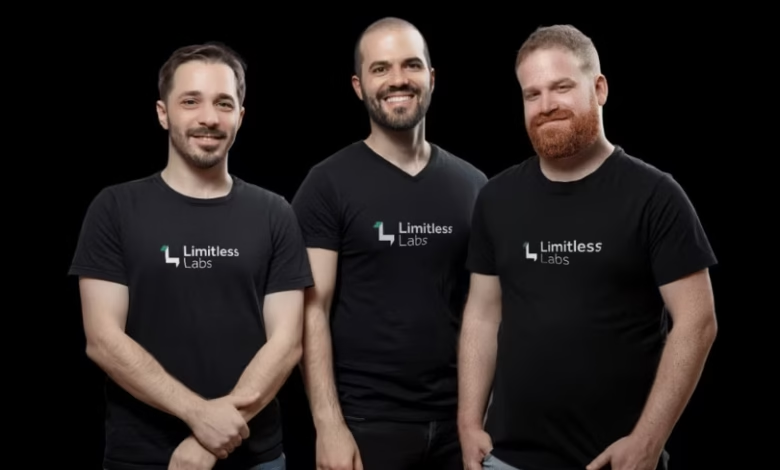
The most sought-after AI investment opportunity today isn’t a conversational bot. It’s software capable of directing machinery on a factory floor, and a young Israeli startup has secured $20 million in Series A funding largely due to its work programming components for Jeff Bezos’s space venture.
Limitless Labs, previously operating under the name LimitlessCNC, has closed a $20 million Series A round co-led by Dell Technologies Capital and Square Peg, with additional participation from Grove Ventures, Meron Capital, and Kinetica. This brings the company’s total funding to $27.3 million.
Based in Tel Aviv, the company has developed an AI agent for CNC machining, a precision metal-cutting process used in everything from rocket engines to medical implants. When given a 3D design file, the AI selects the appropriate cutting tools, sequences the necessary operations, and generates a complete machine program. This can cut programming time by as much as half.
The core challenge Limitless addresses is demographic. Nearly a quarter of manufacturing workers in the US are 55 or older, roughly 409,000 factory positions remain unfilled, and that gap is expected to reach 1.9 million by 2033.
Much of the necessary expertise resides in the minds of veteran machinists, a form of “tribal knowledge” that disappears when they retire. “The manufacturing world needs a better way to capture and scale the expertise that lives inside the heads of a relatively small number of experienced machinists,” said co-founder and CEO David Priev.
Instead of training on text, Limitless’s “Physical AI” is built on the physics of metal cutting, machine limitations, and CAD geometry. It integrates directly into software that engineers already use, including Siemens NX, Mastercam, and PTC Creo.
What truly sets Limitless apart is its customer base. The company is already in active production with Blue Origin, Cadillac’s Formula One team, Sandvik, and toolmaker ISCAR. These are environments where a programming mistake could be catastrophic and tolerances are measured in microns. The system is ITAR-compliant and operates on AWS GovCloud for defense-related work.
Securing these high-profile clients at the Series A stage, while many competitors are still running pilot programs, is the strongest evidence that the approach works. The founders, two of whom are veterans of the IDF’s elite 81 tech unit, completed the funding round in just three weeks. Priev told Geektime that the US investor roadshow took place during the opening days of the Iran war, with his family sheltering at home while he pitched to investors abroad.
The “Physical AI” space is becoming increasingly crowded and well-funded. THEKER in Barcelona raised €73 million for factory robots, NEURA Robotics secured up to $1.4 billion, and major players from Fanuc and Google to Accenture are racing to integrate AI into manufacturing. In this context, $20 million is a relatively modest sum.
The more difficult objective still lies ahead. Limitless aims to push toward “closed-loop” automation, but for now, a human engineer must sign off on every program. The real challenge is capturing a master machinist’s instincts in a model reliably enough to trust on a rocket, and that is exactly what the new funding is intended to solve.
(Source: The Next Web)