Old-school strategy duel makes F1 in Spain thrilling
▼ Summary
– The Barcelona-Catalunya circuit’s abrasive surface and fast corners make downforce crucial for minimizing tire wear and energy loss.
– Tire wear at Catalunya forced teams to consider three or four pit stops, unlike the one-stop races seen earlier in the season.
– An “undercut” strategy pits early onto fresh tires to gain time over rivals whose tires are degrading.
– Splitting the race into four stints costs about 22 seconds per extra pit stop but allows harder tire use to offset that time.
– Ferrari took a bold two-stop approach with a major car upgrade, including a new front wing and floor, which worked well with driver Lewis Hamilton.
Formula 1 returned to Spain over the weekend, and the Barcelona-Catalunya circuit once again proved why it demands a distinct approach. This track is a purpose-built venue defined by high-speed corners and an unusually abrasive surface. Success here hinges on downforce. While good aerodynamics have always been required at Catalunya, they are now absolutely critical. The reasoning is straightforward: carrying more speed through corners reduces the energy needed on the subsequent straights. In modern F1, energy management is just as vital as it is in endurance racing at Le Mans, Formula E, or IndyCar. More downforce also minimizes sliding, which in turn preserves tire life.
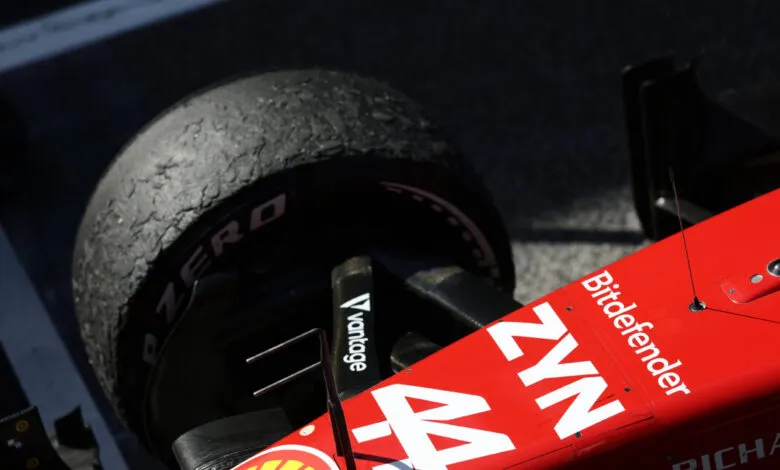
That tire degradation directly shaped the race strategies. Every Grand Prix this season had been a one-stop affair, with drivers switching tire compounds just once. But covering 66 laps in Spain demanded at least three sets of Pirelli tires, possibly four. As tires wear, lap times suffer by roughly 0.2 to 0.3 seconds per lap. This creates an opportunity for the “undercut” ,pitting early for fresh rubber and using the tire advantage to post fast laps while rivals struggle with worn tires. Execute it well, and when those rivals finally pit, you should emerge ahead.
A four-stint strategy means an additional pit stop, costing about 22 seconds for the full pit lane cycle with a sub-three-second tire change. But because each set of tires covers fewer laps, drivers can push them harder. That extra pace can more than compensate for the 22-second penalty.
Bold strategies like this don’t always pay off. Most teams chose the safer two-stop plan. Ferrari, however, took a different path. The team arrived in Spain with a massive upgrade package,a new front wing, floor, and sidepods. Ferrari likely already had the best chassis on the grid, and unlike a disappointing upgrade two years ago, this one performed well. That was especially true in the hands of a newly resurgent Lewis Hamilton, who made the most of the car’s potential.
(Source: Ars Technica)