Apollo Go gains Level 4 robotaxi approval in Switzerland

▼ Summary
– AmiGo, a joint venture between Baidu’s Apollo Go and Swiss Post’s PostBus, received a Swiss permit for Level 4 autonomous driving, meaning the vehicle drives itself within a defined area.
– Open-road trials began on June 1 across 80 square kilometers in eastern Switzerland, with a safety operator still present in each vehicle.
– The robotaxis are Apollo Go’s RT6 electric pods, seating up to three passengers and equipped with over 30 sensors, designed for eventual driverless operation.
– This is a notable first for Europe, which has almost no robotaxis, and extends Apollo Go’s reach beyond China after it faced issues in Wuhan.
– Apollo Go delivered 3.2 million fully driverless rides in Q1 2026, with plans to progress from a closed trial to regular service by 2027, aiming for Europe’s largest automated public-transport operation.
Baidu’s autonomous driving unit is taking its robotaxis to the Swiss Alps. A partnership between the Chinese tech giant’s Apollo Go division and Swiss Post’s PostBus has secured a special permit from Switzerland’s Federal Roads Office to operate Level 4 autonomous driving on public roads. This marks a significant milestone for a Chinese company in the European market.
Level 4 autonomy means the vehicle can handle all driving tasks within a defined geographic area without human intervention. Open-road testing began on June 1 across roughly 80 square kilometers in eastern Switzerland, covering the cantons of St. Gallen and both Appenzells. For now, a safety operator will remain in each vehicle.
The venture, called AmiGo, combines Chinese self-driving technology with a Swiss public transport operator. PostBus operates the country’s iconic yellow postal buses, while Apollo Go provides the autonomous driving system. Passengers book trips through the AmiGo app.
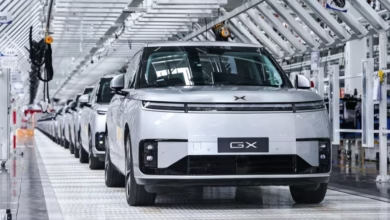
The fleet consists of Apollo Go’s RT6 vehicles: fully electric pods that can carry up to three passengers and are equipped with more than 30 sensors. The steering wheel is designed to be removed once the service transitions to fully driverless operations. “With AmiGo, we are making automated mobility in public transport tangible,” said Stefan Regli, CEO of PostBus.
Why this permit matters for the European market is clear. Robotaxis are virtually nonexistent across most of the continent, with only a handful of early-stage pilots underway. Uber recently launched a program in Munich, but most efforts remain experimental. A Chinese operator obtaining a Level 4 permit in Europe is a notable first, extending Apollo Go’s reach beyond China, where it previously faced issues in Wuhan when a fleet of vehicles froze in traffic.
The numbers behind Apollo Go’s push are substantial. Baidu reports that the service delivered 3.2 million fully driverless rides in the first quarter of 2026, peaking at over 350,000 in a single week in March. Cumulative rides surpassed 22 million by April, spanning 27 Chinese cities.
That scale serves as a strong pitch to European regulators and potential partners. However, the Swiss permit is limited in scope, and the trial zone is small. The partners have outlined a clear roadmap: a closed user trial, followed by rides without a safety operator, and then regular service beginning in 2027. They describe this as the largest planned automated public transport operation of its kind in Europe.
Chinese rivals are also expanding internationally, and Europe’s fragmented national regulations mean every market presents a fresh challenge. The key question is whether this careful Swiss pilot becomes a scalable template for the continent, or remains an isolated experiment.
(Source: The Next Web)