Anthropic spends $150M to place 1,000 AI fellows at nonprofits
▼ Summary
– Anthropic launched Claude Corps, a $150 million program to place 1,000 AI fellows at over 400 U.S. nonprofits, with a salary of $85,000 plus benefits for one-year placements.
– Applicants must be 18 or older, have US work authorization, and no more than two years of full-time work experience; no college degree is required, and the first cohort of 100 starts in October 2026.
– Each host nonprofit receives a $10,000 grant and free Claude credits, with recruitment managed by CodePath, a nonprofit supporting first-generation and low-income students.
– Critics argue the program creates dependency on Anthropic’s product, viewing it as a distribution strategy rather than pure philanthropy, with Anthropic framing it as a public benefit initiative.
– The program addresses a real gap in nonprofit AI adoption, as Anthropic prepares for an IPO and positions itself as a responsible AI company.
Anthropic is investing $150 million to embed 1,000 AI fellows within nonprofit organizations nationwide, launching a program called Claude Corps. The initiative will pay early-career workers an $85,000 salary plus benefits for a one-year placement, where they help nonprofits integrate Claude into their daily operations. Applications opened Wednesday and will close on July 17.
There is no college degree requirement. Applicants must be at least 18, hold U. S. work authorization, and have no more than two years of full-time work experience. The first cohort of 100 fellows begins in October 2026, with subsequent groups starting in January and August 2027.
Each of the 400+ host organizations will receive a $10,000 grant and free Claude credits. Anthropic partnered with CodePath, a San Francisco nonprofit that helps first-generation and low-income students enter tech, to manage recruitment and training.
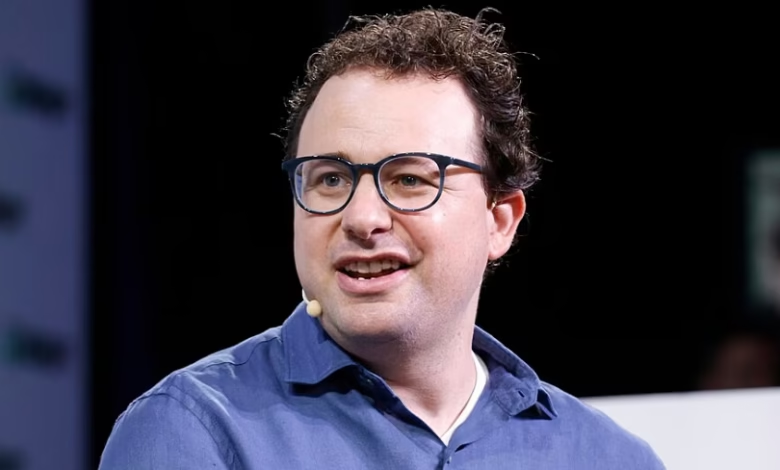
“We hope this program will expand and become a pillar of our strategy to help humankind realize the benefits of AI while also managing its risks,” said Anthropic President Daniela Amodei.
The fellowship is loosely modeled on service corps like AmeriCorps and Teach For America, but with a corporate sponsor and a product at its center. Fellows are trained specifically on Claude. The organizations they serve will build their workflows around Claude. When the fellowship ends, the nonprofits are left with AI infrastructure tied to Anthropic’s ecosystem.
That dual purpose has drawn scrutiny. Fortune highlighted the “fox guarding the henhouse” dynamic: a $965 billion AI company is training the nonprofit sector to depend on its own product, funded by a donation that represents less than 0.02% of its valuation. Anthropic frames it as philanthropy. Critics see a distribution strategy wrapped in a public benefit narrative.
Regardless of the framing, the program addresses a real gap. Most nonprofits lack the staff, budget, and technical know-how to adopt AI tools, even when those tools could significantly improve operations. Anthropic’s $100 million Claude Partner Network, launched earlier, targets enterprises. Claude Corps targets the organizations that cannot afford enterprise partnerships.
The timing is deliberate. Anthropic is preparing for an IPO and positioning itself as the responsible AI company in a field dominated by OpenAI’s commercial aggression and Google’s scale. A $150 million nonprofit fellowship is a narrative play as much as a product play. Whether 1,000 fellows can make a meaningful difference across 400 organizations depends on whether the program outlasts its PR value. Anthropic’s policy framework, published this week, calls for AI’s benefits to be “broadly shared.” Claude Corps is its first concrete attempt to deliver on that promise.
(Source: The Next Web)