Lego’s Pokémon Smart Play sets train and battle, but can’t connect to the app
▼ Summary
– Lego’s second-generation Smart Bricks, launching in 12 new Pokémon sets on August 1st, improve on the first Star Wars line by adding battle and training features, but still fall short of the advanced interactions shown at CES.
– Only two of the 12 sets are all-in-one, including a Smart Brick and charger; the rest are compatible sets requiring a separate brick purchase, and only the Charizard vs. Jolteon set includes two bricks for out-of-the-box battles.
– Battle mode uses simple mechanics—shake to start, quick attacks, charged attacks, and dodging—with type advantages and inherent strength differences between Pokémon, but combat is intentionally basic to encourage open-ended play.
– Training provides a temporary power boost that resets when the Smart Brick is removed or battery dies, designed to let kids repeat the loop rather than build a permanent squad.
– The bricks’ technical limits, including a runtime synthesizer and small memory, prevent Pokémon from saying their names or making recognizable game sounds, forcing kids to supply vocalizations themselves.
When Lego first unveiled its ambitious Smart Bricks concept at CES earlier this year, the promise of interactive, tech-infused play earned the company our coveted Best in Show award. Yet the initial Star Wars sets that hit shelves in March fell flat. What was supposed to be a breakthrough in creative interaction boiled down to little more than a few voice snippets and blinking lights. The advanced features that wowed us at the show were conspicuously absent.
Now, Lego is taking another swing. This morning, the company announced 12 new Pokémon Smart Play sets, launching this summer, that aim to deliver on that original vision. After spending several hours training and battling with the new kits, it’s clear the Smart Brick is evolving. But Lego is taking a cautious path toward fulfilling the potential it teased in January, and it’s still struggling with one of the most obvious selling points: authentic, recognizable sound effects.
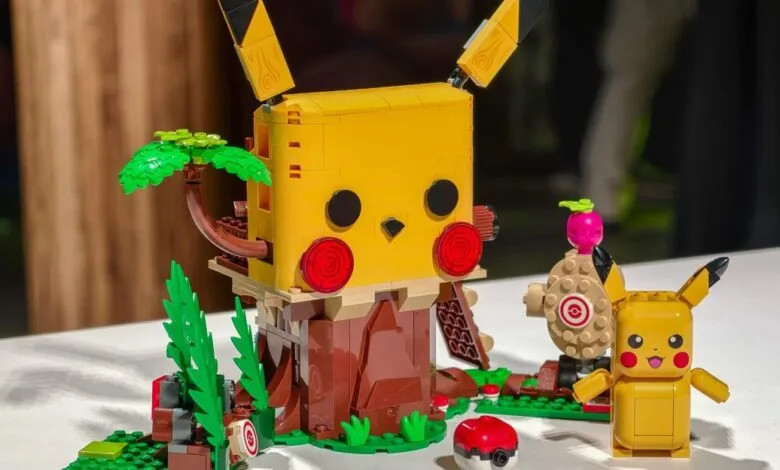
Preorders are open now, but the sets won’t ship until August 1st. Of the 12, only two are “all-in-one” bundles that include at least one Smart Brick and a charger. The $69.99 Pikachu set features a treehouse and one brick, while the $119.99 Charizard vs. Jolteon battle set includes two bricks for head-to-head combat. The remaining 10 kits, priced from $14.99 (Jigglypuff) to $89.99 (Cubone vs. Gengar), are labeled “compatible.” That means they include Smart Tags that trigger effects and interactions but lack the Smart Bricks needed to power the full experience. To actually battle, you need two bricks, and only the Charizard set delivers that out of the box.
The most exciting new feature is Pokémon battles. Shake two Smart Brick-equipped figures together, and the system enters Battle mode. An 8-bit soundtrack kicks in as kids fight by thrusting the figures through the air. A quick jab triggers a low-damage quick attack. Holding the figure back for a few seconds charges a stronger move. Pulling it back dodges incoming damage. After a minute or two of back-and-forth, one Pokémon emerges victorious, celebrated with flashing lights and victory music.
Federico Begher, Lego’s SVP of product and marketing development, explained that the combat is intentionally simple. The four core mechanics , shake to start, two attack types, and dodging , hit what he calls “the sweet spot” for open-ended play. It can’t be too complicated or overwhelming. This isn’t a full recreation of the video games’ turn-based battles, but there’s a real skill element, especially in mastering the dodge and timing the charge attack.
Behind the scenes, there’s more nuance. Not all Pokémon are equal. Mewtwo naturally has an edge over Pikachu, and type advantages apply. Squirtle will usually beat Charmander. Each Pokémon’s Smart Tag, hidden inside its body, displays its type(s) and Pokédex number. Different types produce different sound effects , lightning crackles for Pikachu, water rushes for Lapras.
The Smart Bricks slot into each Pokémon’s belly, leaving room for flashing lights.
Training mode adds another layer. Tap a Pokémon on its training tag, then tap it against targets built into the sets , or any object you choose, or even wave it in the air. The accelerometer in the Smart Brick tracks the movement, leveling up your Pokémon and making it stronger for the next battle. But don’t expect permanent progress. The power boost resets once you remove the Smart Brick or its battery dies. A Lego representative said this is partly by design: kids in testing enjoyed repeating the training loop from scratch. But it’s likely also a limitation of the Smart Brick’s technology.
Those technological constraints are also why none of these Pokémon say their own names or make recognizable sounds from the games or cartoons. This was the one feature I desperately wanted from Lego Pikachu, and it simply can’t deliver. Instead, you get generic critter noises and the occasional electricity effect. The same problem plagued the Star Wars sets, which had Darth Vader’s breathing but no recognizable laser sounds. The issue comes down to the bricks’ runtime synthesizer, which generates sounds in real time using a MIDI-like system. Memory is limited, forcing Lego to be sparing. There’s also a localization challenge: Pokémon names differ worldwide. Squirtle is Zenigame in Japan. Unlike the games, Lego’s bricks aren’t localized, so any sound effects must work universally. Kids will have to say “pika pika” themselves, avoiding the risk of a name that sounds wrong. Perhaps that’s why Luke Skywalker didn’t talk either , not every child expects him to speak English.
The 12 sets vary widely in size and complexity, from an 88-piece Jigglypuff to an 831-piece battle between Umbreon and Garchomp. Most include moving parts, like Gengar’s wagging tongue. The larger kits are rated for ages 10 and up, while simpler ones start at six. The bigger sets build larger Pokémon, but all remain interoperable in battles. They’re relatively sturdy, and Lego staff said the kits underwent repeated playtesting to limit weak spots. But since training and battling involve knocking figures around at speed, they’ll eventually break apart. During my session, an unfortunate mid-battle collision sent my Charmander flying apart under a hard hit from Bulbasaur. Fortunately, Lego had a “toy doctor” on hand for repairs. What’s less clear is how much variety exists when you combine a Pokémon from one set with a prop from another outside of battles , they should work together, but I didn’t have enough time to test unusual combinations.
The Pokémon Smart Play kits are a clear step up from the Star Wars sets, thanks to battles alone. They build a layer of screen-free gameplay around open-ended creative play. But Lego still hasn’t released sets that use the more advanced features it showed at CES, like interactions that change based on the precise positioning of characters, tags, and bricks. This feels like progress, proof that Smart Play can deliver more than just lights and swooshes. But its true potential remains untapped.
(Source: The Verge)