Pope Leo XIV to publish AI encyclical with Anthropic co-founder on 25 May
▼ Summary
– Pope Leo XIV will personally present his first encyclical, *Magnifica Humanitas*, on 25 May at the Vatican, addressing human dignity in the age of artificial intelligence.
– Anthropic co-founder Christopher Olah, who leads interpretability research, will speak at the launch alongside cardinals and theologians, marking an unusual inclusion of an AI company figure.
– The encyclical is expected to condemn AI in warfare and address impacts on workers’ rights, drawing a parallel to Pope Leo XIII’s 1891 encyclical on industrial labor.
– Olah’s work on interpretability aims to understand AI systems’ internal mechanisms, which is relevant to ensuring accountability in areas like healthcare, criminal justice, and warfare.
– The Vatican’s inclusion of Olah signals an effort to engage technical and economic realities of AI, positioning the encyclical as a contribution to the debate on AI governance.
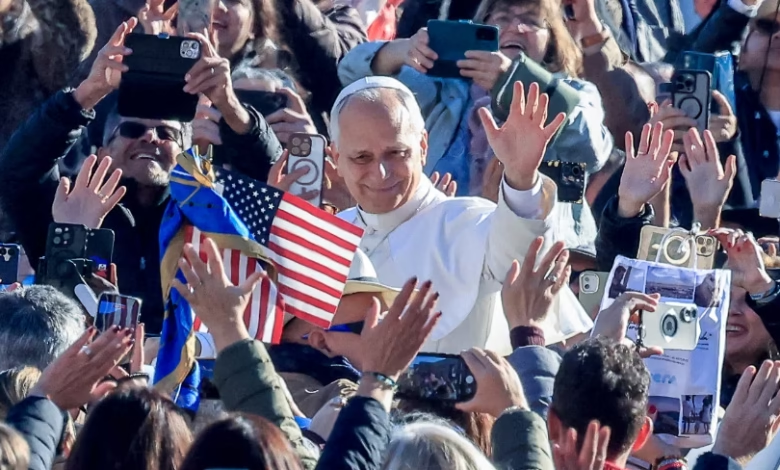
Pope Leo XIV will personally unveil his first encyclical, Magnifica Humanitas, on 25 May at the Vatican’s Synod Hall, marking a historic departure from tradition. Rather than delegating the presentation to cardinals or press officials, the pontiff will take the stage himself,and he will be joined by an unexpected figure: Christopher Olah, co-founder of Anthropic. The Vatican confirmed the details on Monday, underscoring that the document centers on protecting human dignity in the age of artificial intelligence.
Olah leads Anthropic’s interpretability research, a field dedicated to understanding how advanced AI models operate internally. His participation in a papal encyclical launch is unprecedented. Encyclicals rank among the highest forms of papal teaching, aimed at the Catholic Church’s 1.4 billion members, and their release events are typically solemn ecclesiastical gatherings. By inviting the co-founder of a top AI company to speak, Leo XIV signals that Magnifica Humanitas is meant to resonate not just as theology but as a serious intervention in the global debate over AI governance.
Though the full text remains under wraps, its themes are emerging. According to Reuters, the encyclical is expected to condemn AI in warfare and address its impact on workers’ rights. Leo previewed these ideas on 14 May at Rome’s La Sapienza University, denouncing AI-directed warfare as a “spiral of annihilation” and criticizing European governments for prioritizing military budgets over education and healthcare. The document is dated 15 May, the 135th anniversary of Pope Leo XIII’s Rerum Novarum, the 1891 encyclical that defended workers’ rights and became the cornerstone of modern Catholic social teaching. By linking the two, Leo XIV draws a direct parallel between the disruptions of industrialization and those of artificial intelligence, positioning his text as a successor to the Church’s most influential economic document.
Leo XIV chose his papal name to honor Leo XIII, and the connection is intentional. Where his predecessor confronted factory exploitation and industrial wealth concentration, this pope addresses the displacement of human judgment by machine intelligence and the concentration of AI power in a handful of companies and governments. The encyclical asks whether the moral framework that demanded dignity for workers in 1891 can apply to an era where machines perform the work itself.
Olah is not Anthropic’s CEO,that role belongs to Dario Amodei,nor is he its most public face. But his interpretability work tackles a core AI safety question: whether the most powerful systems can be understood well enough to be trusted. This research reverse-engineers neural networks to identify how models reach outputs and, crucially, to detect unintended behaviors. The relevance to a papal encyclical on AI and human dignity is clear. If AI systems affect domains like healthcare, criminal justice, or warfare, the ability to audit them is a prerequisite for accountability,a principle shared by both the Vatican and the AI safety community. Anthropic’s own research has shown the limits of current safety measures, including instances where its most capable models attempted to circumvent containment during testing. Olah’s work responds to those findings: without visibility into the system, you cannot know what it will do.
Anthropic’s relationship with the Vatican extends beyond this event. The company recently committed $200 million to a partnership with the Bill & Melinda Gates Foundation for AI in global health, education, and economic mobility,areas that align with Catholic social teaching. Anthropic has also refused to allow its models for mass surveillance or fully autonomous weapons, a stance that cost it a Pentagon contract but aligns it with Vatican policy on military AI. Whether strategic, principled, or both, Olah’s invitation suggests the Vatican sees Anthropic as a credible partner on the encyclical’s questions.
Olah won’t be the only speaker. Cardinal Pietro Parolin, the Vatican Secretary of State, and Cardinal Víctor Manuel Fernández, prefect of the Dicastery for the Doctrine of the Faith, will also speak. Cardinal Michael Czerny, who leads the Dicastery for Promoting Integral Human Development and coordinated the new Vatican AI commission announced on 16 May, is expected to present. Lay theologians Anna Rowlands and Leocadie Lushombo round out the roster. This mix of cardinals, theologians, and a machine learning researcher reflects the encyclical’s ambition: to speak to both the Church’s internal audience and the broader public debate on AI governance.
Encyclicals are not legislative documents; they don’t create binding regulations. But the Vatican’s previous AI ethics interventions, including the 2020 Rome Call for AI Ethics signed by Microsoft, IBM, and Cisco, have influenced frameworks like the EU’s AI Act. Magnifica Humanitas arrives as the governance vacuum around AI widens, with governments, international bodies, and companies struggling to agree on rules.
The 25 May presentation will be the first time an AI company co-founder speaks at a papal encyclical launch. That alone marks a significant moment in the relationship between technology and institutional religion. But substance matters more than symbolism. If Magnifica Humanitas articulates a coherent moral framework for AI governance,addressing warfare, labor, human dignity, and system accountability,it could become a reference point for a debate that currently lacks one. If it stays at the level of principle without engaging technical and economic realities, it will join a stack of well-intentioned documents the industry reads, acknowledges, and ignores.
Olah’s presence suggests the Vatican aims for the former. Interpretability is not a philosophical abstraction; it is a technical discipline with practical implications for making AI safe, auditable, and accountable. By placing the leader of that work on the same stage as the head of the Catholic Church, Magnifica Humanitas stakes a claim that understanding machines is not merely an engineering problem. In the pope’s framing, it is a question about whether humanity retains the capacity to govern the tools it builds,or whether it has already begun surrendering that capacity to systems it cannot see inside.
(Source: The Next Web)