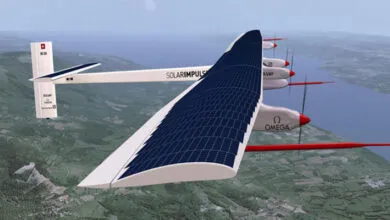
Solar drone with jumbo-jet wingspan set record, then crashed

▼ Summary
– A solar-powered drone, the modified Solar Impulse 2, crashed at sea after a record-breaking eight-day flight between late April and early May.
– The aircraft previously made history as the first solar-powered plane to cross the Atlantic and Pacific oceans before becoming an uncrewed military test platform.
– The drone’s 236-foot wingspan, covered with over 17,000 solar cells, allowed it to fly continuously using only renewable energy and batteries.
– Skydweller Aero purchased and modified the original Solar Impulse 2 to carry up to 800 pounds of payload for “perpetual uncrewed flight” missions.
– The final flight was part of maritime patrol test scenarios for the US military, conducted under contracts with the Navy and Air Force.
A solar-powered drone with a wingspan matching that of a Boeing 747 set a new endurance record during an eight-day flight spanning late April to early May, only to be lost at sea. The crash also ended the operational life of the pioneering aircraft, originally known as Solar Impulse 2, which had previously achieved the first solar-powered crossings of the Atlantic and Pacific Oceans before being converted into an uncrewed testbed for U.S. military missions.
The carbon-fiber aircraft was able to sustain such extraordinary flight durations on nothing but renewable energy and batteries thanks to its massive 236-foot (72-meter) wingspan, covered with more than 17,000 solar cells. That span is comparable to a jumbo jet’s, yet the entire structure is remarkably lightweight. The company Skydweller Aero purchased and modified the original Solar Impulse 2 to serve as a platform for “perpetual uncrewed flight,” capable of carrying up to 800 pounds (363 kilograms) of payload.
Skydweller Aero had been conducting test flights for maritime patrol mission scenarios with the U. S. military, holding contracts with both the Navy and the Air Force. It was in this operational capacity that the Skydweller drone took off on its final flight in the early morning hours of April 26. The record-breaking mission ended not with a landing, but with a crash into the ocean, marking a bittersweet conclusion for a machine that had already redefined the limits of solar aviation.
(Source: Ars Technica)