DJI Osmo Pocket 4: Every Camera Upgrade You’d Want
▼ Summary
– DJI’s Osmo Pocket 4 is not launching in the U.S. due to a pending authorization application, following a trend of DJI products missing the U.S. market.
– The Pocket 4 is an evolutionary upgrade over the Pocket 3, with improvements to the sensor, dynamic range, slow-motion capabilities, and battery life.
– New physical features include two additional buttons under the screen for zoom and customizable shortcuts, though customization options are limited.
– The camera now offers 37-megapixel stills, 4K video with 4x zoom, 14 stops of dynamic range, and 4K slow motion at up to 240fps.
– The Pocket 4 includes 107GB of internal storage, six film simulations, and improved stabilization, though it is not designed for intense action use.
DJI has made a habit of expanding its influence beyond aerial cameras, and with the DJI Osmo Pocket 4, the company continues to refine the compact vlogging experience. However, for the first time in the series, this model will not be sold in the United States, following a pattern set by several recent DJI drone releases that have also skipped the US market.
For American consumers, there is a silver lining: the Pocket 4 is largely an iterative update. It does not fundamentally reinvent what the Pocket 3 already offers, and the rumored dual-lens Pro variant may be the more dramatic leap. For buyers elsewhere, though, the refinements are meaningful. The upgrades touch nearly every aspect of the camera, from the imaging sensor to the physical controls, making this a clear step forward.
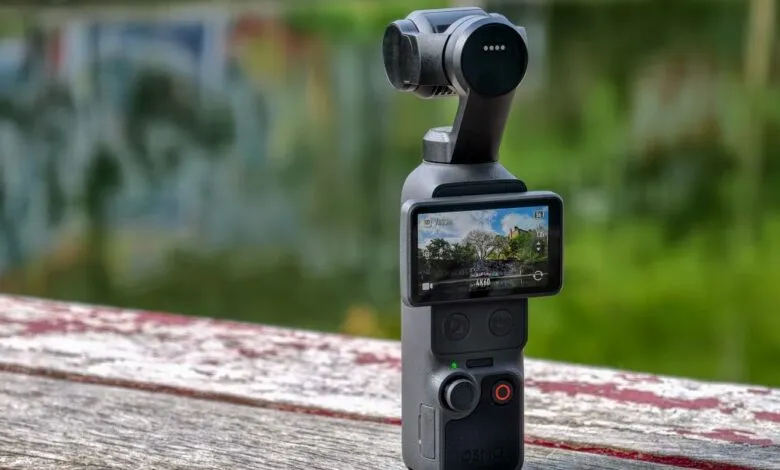
At first glance, the Pocket 4 is nearly indistinguishable from its predecessor. It shares the same compact form factor, a rotating 2-inch touchscreen for switching between portrait and landscape orientations, and the familiar control stick and record button. The gimbal mechanism at the top remains unchanged as well. The most noticeable physical addition is a pair of new buttons that appear only when the screen is flipped horizontally. One serves as a shortcut for zoom, while the other is customizable for three actions via single, double, or triple presses. However, the customization is oddly restrictive: only the triple press can adjust gimbal modes, and that is its sole function. More flexibility here would reduce the need to dig through small on-screen menus, which remains a minor frustration.
The real improvements lie beneath the surface. The 1-inch sensor has been overhauled, now capturing 37-megapixel stills (up from 9.4 megapixels) and offering 4K video with up to 4x zoom without resolution loss. The Pocket 3 was limited to 2x at 4K. Portrait mode still drops to 3K, but the new sensor brings 14 stops of dynamic range (up from 12) and a maximum ISO of 25,600 for better low-light performance. In testing, the Pocket 4 handled dim city streets well, with only minor blowout in direct lights and some loss of detail in deep shadows. For most users, the video quality will be more than sufficient.
Slow-motion capture receives a significant boost, now supporting 4K at up to 240fps , double the Pocket 3’s capability. This feature is limited to landscape mode, and there is a slight dip in dynamic range, but the footage remains largely consistent with standard recording.
Battery life has improved substantially. DJI claims up to 240 minutes of use under ideal conditions, though real-world testing with 4K 60fps footage suggests around an hour of active recording is more realistic. For the first time in the series, the Pocket 4 includes 107GB of internal storage, which is generous enough to make a microSD card optional. In testing, 40 minutes of mixed footage used less than 20GB, with battery remaining at 25 percent.
The stabilization system remains largely unchanged from the Pocket 3, relying on the same gimbal hardware. It is still excellent for walking shots and vlogging, with effective face tracking and a Spotlight Follow mode. However, it is not designed for high-intensity activity; even a light jog introduces noticeable shakiness.
Audio quality is solid from the built-in microphones in quiet environments, but for best results, the DJI Mic 3 included in the Creator Combo bundle is recommended. The wireless mic offers superior clarity and noise cancellation, making it a worthwhile addition for any video where sound matters.
Six built-in film simulations add creative flexibility, each adjustable in strength. Accessories like a fill light, tripod, and wide-angle lens attach via pins on the gimbal’s rear, expanding the camera’s versatility without compromising portability.
Availability is the key caveat. DJI spokesperson Daisy Kong confirmed to The Verge that the Pocket 4 “will not be available in the US market as the application for authorization is still pending.” There has been no sign of a rebranded version from Xtra, the company that previously sold the Pocket 3 as the Xtra Muse. However, Xtra is teasing a dual-lens steadicam that resembles leaked renders of the Osmo Pocket 4 Pro, leaving a glimmer of hope for US buyers.
Pricing outside the US starts at £429 / €479 (roughly $560) for the Essential Combo, which includes the camera, pouch, and tripod-mountable handle. The Standard Combo adds a wrist strap and gimbal clamp for £445 / €499 ($585). The Creator Combo, at £549 / €619 ($725), bundles the DJI Mic 3, fill light, tripod, wide-angle lens, and a larger carrying case.
The DJI Osmo Pocket 4 is not a revolutionary device, but it is a comprehensive refinement. Nearly every feature has been enhanced, from the brighter screen to the upgraded sensor and improved battery life. For existing Pocket 3 owners, there is little reason to upgrade. For anyone still using a Pocket 2 or older, or for new buyers outside the US, this is the best Osmo Pocket DJI has ever made.
(Source: The Verge)