Google Launches New TPUs for AI Agents
▼ Summary
– Google primarily uses custom Tensor Processing Units (TPUs) for its AI infrastructure, unlike most companies that rely heavily on Nvidia accelerators.
– Its new eighth-generation TPU is designed for the “agent era” and represents a new hardware approach, not just a faster version of the previous chip.
– The new generation comes in two specialized variants: the TPU 8t for training models and the TPU 8i for running inference.
– The TPU 8t is specifically engineered to drastically reduce the training time for advanced AI models from months down to weeks.
– Training is the initial phase where AI models are developed before they can be used for tasks like data analysis or content creation.
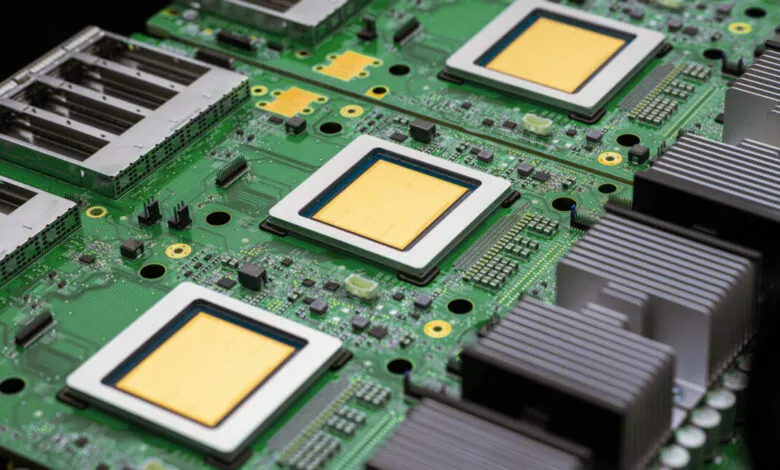
While many leading tech firms are locked in a race to secure Nvidia’s latest AI accelerators, Google continues to chart its own course. The company’s cloud infrastructure relies heavily on its custom-built Tensor Processing Units (TPUs), a strategy that has now advanced with a new eighth-generation design. This launch follows the 2025 introduction of the seventh-gen Ironwood TPU, but the latest iteration represents more than a simple speed boost. Google asserts these new chips are engineered for a distinct phase of artificial intelligence, which it calls the agentic era.
To meet the demands of this new paradigm, Google has introduced two specialized processors. The TPU 8t is optimized for the intensive computational work of training frontier AI models, a process that can otherwise take months. Its counterpart, the TPU 8i, is dedicated to inference, which is the stage where a trained model generates outputs for users. This bifurcated approach aims to deliver a platform that is both faster and more power-efficient for Google and its cloud customers.
The company’s philosophy is that the shift toward autonomous AI agents requires a fundamental rethinking of underlying hardware. These systems must handle complex, multi-step reasoning and real-time interaction, a challenge different from previous generations of AI. By creating distinct chips for training and inference, Google’s engineers are tailoring silicon to specific points in the AI lifecycle, seeking to accelerate development and deployment cycles for the next wave of intelligent applications.
(Source: Ars Technica)