AI Transforms Mathematics Research and Discovery
▼ Summary
– AI is currently accelerating the pace of proving new mathematical theorems.
– Mathematicians believe this trend represents only the initial phase of AI’s impact.
– The technology is actively being applied within mathematical research.
– Its use is leading to the discovery of novel results.
– Experts anticipate its role and influence will continue to grow significantly.
The integration of artificial intelligence into mathematical research is accelerating the pace of discovery. Researchers are now leveraging these powerful tools to prove novel theorems and uncover complex patterns, signaling a profound shift in how foundational science is conducted. Many experts believe the current applications merely scratch the surface of a much larger transformation.
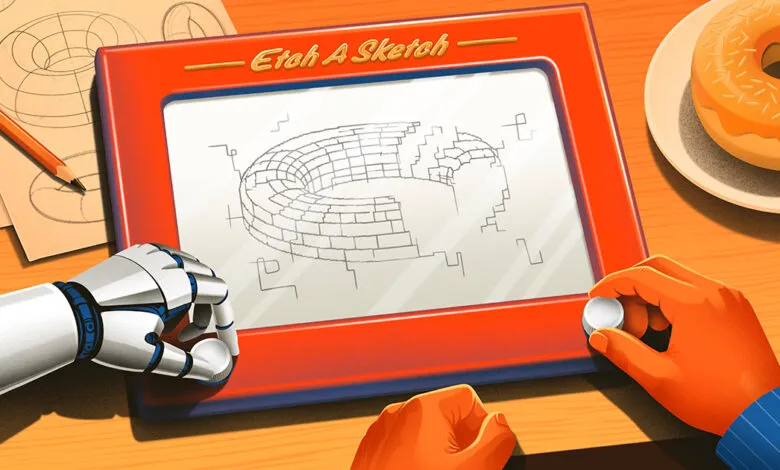
This technological shift is not about replacing human intuition but augmenting it. AI systems can process vast combinatorial spaces and explore potential proof pathways far beyond human capacity. This allows mathematicians to focus their creative efforts on high-level strategy and interpretation, while machine learning algorithms handle intricate, labor-intensive verification. The synergy is producing results that would have been impractical or impossible to find through traditional methods alone.
The impact extends across pure and applied mathematics. In fields like number theory and algebraic geometry, AI is helping formulate new conjectures and test their validity against enormous datasets. For applied domains, these tools optimize models and solve intricate systems of equations critical for physics, engineering, and data science. The automation of mathematical reasoning is thus becoming a cornerstone for innovation in both theoretical and practical disciplines.
Looking ahead, the trajectory suggests AI will become an indispensable collaborator in the research process. Its ability to learn from mathematical structures and propose unexpected connections could lead to breakthroughs in long-standing problems. The future of mathematical discovery is increasingly collaborative, blending human creativity with computational power to explore the deepest frontiers of knowledge.
(Source: Quanta Magazine)