AI Buttons: Smart UX or Risky Strategy?
▼ Summary
– AI buttons are user experience shortcuts that let readers summarize, save, or ask questions about content using their personal AI assistant, but they do not directly influence search rankings or global AI training.
– Bloggers adopt these buttons to adapt to changing user behavior, where people now use AI tools for tasks like modifying recipes, aiming to keep their brand attached in this emerging AI discovery layer.
– Data from an early adopter shows AI referral traffic is growing rapidly but remains a small portion of overall traffic, and that on-page AI summaries, not the buttons alone, appear to drive significant SEO improvements.
– Critics raise concerns about potential AI manipulation, such as hidden prompt instructions that could bias AI recommendations, though transparent, user-initiated buttons are distinct from such deceptive practices.
– Best practices recommend focusing first on adding helpful AI summaries to content, using buttons as a transparent UX feature, and treating them as an experimental tool within a broader strategy for AI-driven discovery.
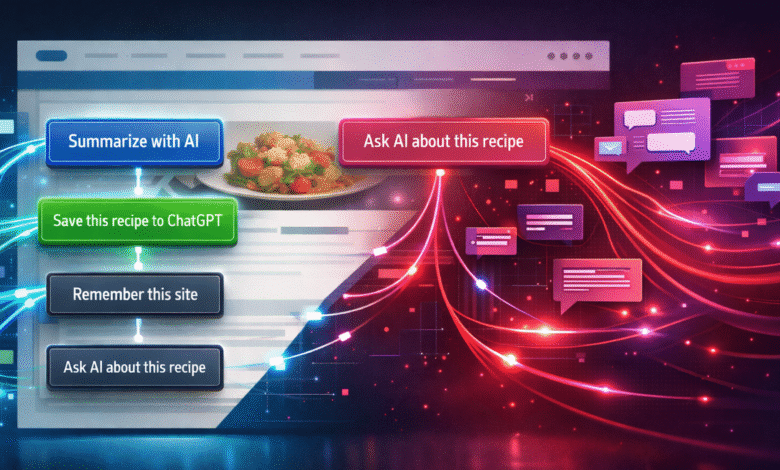
A new wave of interactive features has emerged across digital content platforms in recent months. These AI buttons, offering options like “Summarize with AI” or “Ask AI about this recipe,” represent a significant shift in how creators approach user experience. While plugins from companies like Feast and Hubbub have simplified their deployment, sparking widespread experimentation, a vigorous debate has arisen about their strategic value and potential risks.
Microsoft’s recent research on AI recommendation poisoning has fueled concerns, with some SEO professionals warning these features could be interpreted as a form of prompt injection. Critics also question whether encouraging users to engage with AI assistants might inadvertently drive them away from the original website permanently. Determining whether these buttons are a forward-thinking adaptation or a precarious gamble requires a closer examination of their function and impact.
Fundamentally, these buttons are user experience shortcuts. They allow a visitor to quickly summarize content, save a page to an AI’s memory, or ask follow-up questions directly within an assistant like ChatGPT. It is crucial to understand what they do not do: they do not alter Google rankings, retrain large language models, or guarantee citations in AI systems like Perplexity. Their primary effect is to streamline how a user interacts with content through AI, potentially helping a personal assistant remember that site for future reference. This distinction between influencing global AI behavior and enhancing a single user’s personal AI experience is central to the debate.
The adoption of these tools is a direct response to changes in search discovery. The traditional traffic flow from Google to a blog and back is being supplemented by a new pattern: users go from Google to a blog, then copy content into an AI tool for summarization or modification. AI buttons acknowledge this existing behavior. By integrating this step, sites aim to keep their brand attached to the summarized content, simplify the process for users, and stand out in a crowded market. This makes the feature less about traditional SEO and more about engaging with the emerging AI discovery layer.
Early data from implementations offers valuable insights. On the prominent food blog Leite’s Culinaria, which added AI summaries and buttons in mid-2025, referral traffic from AI platforms saw dramatic percentage growth. However, this traffic remains a small fraction of overall site visits, confirming it as a secondary, emerging channel rather than a replacement for search. The data reveals a critical nuance: while buttons and summaries work best together, the summaries themselves appear to be the primary SEO driver. Pages featuring both saw impressive gains in impressions and average search position, while pages with only buttons showed minimal improvement.
User interaction data is equally telling. On recipe pages, the most clicked button functions were for ingredient substitutions, scaling recipes, and dietary modifications,not for summarization. This reinforces the idea that these are fundamentally UX tools for content interaction, not mere SEO tricks. Notably, even with summaries on only 15% of its content, the site experienced substantial organic growth, suggesting the summaries themselves have a significant impact.
Legitimate concerns exist, particularly around opaque practices. Hidden prompt instructions designed to bias an AI assistant without user consent constitute genuine prompt injection and should be avoided. Strategies should not assume buttons alone will boost rankings or that AI platforms will not eventually ignore overused signals. The core strategy must still rest on great content and topical authority.
However, many fears are likely overstated for the average content creator. Most implementations are transparent, user-initiated actions, akin to bookmarking, not system-level manipulation. A user saving a site to their personal AI memory does not retrain global models or directly influence algorithms like Google’s. Currently, there is no clear mechanism for search engines to penalize a site for this external user behavior. The larger strategic risk for creators is not using these buttons, but becoming invisible as discovery expands into AI assistants.
For those considering implementation, several best practices are emerging. First, prioritize adding helpful AI summaries or TL;DR sections to content, as these show the strongest SEO correlation. Use buttons as a transparent UX feature to help users summarize, modify, or save content, keeping all prompts visible and user-initiated. Position buttons near the summary for optimal synergy, and treat the entire approach as an ongoing experiment within a broader content strategy.
Ultimately, the conversation about AI buttons is really about the evolution of content discovery. For decades, optimization focused on search engines; now it must also consider AI assistants that answer questions directly. In a hierarchy of strategic importance, content quality and expertise signals remain paramount, with AI buttons serving as a supportive UX feature. They are not a magic solution nor a likely source of penalty, but one tool among many for adapting to a shifting digital landscape. The substantive opportunity lies in well-crafted AI summaries, with the buttons acting as the accessible interface. Ignoring this shift in how users find and interact with information poses a greater long-term risk than carefully testing these new features.
(Source: Search Engine Land)