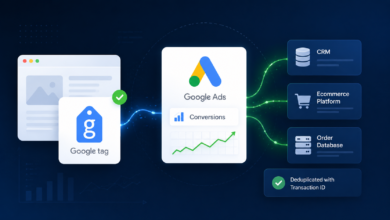
Google’s Data Strategy Aims to Improve Ad Bidding

▼ Summary
– Google is emphasizing that AI-driven campaign performance depends entirely on the quality and structure of the data fed into its systems.
– A common problem is that advertisers have added many conversion actions without refinement, creating noisy data that confuses automated bidding.
– Google advises selecting conversion signals based on their predictability of business value, frequency, and speed, not just tracking every possible action.
– This focus on “Data Strength” is a response to reduced signal visibility from privacy changes and the need for more reliable inputs for automation.
– Google is positioning itself as more integrated into business outcomes by connecting to CRM and offline data, moving beyond just being an ad platform.
The effectiveness of any AI-driven advertising system is fundamentally tied to the quality of the data it receives. This principle is at the core of Google’s current strategic direction, a recurring theme emphasized across its platforms, from advertiser-focused podcasts to technical developer content. The push signals a significant evolution in how campaigns must be constructed and refined, moving beyond mere data collection to a disciplined focus on signal quality and data strength.
For a long time, the prevailing approach to conversion tracking was expansionist. Advertisers frequently added every trackable action, importing data from CRMs and adopting new conversion types with minimal scrutiny. The assumption was simple: more data equates to better performance. However, this has often resulted in a noisy dataset where high-intent signals are diluted by numerous low-value actions. Campaigns end up optimized toward a blended set of goals that do not share equivalent business value, timing, or customer intent. This was manageable when automation was less sophisticated, but it creates substantial friction for modern AI-driven bidding systems that depend on clear, predictive patterns to make real-time decisions.
The central challenge for many advertisers lies in their conversion setup. Google’s recent guidance, particularly for lead generation, highlights the need to map the full customer journey and identify the conversion point that offers a usable signal for bidding. This involves evaluating three concurrent factors: how predictive an action is of real value, its frequency, and its speed. A common misstep is defaulting to the deepest conversion, like a final sale, for all campaigns. While that goal is valid, if it occurs infrequently or after a long delay, it provides a weak, slow-learning signal for the system, often leading to sluggish optimization and volatile performance. Conversely, optimizing solely for high-volume, early-stage actions without regard for quality can inflate metrics without driving meaningful outcomes.
This intensified focus on data strength is not arbitrary. Practical realities drive it. Advertisers have lost visibility due to privacy changes and browser restrictions, while Google’s systems are expected to deliver results with fewer direct signals. The company’s response is a suite of tools and integrations designed to make the remaining signals more reliable and actionable. Products like Data Manager and the tag gateway aim to improve data consistency, while expanded partnerships with platforms like HubSpot and Zapier simplify connecting first-party data sources. The goal is to enhance the effectiveness of automation in a constrained signal environment.
Beneath these product updates, a broader strategic shift is apparent. Google is integrating more deeply with the systems where business outcomes are realized, such as CRMs and offline sales data. This move allows its platforms to better understand what constitutes a valuable customer beyond the initial ad interaction. It positions Google as more integral to business measurement and value definition, not just an ad delivery network.
Regarding implementation, there has been some confusion between server-side tagging and Google’s current promotions. The tag gateway focuses on resilient first-party delivery of the Google tag, often serving as an accessible step for improving data reliability. Server-side tagging is a more comprehensive architectural shift, moving data processing to a controlled server environment. The two can be complementary, with gateway serving as a stepping stone for many advertisers.
Adopting a thoughtful approach to this new emphasis is crucial. Streamlining data flow will not compensate for poorly defined conversion actions. Marketers should collaborate with analytics teams to audit current conversion events, ensuring they are aligned with campaign intent. Governance is also key, as automated data collection expands, teams must understand what is being captured and how it is used. Furthermore, while improving performance within Google’s ecosystem is valuable, these efforts should be part of a broader measurement strategy that includes cross-channel evaluation, an area where initiatives like the open-source Meridian project can play a role.
The consistency of this message across Google’s communications is telling. Educational series like Ads Decoded tackle strategic journey mapping, while the technical Ads DevCast delves into APIs and integration workflows. The introduction of the Data Manager API, which centralizes workflows like Customer Match, underscores a coordinated effort to strengthen data collection, privacy controls, and usage across the advertising landscape.
This focus has resonated within the advertising community, sparking necessary dialogues. Responses to content on lead quality, particularly in B2B contexts, have been positive, with practitioners highlighting the long-needed attention to lead quality and bot filtration. Industry experts have echoed the sentiment that AI is merely an engine, incapable of compensating for fundamentally weak data inputs. Practitioners report that dedicating effort to data strength, while demanding, yields tangible results, including significant increases in conversions and decreases in cost.
For individual campaigns, the implications are immediate upon review. Accounts that treat conversion tracking as a set-and-forget function will increasingly struggle. When the signals guiding bids do not match the intent of the targeted queries, performance becomes inconsistent and scaling difficult. The push for data strength compels a critical examination of which signals are used for optimization, their reliability, and their true reflection of business outcomes. This may involve better CRM integration, fixing tagging infrastructure, or redefining conversion actions altogether. As this direction solidifies, the performance gap will likely widen between advertisers who are intentional about their data foundation and those who are not.
(Source: Search Engine Journal)