AI Tool Detects Mental Health Conditions Early
▼ Summary
– Abhishek Appaji is an IEEE senior member and associate professor who integrates AI, biomedical engineering, and neuroscience to create accessible diagnostic tools for under-resourced communities.
– His inventions include an AI-powered retinal scan kiosk for detecting eye diseases and mental health biomarkers, and a wireless smart bed that monitors vital signs, both deployed in remote Indian hospitals.
– He received the 2024 IEEE Theodore W. Hissey Outstanding Young Professional Award for his contributions to accessible healthcare and leadership in empowering young professionals.
– Appaji co-founded Glucotek, developing a noninvasive blood glucose monitor, after participating in an MIT entrepreneurship program to bridge the gap between research and market.
– He actively mentors entrepreneurs through the BMSreenivasiah Innovators Guild Foundation and holds multiple IEEE leadership roles, having also led humanitarian projects like producing 3D-printed protective equipment during the COVID-19 pandemic.
For IEEE senior member Abhishek Appaji, the true measure of engineering success lies in its real-world impact. His work at the intersection of artificial intelligence, biomedical engineering, and neuroscience is dedicated to creating accessible diagnostic tools, particularly for under-resourced communities. An associate professor at Bengaluru’s B.M.S. College of Engineering, Appaji’s contributions have earned him this year’s IEEE Theodore W. Hissey Outstanding Young Professional Award.
His career path reflects a consistent drive to translate technical expertise into practical solutions. After earning his bachelor’s degree and beginning to teach, he sought to bridge the gap between lab research and the marketplace. Participation in the MIT Global Entrepreneurship Bootcamp provided that crucial framework. There, his team tackled gestational diabetes by developing a noninvasive blood glucose measurement device, an effort that later evolved into the startup Glucotek.
This experience inspired a deeper focus on healthcare technology, leading Appaji to pursue a doctorate at Maastricht University. His research centered on a compelling premise: the retina offers a unique, noninvasive window into the brain’s health. “The retina is the only place in the human body where the central nervous system and the vascular system can be visualized directly,” he explains. His thesis explored how computational methods could analyze retinal vascular patterns, as changes in these tiny blood vessels can mirror neurovascular shifts associated with conditions like schizophrenia and bipolar disorder.
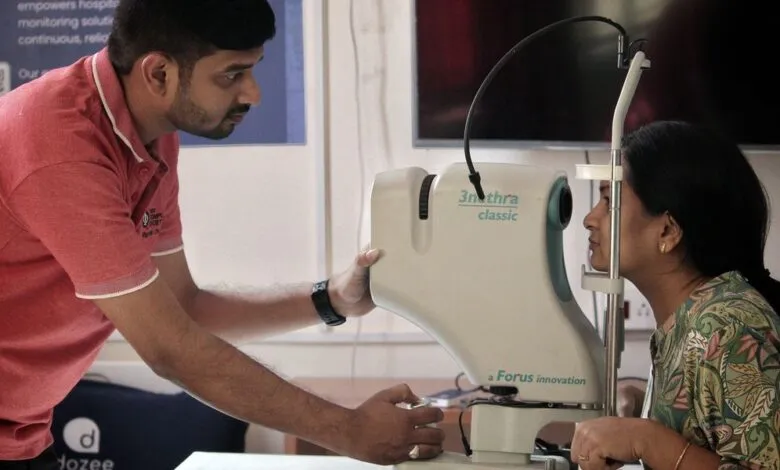
This foundational work led directly to the Smart Eye Kiosk, an AI-powered screening tool developed with clinical and engineering collaborators. The kiosk scans the retina’s vascular network, analyzing metrics such as vessel thickness to monitor stress and screen for both eye disease and biomarkers of psychiatric illness. A related study, funded by India’s Department of Science & Technology, included relatives of patients to explore genetic links, paving the way for earlier and more accurate diagnoses.
Appaji’s portfolio extends beyond ophthalmology. He has also enhanced a wireless smart bed sensor system in collaboration with health AI company Dozee. A sensitive sheet placed under the mattress detects microvibrations from heartbeat and respiration, converting them into vital sign data without wires or wearables. This technology, funded in part by the Indian government, is now deployed in hundreds of hospitals and thousands of homes across India.
Beyond his inventions, Appaji is deeply committed to mentorship and leadership. As executive director of the BMSreenivasiah Innovators Guild Foundation, he guides students and faculty through startup incubation, with several healthcare ventures securing investor backing. His dedication extends to IEEE, where he has held numerous leadership roles. His involvement began as an undergraduate volunteering at a conference, an experience he calls “transformative” for placing him alongside the authors of his textbooks.
This engagement has come full circle, with IEEE directly supporting his humanitarian work. During the COVID-19 pandemic, a grant from the IEEE Humanitarian Technologies Board enabled his team to produce and distribute 3D-printed protective equipment to hundreds of vulnerable households in Bengaluru. “This work remains one of my most meaningful contributions,” Appaji states, highlighting engineering’s role in crisis response.
He encourages emerging professionals to embrace volunteer roles within IEEE, noting that the networking and skills gained are invaluable. For Appaji, the organization’s mission aligns perfectly with his own. “IEEE is a global platform that allows me to collaborate with a diverse network of experts to solve local humanitarian challenges,” he says. The recent award validates his core belief: that the ultimate goal is creating tangible impact through accessible technology and empowering the next generation of leaders.
(Source: Ieee.org)