WordPress Launches Private Browser-Based Workspace: my.WordPress.net
▼ Summary
– WordPress now offers a browser-based service called my.WordPress.net, allowing users to create and publish a site without signing up for hosting or a domain.
– Sites created with this service are private by default, not accessible to the public, and are designed as a personal workspace for drafting or private projects.
– The sites are bound to the user’s web browser, with data saved locally, meaning they cannot be accessed from another device but can be migrated to a public host.
– The service includes an App Catalog with tools like a Personal CRM and AI Workspace, and integrates with an AI assistant to modify plugins or query stored data.
– It is powered by WordPress Playground, has limited storage (~100 MB), and allows users to reset their site or create temporary instances that clear on browser refresh.
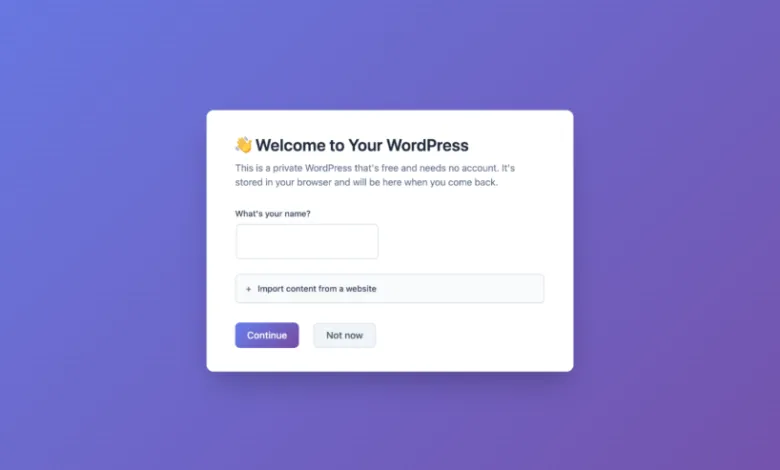
The popular WordPress publishing platform has taken a significant step forward by introducing a fully browser-based workspace. This new service, called my.WordPress.net, allows anyone to start building a website and publishing content directly from their web browser. Users can begin without the usual prerequisites of creating an account, purchasing hosting, or registering a domain name. It transforms the technology previously used for temporary demos into a persistent, personal platform for creation and organization.
A major point to understand about this approach is its inherent privacy. Sites created on my.WordPress.net are private by default and cannot be found or accessed on the open web. According to the platform’s announcement, these sites are not designed for public visibility or handling large amounts of traffic. Instead, they serve as a personal digital environment where thoughts, drafts, and projects can develop in private, whether they are eventually shared with the world or remain solely for the creator’s use.
The entire site is tethered to the specific web browser where it was created, with all data saved locally in the browser’s storage. This design means you cannot access your work from a different computer or device. However, if you decide to launch a project publicly, the platform provides a pathway to migrate your site to a traditional WordPress hosting provider.
This initiative reimagines WordPress as a versatile private workspace. It’s suited for activities like journaling, drafting long-form content, conducting research, or learning web development. The service also includes an App Catalog featuring a range of personal tools built with WordPress plugins. Available applications include a Personal CRM for managing contacts, a dedicated RSS reader, a bookmarking system, and a specialized AI Workspace, among others.
Under the hood, my.WordPress.net is powered by WordPress Playground. This open-source technology enables instant, one-click WordPress installations and has integrations with services like OpenAI. A key feature is the built-in AI assistant, which users can instruct to modify their site. You can ask it to adjust an existing plugin’s settings or even help code a brand new one from scratch.
Furthermore, this assistant can interact with and recall information stored within your WordPress site. This functionality allows the platform to evolve into a personalized knowledge base that you can query conversationally, making your private notes and data more accessible and useful.
Users should note that the initial launch of a new workspace may take a bit longer to load. The platform advises saving backups regularly, as the local storage begins at approximately 100 MB. This capacity is ideal for smaller, personal applications and projects but may not suit very large media libraries.
If you wish to completely erase your current work, a simple reset button will clear the site. You also have the option to create new, temporary instances that automatically reset and disappear once you refresh or close the browser tab.
This launch builds on the WordPress project’s growing investment in artificial intelligence. A dedicated AI team was formed last year to explore new products for developers. Separately, the commercial arm, WordPress.com, released an AI-powered website builder last year that guides users through a conversational, chatbot-style interface to design a site.
(Source: TechCrunch)