Unlock Better Sound: How LE Audio Transforms Listening
▼ Summary
– Bluetooth LE Audio represents a fundamental architectural shift from continuous streaming to a scheduled, isochronous transport, enabling low-power, high-quality, and scalable audio delivery for new applications.
– The Low Complexity Communication Codec (LC3) provides superior audio quality at roughly half the bitrate of older codecs like SBC, reducing airtime and power consumption while offering robust packet loss concealment.
– For hearing aids and similar power-constrained devices, LE Audio improves energy efficiency through the LC3 codec, more efficient radios, and Connected Isochronous Streams (CIS) that allow the radio to sleep between transmissions.
– LE Audio enables direct, synchronized stereo streaming to multiple devices (like earbuds) without relaying and introduces Broadcast Isochronous Streams (Auracast) for one-to-many, connectionless public or private audio broadcasting.
– The technology supports demanding use cases like gaming with low-latency, bidirectional stereo audio and requires rigorous acoustic testing using anthropomorphic fixtures to ensure end-user audio performance.
The journey of Bluetooth from a basic wireless link for phone calls to the invisible scaffolding for modern audio experiences is a story of continuous innovation. What began as a simple connection has evolved through incremental improvements in radio technology, audio codecs, and power management. This evolution now reaches a pivotal moment with Bluetooth Low Energy (LE) Audio, a new architectural foundation designed for low-power, high-quality, and scalable sound delivery that promises to unlock a wider array of applications than ever before.
The story starts with the original Basic Rate (BR) radio in 1999, which used a specific modulation scheme to hop between channels, providing the short-range robustness needed to compete with wired devices. A major leap came in 2003 with the Advanced Audio Distribution Profile (A2DP), the standard that enabled stereo music streaming over what we now call Bluetooth Classic. A2DP relies on the Sub-Band Codec (SBC) for audio compression. Through careful digital signal processing work, engineers optimized SBC implementations to sound excellent while using minimal processing power and energy.
Subsequent radio enhancements, like the Enhanced Data Rate (EDR) in 2004, boosted data throughput. A more fundamental shift arrived around 2010 with the introduction of Bluetooth Low Energy (BLE), a radio technology tuned for intermittent, low-duty-cycle communication. This created the distinction between “Bluetooth Classic” and the new BLE standard.
The real transformation for audio arrived with the concept of isochronous transport. While Bluetooth 5.0 introduced a faster LE radio, Bluetooth 5.2 and LE Audio shifted the focus to a transport method built around timing deadlines. Instead of a continuous stream, LE Audio uses scheduled time slots called isochronous channels. This architecture comes in two key forms. Connected Isochronous Streams (CIS) are unicast flows where parameters like timing intervals and retransmissions can be finely tuned. This allows the radio to sleep predictably between data bursts while the application knows exactly when audio frames will arrive, creating a foundation for low latency and high energy efficiency. The second form, Broadcast Isochronous Streams (BIS), commercially known as Auracast, extends this scheduled delivery to one-to-many, connectionless audio broadcasts.
A major component of LE Audio’s advantage is the Low Complexity Communication Codec (LC3). Extensive listening tests show that LC3 delivers superior audio quality compared to the older SBC codec, but does so at roughly half the bitrate. It also features robust packet loss concealment and flexible frame sizes, including low-latency modes. The practical benefits are significant: a lower bitrate reduces the time the radio needs to be active, which saves power and lowers collision risk, while shorter frames align perfectly with the scheduled CIS architecture.
Nowhere is energy efficiency more critical than in modern hearing aids. These are complex devices with multiple microphones, processors, and severely limited battery capacity. LE Audio improves energy efficiency through three primary mechanisms: the LC3 codec achieves equivalent quality at lower bitrates than SBC, the LE radios reduce on-air time per packet, and the CIS scheduling allows the radio to enter low-power sleep states between transmissions. Advanced techniques like wake-up receivers, which monitor for signals with micro-watt sensitivity, further extend battery life through intelligent sleep scheduling.
LE Audio also redefines the experience for true wireless earbuds. Bluetooth Classic’s A2DP supports only a single audio stream, forcing one earbud to act as a primary receiver that relays audio to the other, adding latency and power drain. LE Audio eliminates this relay limitation entirely. Its dual CIS capability allows a phone to send synchronized left and right audio streams directly to each earbud independently. Furthermore, services like the Coordinated Set Identification Service (CSIS) allow two earbuds or hearing aids to be discovered and managed as a single, synchronized pair.
For gaming headsets, low latency and high-fidelity bidirectional audio are non-negotiable. Bluetooth Classic’s voice profiles are limited to mono audio with lower sampling rates. LE Audio Unicast Voice supports stereo audio with higher sampling rates, dramatically improving spatial audio and speech quality for in-game communication. By combining LC3’s shorter frames with carefully tuned CIS parameters, developers can achieve the end-to-end latencies of just tens of milliseconds required for responsive gameplay.
Perhaps the most transformative new application is public broadcast audio via Auracast. Bluetooth Classic, with its limited range and one-to-one connection model, was unsuitable for venues like lecture halls or airports. Auracast enables true one-to-many audio transmission to an unlimited number of receiving devices like headphones or hearing aids, with typical ranges extending much farther than classic Bluetooth. This connectionless delivery scales effortlessly, improves signal clarity by bypassing poor room acoustics, and reduces radio congestion.
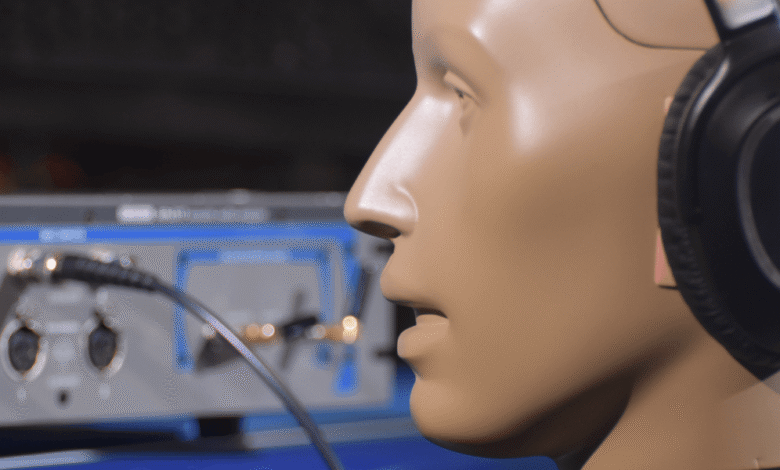
Regardless of the advanced transmission technology, ensuring a device sounds good to the end user remains paramount. The interaction between a headphone and the human ear is complex; factors like the seal of an earbud critically affect bass response and noise cancellation effectiveness. Anthropomorphic test fixtures, such as head and torso simulators with realistic ear pinnas, allow engineers to accurately and repeatably measure performance under conditions that mimic real-world use. For devices with microphones, like gaming headsets, test systems use an artificial mouth to evaluate speech capture quality against standardized reference points.
In summary, modern Bluetooth audio is defined by a coordinated, timed pipeline. It combines a high-efficiency codec, a transport that guarantees timely delivery, a radio that sleeps efficiently, and sophisticated front-end processing. From extending hearing aid battery life to enabling immersive gaming and inclusive public broadcasts, LE Audio represents a fundamental architectural shift. It moves beyond continuous point-to-point streams to a scheduled, low-power, and scalable model, setting the stage for audio that is more instant, clear, and accessible across an expanding universe of devices and experiences.
(Source: Spectrum)