Master Unstable Networks & Air-Gapped Sites with GL.iNet Comet 5G Failover
▼ Summary
– The GL.iNet Comet 5G is a remote KVM device designed to maintain persistent control over computers when primary network access fails or is unavailable.
– It features multi-network failover, automatically switching between Ethernet, Wi-Fi 6, and cellular 5G RedCap connectivity to ensure reachability.
– The device includes a local wireless SSID, allowing for direct on-site control even in internet-deprived or air-gapped environments.
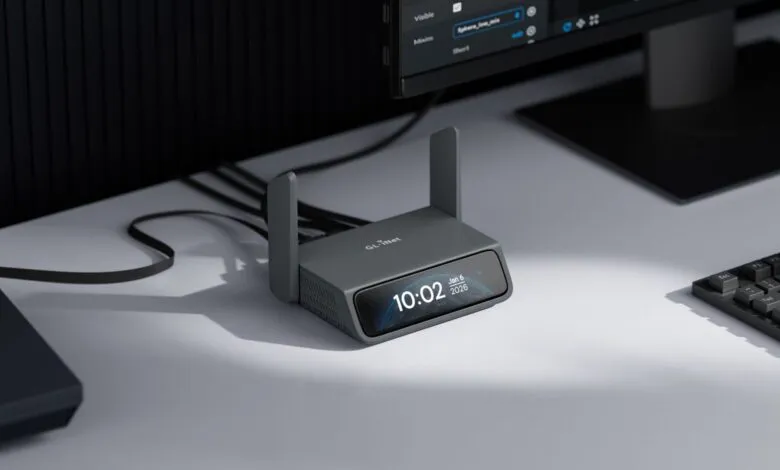
– It offers 64GB of internal eMMC storage for OS images and features a touchscreen and HDMI port for direct monitoring and control.
– The cellular component uses the 5G RedCap standard for basic, affordable remote access but lacks full 5G performance, eSIM support, and a microSD card slot.
Maintaining persistent remote access to critical systems during network failures is a fundamental challenge for IT professionals. The GL.iNet Comet 5G directly addresses this by integrating a multi-network failover system that automatically switches between Ethernet, Wi-Fi 6, and cellular 5G RedCap connectivity. This design ensures control over computers remains intact even when primary networks become unreliable or are entirely absent, such as in air-gapped or internet-deprived environments.
The device builds upon the foundation of the original GL.iNet Comet, preserving its compact, subscription-free KVM-over-IP functionality. Its primary objective is to eliminate dependence on any single access method. When a wired or standard wireless connection drops, a common occurrence during critical troubleshooting or disaster recovery, the system seamlessly transitions to an available backup link. This capability is particularly valuable in locations with unstable infrastructure or deliberately restricted connectivity.
The cellular component utilizes 5G RedCap technology, a standard engineered for lower power and bandwidth requirements. Similar to its use in certain Chromebooks, this implementation provides affordable, mid-speed connectivity for essential remote access tasks. It is important to note that this does not deliver the full throughput of standard 5G, but it establishes a reliable lifeline when other options fail. A notable hardware limitation is the lack of a microSD card slot, which removes an easy path for expandable local storage. Furthermore, the absence of eSIM support means physical SIM cards are required for cellular service, slightly reducing deployment flexibility.
Beyond wide-area network failover, the Comet 5G offers a valuable local access feature for completely isolated scenarios. The device can broadcast its own wireless SSID, creating a direct management link to a nearby laptop or mobile device. This allows an administrator to interact with connected machines on-site even when neither the KVM nor the controller has any external internet access whatsoever. While this functionality depends on physical proximity, it significantly broadens the range of viable deployment use cases.
GL.iNet has also upgraded the internal storage to 64 GB of eMMC memory, which is intended to house multiple operating system images for recovery purposes. With specified data transfer rates up to 25 MB/s, restoring a system after a failure could be expedited. This integrated storage replaces the need for removable media, though it also underscores the limitation presented by the missing microSD slot. The hardware further includes a touchscreen and an HDMI port, positioning the device as a hands-on control and monitoring tool rather than a purely remote, headless unit.
The design philosophy incorporates elements from other GL.iNet products, such as the touchscreen and dual Ethernet seen in the Slate router, while refining the multi-network failover concept from their cellular router line. Marketed as a solution for increasingly fragile network assumptions, the Comet 5G is positioned as a dedicated tool for ensuring uninterrupted system management.
(Source: techradar)