Spotify on United Seatbacks, Powered by Starlink
▼ Summary
– United Airlines has launched a custom Spotify app for seatback displays, enabling passengers to stream personal libraries and playlists during flights.
– This integration leverages Starlink’s satellite Wi-Fi network to provide the high-speed, low-latency connectivity required for seamless in-flight streaming.
– The service represents a significant evolution from legacy entertainment systems that relied on pre-loaded content due to limited or non-existent internet access.
– United executives cited Starlink’s robust global coverage and reliability as key factors in choosing the provider over other in-flight Wi-Fi options.
– Independent tests indicate Starlink’s extensive satellite constellation offers superior performance compared to traditional geostationary satellite providers.
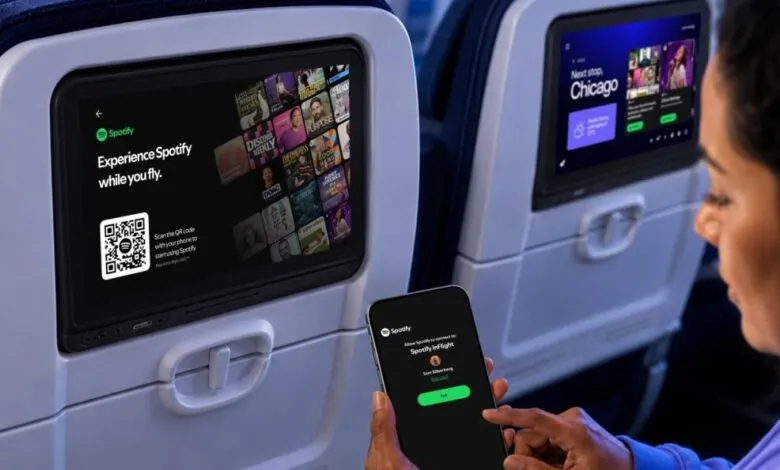
United Airlines has launched a native Spotify application for its seatback entertainment systems, marking a significant evolution in in-flight entertainment. Passengers can now log directly into their personal accounts to stream music libraries, curated playlists, and video podcasts while cruising at 35,000 feet. This seamless digital experience is powered by Starlink’s satellite Wi-Fi, which the carrier is currently deploying across its entire fleet.
This integration signals a decisive break from legacy in-flight audio systems. The industry is moving away from outdated hardware such as stethoscope-style plastic tubes, armrest dials, and pre-loaded canned playlists. Those older systems were designed under the assumption that flights would remain offline, requiring all media to be stored physically on the aircraft. With the advent of high-speed internet via Starlink, travelers can now access live content streams just as they do in their homes.
The partnership between United and Spotify was announced slightly over a year ago, initially focusing on exploring how to preload music content onto seatback displays. However, the airline determined that offering a personalized experience where customers could activate their own accounts was the superior approach. Mark Muren, managing director for product marketing at United, emphasized the value of this customization during an interview.
“It’s supreme, perfect personalization in that it’s that customer’s actual account, all of their material available there,” Muren said.
Such a sophisticated integration relies heavily on the infrastructure provided by Starlink. Grant Milstead, United’s VP for digital, noted that the network of geostationary satellites makes the service possible. Independent testing indicates that Starlink outperforms many other providers due to its massive constellation of over 11,000 satellites in low Earth orbit. This dense network reduces latency significantly because the signal travels a shorter distance compared to traditional geostationary satellites.
“You know, for us, having fast, low-latency connectivity has been the enabler,” Milstead said. “Without Starlink, we couldn’t generate that living-room-in-the-sky experience.”
United selected Starlink primarily for its reputation for robust global connectivity. Unlike previous providers that suffered from dropped signals and coverage dead zones, Starlink offers consistent performance even over polar regions during transatlantic and transpacific routes. Milstead highlighted that the bandwidth and reliability have been strong enough to allow uninterrupted streaming across seatbacks, eliminating the need for complex engineering solutions required in the past.
“One of the reasons that we chose Starlink is for the global connectivity, even in the poles for some of our transatlantic and transpacific flights,” he added. “And so, candidly, the bandwidth and the coverage and the reliability has been so strong that we’ve seen consumers be able to stream across seatback with no interruptions. So we really haven’t had to do some of the complex engineering we’ve had to do in the past.”
Passengers can now choose to stream Spotify content through either the seatback display or their personal mobile devices. This launch serves as a blueprint for future partnerships, with United planning to integrate other third-party streaming applications soon. Muren expressed confidence that this model will expand beyond music.
“Spotify has been a great partner,” he added. “I think they shared a vision for what we’re doing here very early on … I can imagine a world where really any platform that customers are accustomed to using in their living room, as Grant says, or during their workday or anywhere in between … there’s room for that at United.”
United is not alone in recognizing the potential of satellite Wi-Fi. Competitors such as American, Qatar, Emirates, Lufthansa, Air France, and British Airways are also installing Starlink systems. Delta Air Lines has partnered with Amazon’s Low Earth Orbit project, while JetBlue continues to utilize Fly-Fi powered by Viasat. As faster and more reliable connectivity becomes the industry standard, United aims to maintain its competitive edge through superior technology experiences.
Mestad acknowledged that while fast Wi-Fi will eventually become ubiquitous, United seeks to differentiate itself through software innovation.
“Starlink being a differentiator for United is a moment in time,” Milstead acknowledged. “We know that fast Wi-Fi is coming for every airline. I think the mobile app is a pretty significant differentiator for United, [and] I think you will see the seatback screen be a differentiator in the future when connectivity is the expectation.”
(Source: The Verge)