Rivian Spinoff Mind Robotics Taps Doug Field as President

▼ Summary
– Rivian spinoff Mind Robotics has appointed Doug Field as president to lead its robotics development efforts.
– Field brings extensive experience from previous leadership roles at Apple, Tesla, and Ford in electric vehicle and engineering sectors.
– Mind Robotics aims to build universally capable robots for industrial use, backed by over $1 billion in financing since its 2025 founding.
– The startup maintains a strategic link to Rivian, which provides AI training data, factory testing grounds, and serves as the primary customer.
– The appointment highlights the industry’s push toward practical humanoid or industrial robots despite ongoing hardware and software scaling challenges.
Doug Field, the former automotive executive who helmed electric vehicle and software initiatives at Ford, has been named president of Mind Robotics. The appointment marks a significant strategic move for the robotics startup, which was spun out from Rivian in 2025. Mind Robotics has already secured more than $1 billion in funding since its inception, positioning it as a well-capitalized player in the industrial automation sector.
Field brings a resume defined by high-profile leadership roles in the tech and automotive industries. Most recently, he served as the head of Ford’s EV and software division until earlier this year. Prior to that, he held key positions at Apple, including leading the company’s autonomous car project, Project Titan, and serving as VP of Mac hardware engineering. His career also includes a tenure at Tesla, where he acted as chief vehicle engineer during the development of the Model 3 before returning to Apple in 2018.
The newly appointed president will lead Mind Robotics’ mission to develop “universally capable robots” designed for deployment within Rivian’s manufacturing plants and other industrial environments. Although the startup has not yet revealed specific designs to the public, it emphasizes that its machines are engineered with the dexterity and physical reasoning necessary for complex factory tasks. This focus comes at a time when the robotics industry is experiencing rapid advancements in physical AI, despite ongoing challenges in scaling hardware and software solutions. Competitors such as Tesla and Hyundai are also aggressively pursuing humanoid robots for warehouse and factory applications, though experts caution that replicating human-like movement does not necessarily equate to practical utility. Mind Robotics has not disclosed whether its units will be humanoid or utilize a different architectural approach. To support its ambitious goals, the company is currently recruiting talent, with 32 open positions listed on its job board.
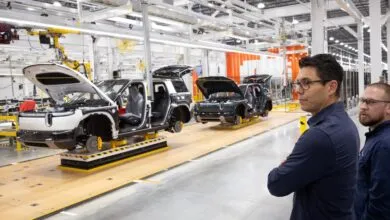
RJ Scaringe, Rivian’s CEO and the founder of Mind Robotics, continues to serve as acting CEO and chair of the new entity. Scaringe has explicitly stated his intention to keep the two companies distinct, rejecting the integrated model employed by Tesla. However, deep operational ties remain between the parent automaker and the spinoff. Mind Robotics utilizes AI training data generated by Rivian and plans to conduct initial tests within Rivian’s existing facilities. Furthermore, Rivian holds equity stakes in Mind Robotics and is slated to be the first commercial customer for its robotic systems.
Scaringe praised Field’s leadership capabilities and technical background in announcing the partnership.
“Doug is a remarkable leader with a track record of delivering new technologies in successful products, and I couldn’t be more excited to be building Mind with him,” Scaringe said in a statement. “He has an incredible ability to foster great teams that take on big, complex ideas and deliver products that reset expectations. That’s exactly what Mind needs as we deploy robots into real factories and beyond.”
Field expressed enthusiasm about tackling the engineering complexities involved in merging artificial intelligence with mechanical systems. He highlighted the unique opportunity provided by Rivian’s infrastructure as a critical advantage for the startup’s early development phase.
“Integrating AI and robotics is one of the most important,and difficult,engineering challenges of our time,” Field said in a statement. “Mind has assembled an exceptional team and has a unique advantage: the ability to deploy and learn inside a real, high-volume factory from day one. I’m thrilled to join RJ in building a team, culture, and technology that will redefine what we can make in America.”
(Source: The Verge)