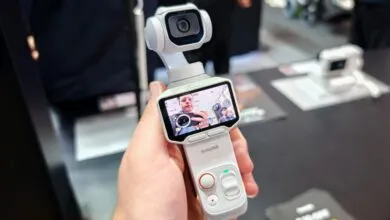
Insta360 Dominates 360 Cameras, Targets Smart Glasses Market

▼ Summary
– Insta360 is expanding its market presence by opening its first US flagship store in New York and aiming to become a top imaging tech company.
– The company plans to challenge major camera brands like Canon and Sony by developing experimental mirrorless cameras and smart glasses for content creators.
– Insta360 targets the gap between smartphone users and professional photographers, focusing on convenient high-quality capture rather than AI features.
– Founders Max Richter and JK Liu confirm that two new mirrorless cameras are in development with novel designs tailored for modern creators.
– While leading the 360-camera market, Insta360 holds a smaller share in handheld smart cameras compared to rival DJI but is diversifying into drones and gimbals.
Insta360, the dominant force in the 360-degree camera market, is leveraging its milestone of selling 10 million units to pivot toward a broader technological future. With the opening of its first flagship US store in Times Square, New York, the company is signaling ambitions that extend far beyond its current niche. Co-founder Max Richter outlines a vision to challenge industry giants like Canon, Sony, Nikon, and Fujifilm by evolving into a comprehensive imaging and tech enterprise. This expansion includes experimental development of mirrorless cameras and smart glasses, aiming to capture a segment of users who seek more than smartphone capabilities but do not require professional-grade equipment.
Bridging the Gap Between Smartphones and Pro Gear
The company’s strategy focuses on an underserved demographic: creators who want expressive, high-quality visuals without the complexity of traditional DSLRs. Richter emphasizes that Insta360 does not view smartphones as enemies but rather as part of a spectrum where their devices fill a specific void. “We don’t try to fight against the rise of the smartphone in photography and content creation,” says Richter. “We see that there’s an opportunity between smartphone users and professional cameras , a growing trend that people want to express themselves.”
This approach extends to potential wearable technology. While the company explores smart glasses, the focus remains on convenience and image quality rather than artificial intelligence assistants. Richter notes that such devices would prioritize capturing high-quality images over providing AI features, potentially avoiding privacy concerns by designing headgear that is visibly a camera rather than covert surveillance equipment. Although detailed reports on these glasses are scarce, founder JK Liu has confirmed that two new mirrorless cameras are already in development. One model promises a form factor that has “you have never thought of before,” according to Liu’s comments to MyNavi News. Liu became a billionaire following the company’s public listing last year.
Challenging DJI and Redefining Camera Categories
Insta360 is aggressively expanding into categories previously dominated by Chinese rival DJI. While the company holds a commanding 73 percent share of the 360-camera market, it is rapidly gaining ground in handheld smart cameras, action cams, and gimbals. According to IDC data from Q2 2026, Insta360 captured 43 percent of the detachable action camera market and 17 percent of non-detachable GoPro-style action cameras. Its newly launched Luna Ultra gimbal camera has already secured a 6 percent market share. In contrast, GoPro sits at number three with just 3 percent of the smart camera market, having seen shipments drop by half to 200,000 units in the same quarter.
The competitive landscape is shifting significantly. Traditional leader Canon shipped 4.5 million digital cameras last year, while DJI moved 4.3 million cameras in a single quarter. Insta360 aims to disrupt this status quo by creating devices tailored for a new generation of content creators. Richter explains, “When you think about mirrorless, for us it would really go into making it more convenient and making a camera that is really suited for a new generation of content creators, not necessarily what’s already out there on the market.”
AI Integration and Geopolitical Risks
A core component of Insta360’s long-term strategy is automating the creative process through AI. The founders envision their devices acting as a “robot cameraman” that understands user intent, handles motion, and performs editing automatically. The latest Insta360 X6 exemplifies this shift, featuring an onboard AI model capable of generating highlight reels while charging and utilizing an upgraded InstaFrame feature to track and frame subjects automatically. Additionally, the device supports one-tap creation of 3D Gaussian splats via the companion app, processing the heavy lifting on cloud servers for free up to four times per month.
Despite these innovations, Insta360 faces potential hurdles in the United States due to geopolitical tensions surrounding foreign technology. The company has already distanced itself from its drone brand, Antigravity, which was blocked from shipping future drones into the US. Regarding Insta360’s camera business, Richter states, “We remain on the ground. When it comes to drones, it’s not something that Insta360 is working on.” He expresses confidence in complying with local laws but acknowledges external risks. When asked about manufacturing products in the US to mitigate these risks, Richter indicated there are no current plans, though the company remains committed to the American market for the long haul.
(Source: The Verge)