Dyson Remains Silent on CameraJet Toothbrush Defects
▼ Summary
– Dyson recently unveiled the $499 CameraJet, a high-tech electric toothbrush featuring a camera aimed at targeting fluid streams between teeth.
– Despite a global launch event in Paris, the product was rapidly pulled from shelves in the US, UK, Singapore, and France due to widespread technical failures.
– Users reported critical issues including water leakage into battery compartments and device failures occurring within seconds of initial use.
– Dyson denies issuing a formal recall, attributing the product’s unavailability to strong global demand and ongoing production scaling efforts.
– The incident highlights potential risks in over-complicating simple consumer products with advanced technology like cameras and liquid reservoirs.
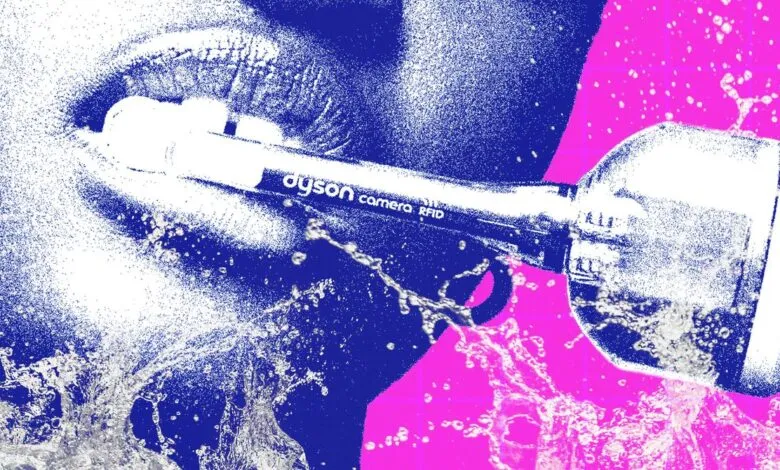
Dyson has abruptly pulled its high-tech CameraJet toothbrush from global shelves, leaving customers and retailers in the dark regarding the sudden disappearance of the $499 device. The removal comes just days after a tumultuous launch that highlighted significant engineering flaws, including reports of water leakage into battery compartments and rapid hardware failures. While the company maintains that this is a supply chain issue rather than a safety recall, the timing raises serious questions about the reliability of a product that promised to revolutionize oral care through advanced optics and fluid dynamics.
The concept of powered oral hygiene is not new. Although the first bristle toothbrush dates back to the Ming dynasty, the electric iteration did not emerge until 1937, when Tomlinson Moseley patented an early model. For decades, the Motodent served as the bridge between manual brushing and modern powered devices. Dyson recently attempted to leapfrog this established evolution with the CameraJet, a device that integrates a macro-lens camera and a reservoir for rinsing fluid. This technology, dubbed the “Gap Optical Targeting system,” was trained on 470,00 dental images to identify gaps between teeth within 100 milliseconds, directing streams of mouth rinse precisely where needed.
This ambitious project required six years of development, 38 patents, and substantial financial investment. Yet, the execution appears flawed. The device launched in US stores on September 8, but by September 9, users were already reporting catastrophic failures. Many units stopped working within 30 seconds of use, while others suffered from water ingress into the battery compartment. Consumer Reports noted that their review unit ceased functioning less than 24 hours after unboxing. By mid-September, retail presence had vanished across multiple regions. French outlet Numerama reported that the French Dyson site and physical stores had removed the item by September 11. Within four days, major markets including the US, UK, and Singapore, where Dyson’s headquarters are located, followed suit.
Despite the widespread withdrawal, Dyson officials have refused to characterize the situation as a product recall. Liv Thomas, the company’s head of Beauty Communications, told WIRED that the device remains available in theory, merely constrained by logistics. She stated that the CameraJet is “experiencing strong demand globally” and facing “shortages of supply as we are in the process of scaling up production.” According to Thomas, units will reappear in “the coming weeks.” This explanation stands in stark contrast to the technical issues plaguing early adopters, leaving consumers wondering whether the shortage masks deeper quality control problems or if the complex integration of cameras and liquid systems has proven too difficult to manufacture at scale.
(Source: Wired)