Enterprise Software Features Will Be Generated, Not Shipped
▼ Summary
– Enterprise software is shifting from static product backlogs to on-demand AI-generated features that execute specific user requests instantly.
– Unlike traditional retrieval methods like RAG that select existing evidence, this new approach computes new evidence by generating temporary programs tailored to the query.
– This paradigm allows users to obtain complex analytical results without writing code or waiting for product teams to build pre-defined reports.
– The system ensures security and governance by restricting generated code to approved capabilities and discarding it immediately after execution.
– This transition redefines the concept of a feature, moving from permanent software modules to transient, programmable contexts that solve immediate problems.
The End of the Feature Backlog
Enterprise software is undergoing a fundamental transformation in how functionality is delivered. We are moving away from the traditional model where product teams build features based on prioritized backlogs and ship them to users months later. Instead, we are entering an era of programmable context, where AI assistants generate specific tools on demand. In this new paradigm, a user describes a need, and the system instantly creates a small, ephemeral program to fulfill it. This shift eliminates the long wait times associated with custom development, allowing organizations to answer complex questions immediately rather than waiting for a permanent feature to be coded and deployed.
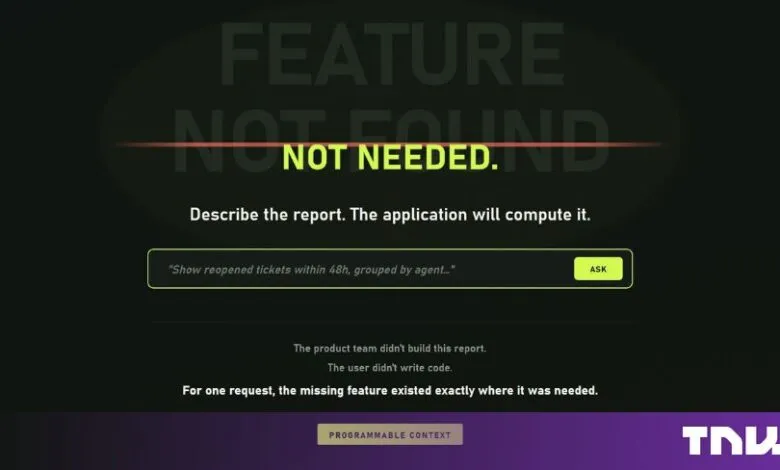
Consider a support team lead who needs to identify tickets that were resolved and then reopened within 48 hours, grouped by the agent who first closed them. Historically, this would require filing a request with the product team, enduring a lengthy prioritization process, and potentially receiving a late or incomplete solution. More recently, an AI might have directed her to export data and analyze it manually in a spreadsheet. Now, the assistant can generate a precise program that scans ticket records, cross-references resolution events with reopenings, and returns a grouped summary. The user never writes code, and the product team never builds a permanent report. For that specific task, the missing feature exists exactly where it is needed, generated and discarded seconds after use.
Beyond Retrieval: Computing New Evidence
This capability represents a significant leap beyond Retrieval-Augmented Generation (RAG). While RAG solved the problem of grounding answers in existing documents, it is limited to selecting evidence that already exists. Many enterprise queries cannot be answered by static artifacts; they require procedures such as filtering, joining, calculating, and summarizing across multiple sources. Questions like “Which expense reports exceed the department average by more than half?” or “Which deployments failed this week and last week, and what changed?” require computation, not just retrieval.
Programmable context closes this gap by translating user intent into temporary programs. The application executes these programs against approved capabilities and places only the computed result into the AI’s context window. This is not a general-purpose code interpreter with unrestricted access to the entire programming language. Instead, the application defines exactly which operations the generated code may call. The code may live for a single request, generating, executing, logging, and discarding itself in rapid succession. This approach allows systems to compute answers that the feature roadmap did not anticipate, providing dynamic solutions to unanticipated problems.
Client-Side Execution and Identity Management
The question of where generated code runs is critical for security and architecture. While server-side sandboxes are suitable for heavy computation, the browser offers a runtime that enterprise users already possess. Every enterprise web application ships a JavaScript engine to every logged-in user, enabling generated code to run without separate backend services or deployment steps. This client-side execution carries a major architectural advantage: the browser session already represents the signed-in user.
By giving generated JavaScript a narrow interface, such as `listTickets` or `getAgentStats`, each call travels to the backend using the current user’s delegated identity. This ensures that role-based and record-level rules governing the application’s screens also govern the generated computation. No separate service account with broader access is required. This design sidesteps a common agent architecture flaw where a central identity can see more data than the person asking the question. The program retrieves only records the current user is entitled to see, processes them locally, and sends a compact result to the model. This reduces both context usage and unnecessary data movement, creating a strategy where computation happens near the user under their specific identity.
Security Boundaries and Governance
Running code on the client does not make authorization automatic. A dangerous version of this concept would involve generating JavaScript and running it with `eval()` inside the main application page, granting full access to the DOM, browser storage, and outbound network. A safer path utilizes the `Function()` constructor, which compiles a string into a function that cannot capture the calling scope’s local variables. When combined with a sandboxed iframe or worker, this creates a practical execution boundary where the application hands the generated function only the capabilities it chooses.
A credible security design gives generated code capabilities, not credentials. Code should run in an isolated worker, sandboxed frame, or constrained runtime with no unrestricted access to the document, cookies, network, or filesystem. The application must expose a small set of typed, auditable operations, with reads being default and writes requiring separate grants. The runtime must enforce limits on execution time, memory, result size, and API call count. Every run should log the generated program, the requesting identity, capabilities invoked, and data provenance. Furthermore, permission to view a record does not imply permission to send it to any model endpoint. Before a computed result enters the context window, the application must apply its data-handling and model-eligibility policies. The principle is simple: let generated code compute, but never let it escape.
From Feature Catalogs to Computation Environments
Client-side JavaScript and server-side skills are two instances of the same emerging pattern. A reusable skill might contain a reviewed Python script for a recurring task, while an ephemeral program might be generated for one question and never run again. Product teams will still ship permanent features, and repeated computations should eventually graduate into built-in functionality. However, builders are now creating a governed execution surface from which unanticipated features can be assembled.
Users do not gain unconstrained access, nor do they become software engineers. They gain the ability to request computations the product team did not know to build, within boundaries deliberately designed by the engineering team. This is not yet standard practice, but every component is production-ready. Just as RAG allowed users to ask questions the interface did not anticipate, programmable context allows systems to compute answers the feature roadmap did not foresee. The support lead who needed to know which agents close tickets prematurely now has her answer, not because someone shipped a report, but because the application let her describe what she needed and computed it on the spot.
(Source: The Next Web)