British Space Startup Sends Longevity Lab to Orbit
▼ Summary
– A British startup, Mass Balance, launched a grapefruit-sized autonomous lab into orbit on a SpaceX transporter to study how live cells function under microgravity.
– The experiment aims to overcome Earth-based limitations like convection and sedimentation that muddy data collection in life sciences.
– Mass Balance hopes microgravity will enable better imaging of disordered proteins linked to age-related diseases like Alzheimer’s and Parkinson’s.
– The company plans to use space-generated data to train an AI model adapter that predicts how disordered proteins behave and respond to medicines.
– Unlike other biotech startups, Mass Balance does not plan to return its system to Earth, avoiding engineering challenges of re-entry.
Space is fast becoming the proving ground for the next wave of longevity breakthroughs. A British startup has launched a self-contained chemical laboratory into orbit, betting that zero-gravity data could unlock secrets about a class of disease-causing proteins that are notoriously difficult to study on Earth. Before that can happen, however, the company must first confirm its autonomous lab can survive and function in the harsh environment of space.
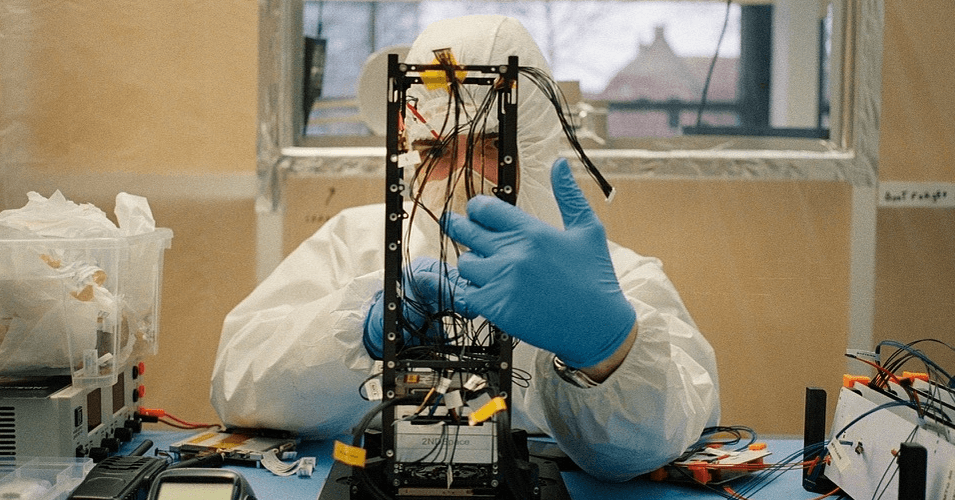
Mass Balance’s experiment, roughly the size of a grapefruit, blasted off aboard a SpaceX transporter on Tuesday morning. The device houses chemicals, sensors, and control elements designed to keep those chemicals active. Encased in a 10-centimeter (4-inch) pod built by Austrian firm Tumbleweed, the unit will circle the Earth for a couple of months, automatically measuring how live cells grow, react, and behave under weak gravity,and beaming that data back to the ground.
This is the first test of a system that Mass Balance hopes will yield high-quality data unobtainable on Earth. On our planet, stronger gravity introduces effects like convection, which influences heat flow, and sedimentation, where heavier compounds sink,both of which can muddy experimental results. Remove gravity, and those distortions vanish.
“When you take away gravity, a lot of weird and wonderful things happen, some of which will be very valuable for life sciences and pharma,” says Toby Call, co-founder and CEO of Mass Balance. “It sounds wild today, but the goal is really to make space boring, reliable, and just another research environment.”
That environment could prove critical for imaging disordered proteins, which are linked to age-related diseases such as Alzheimer’s, Parkinson’s, and certain cancers. On Earth, these proteins constantly shift shape, making them nearly impossible to capture clearly. This creates a blind spot in training data for life sciences models like Google’s AlphaFold, leaving them unable to predict how disordered proteins will behave,or how they might respond to medicines.
In microgravity, however, scientists believe some of these disease-driving proteins may become easier to study and analyze. Call plans to run tests on disordered proteins in orbit, generate data, and use it to train an AI model adapter that fills in those gaps. Revenue for the firm would come from licensing the model, selling data, and providing data access.
For now, the company is focused on validating its operating system and data-capture technology. Tuesday’s mission carries an industrial biocatalyst into space, which will break down another chemical compound. The platform will monitor the reaction using light to confirm everything proceeds as planned.
Mass Balance is not alone in this push. Several other biotech startups are racing to build orbiting laboratories. In May, British firm BioOrbit launched a test unit to grow ultra-pure, stable crystals that could be turned into injectable cancer medications. Meanwhile, American-owned Varda Space Industries is working on processing pharmaceuticals under microgravity. Unlike those two companies, Mass Balance does not intend to bring its system back to Earth intact. That decision spares it some of the biggest engineering headaches,namely, designing a satellite that can withstand the extreme heat and stress of re-entering Earth’s atmosphere.
“Microgravity is a new tool that is under-exploited,” Call says.
(Source: Wired)