Sam Altman Faces Another Legal Battle
▼ Summary
– Apple sued OpenAI in federal court, accusing three former employees of stealing trade secrets related to hardware operations for OpenAI’s benefit.
– The lawsuit claims former Apple VP Tang Tan allegedly solicited Apple hardware from prospective employees during interviews and coached them to bypass offboarding security.
– The legal action comes as OpenAI prepares for an IPO and plans to release a hardware device in 2027, following its $6.5 billion purchase of Jony Ive’s startup.
– Experts note the allegations are “run-of-the-mill” for trade secrets cases but unusual in their scale, involving multiple former employees and high-profile companies.
– The lawsuit marks a departure from the previous positive relationship between Apple and OpenAI, which had integrated ChatGPT into Apple devices in 2024.
OpenAI has spent much of this year tangled in legal disputes, including a high-profile battle with the world’s richest man. But last Friday, the company faced one of its most significant legal challenges yet , this time from Apple. At stake is OpenAI’s ambitious and expensive bet on hardware.
The lawsuit, filed in Northern California federal court, accuses former Apple employees of “stealing Apple’s trade secrets for the benefit of OpenAI.” The 41-page complaint emphasizes that Apple keeps its “product development, manufacturing, supply chain, technology research, and other innovations confidential,” calling the trade secrets tied to its hardware operations “one of the most valuable intellectual assets in all of American business.”
The allegations center on three former Apple employees: Tang Tan, former VP of Apple Watch who spent 24 years at Apple before becoming chief hardware officer at OpenAI (after OpenAI acquired Jony Ive’s hardware company, io); Chang Liu, a former systems electrical engineer for iPhone who left Apple after eight years for OpenAI; and Yu-Ting “Alyssa” Peng, another ex-Apple employee who also joined OpenAI. (Details on Peng’s Apple tenure remain scarce.) The lawsuit makes sweeping claims, including that Tan allegedly asked prospective employees to bring Apple hardware outside the office for “show and tell” during OpenAI interviews and coached Apple employees on how to bypass the company’s offboarding security procedures. It remains unclear which, if any, of Apple’s hardware-related trade secrets may have made it into OpenAI’s device, as the company has yet to publicly show a product.
Avery Williams, cochair of the trade secret practice area at McKool Smith and author of the firm’s AI Litigation Tracker, told The Verge that OpenAI’s legal troubles are far from over. “They’ve gotten sued a lot. [But] OpenAI is not going to be out of the woods until we get a ruling from a higher court on the fair use question for AI training. It’s a trillion-dollar question.”
This lawsuit adds to a turbulent six months for OpenAI, which has faced drama with rivals over US military red lines, protests over a government contract, a drawn-out legal battle with former co-founder Elon Musk, and a race with Anthropic over which frontier lab would IPO first. The list of lawsuits is long, including several from Musk himself. Another ongoing case was brought by the family of Adam Raine, a 16-year-old who died by suicide after confiding in ChatGPT. There is also the long-running suit from The New York Times and other publishers alleging copyright infringement.
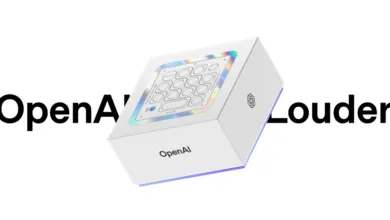
The timing of Apple’s lawsuit couldn’t be worse for OpenAI. The company is preparing to go public, having confidentially submitted a Form S-1 with the SEC last month. It faces investor pressure to turn a profit and has cut “side quests” to focus on key revenue drivers like enterprise and coding. Most critically, OpenAI is gearing up to release a much-hyped hardware device in 2027, after paying nearly $6.5 billion to acquire Jony Ive’s hardware startup, io (and handling yet another lawsuit from a company called Iyo). Apple may lag in AI, but it has always led in hardware, while OpenAI has the opposite reputation. As an industry refrain goes, “hardware is hard”; the graveyard of overhyped AI devices, like the Humane AI pin, is proof.
“The next frontier is going to be AI hardware, more than just chips … Robotics and other types of physical AI is the next area that is ripe for disruption,” said Charlyn Ho, CEO and founder of Rikka Law Group, a law firm focusing on tech, privacy, and cybersecurity law. “It’s kind of interesting to see OpenAI … going into that play, because maybe they’re seeing [that] just the pure software play is not profitable.” She added, “They’re a frontier lab. They’re spending more money than they’re making at the moment.”
It makes sense that OpenAI would hire to fill hardware gaps and speed up progress. But that strategy has now led to what will likely be a costly legal battle.
“It’s never fantastic to get sued by Apple when you’re trying to IPO,” said Williams. “Apple is a tenacious litigant … They do not tend to back down.”
OpenAI did not respond to a request for comment.
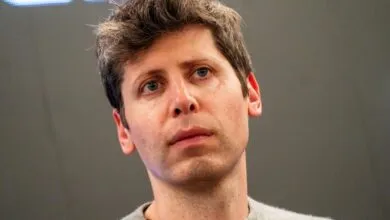
Over the weekend, one X user wrote, “Sam Altman wasn’t afraid of Elon but he is terrified of Apple. You can tell by all his posting today.” Altman replied, “i am not afraid of apple, but i have tremendous respect for them. s-tier company.”
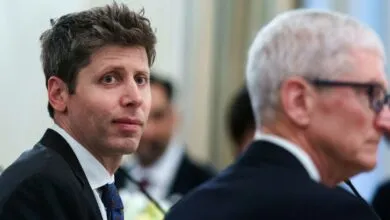
Apple and OpenAI have had a relatively positive public relationship; in 2024, they entered an agreement to integrate ChatGPT into Apple devices. This lawsuit marks a significant shift. “Apple and OpenAI have been on the same side … As the industry gets more and more competitive, you’re starting to see these alliances fracture,” said Ho.
Although Apple’s lawsuit made headlines, most experts The Verge spoke with said the allegations were not particularly unusual , what stood out was that they all appeared in the same case and involved two major players. Trade secrets lawsuits can be tough to prove in court, since unlike copyright or trademark cases, you are not typically comparing one thing directly against another. Haibing Lu, professor of information systems and analytics at Santa Clara University’s Leavey School of Business, said Apple’s allegations are “not unique” and “it’s quite common in Silicon Valley.” Williams called the case a “run-of-the-mill trade secrets misappropriations claim.”
“This isn’t really an AI case as it is a case against an AI company,” Williams continued. “The players are huge, but the allegations are otherwise not unusual.”
For Michael Barnhart, a nation-state threat researcher at cybersecurity firm DTEX, “the layered approach” of the allegations made Apple’s lawsuit interesting: hiring-stage extraction, interview-based solicitation, internal collusion. It is “very run-of-the-mill in terms of insider threats and this is how they act,” he said. But at the same time, “We can sit there and I’ll pull up a company that did one of these things badly … You’ll have one, you’ll have two, you’ll have three , this one’s got all of them. This one has so many. And also, too, at the highest level.”
It is somewhat ironic that in an industry built on consuming vast amounts of data , whether legally or not , AI labs become especially litigious when others take information elsewhere. The AI industry is a small, cliquish world. Anthropic was founded by ex-OpenAI executives, xAI by an ex-OpenAI cofounder, and countless startups have been acquired or their talent acqui-hired by former employers or competitors. Many of the most influential people at every leading AI company once worked closely with rivals at another company, and many likely will again.
But that irony applies across recent decades. Yes, Anthropic allegedly scanned millions of copyrighted books to train its models, but the pre-generative AI tech industry spent decades in similar controversies: Google scanning millions of books for a searchable database, or the piracy YouTube indirectly enabled in the early 2000s.
Apple implied in its legal filing that significantly more former employees left for OpenAI with key information than it named. The company said it had “uncovered a pattern of theft of Apple’s trade secrets by OpenAI employees who were formerly at Apple” and that “this is the tip of the iceberg … At every level, from members of its Technical Staff to its Chief Hardware Officer, and in coordination with business partners, OpenAI has been stealing Apple’s trade secrets and confidential information.”
Alex Terepka, a founding partner of Watstein Terepka LLP, said the case is likely to be contentious and drawn out, potentially over years. “Apple and OpenAI are going to be in this for the long haul,” he said. “What Apple’s put together here is frankly way more than enough to survive a motion to dismiss. Then you’re going to get into discovery, which in these types of cases can be super involved.”
The software side of the AI industry has generated immense hype, competition, and controversy, but hardware is the next frontier AI companies aim to conquer. Since AI devices have not yet been tested at scale, it will take time to see what success looks like , especially with a potential yearslong legal battle between Apple and OpenAI ahead.
(Source: The Verge)