Nvidia unveils RTX Spark, calling it the most efficient PC chip ever
▼ Summary
– Nvidia announces the RTX Spark, a family of Arm-based PC chips for laptops and mini-PCs, marking its entry as a consumer PC chipmaker competing with Intel, AMD, Apple, and Qualcomm.
– The flagship RTX Spark chip matches the DGX Spark’s specs with 20 CPU cores, 6,144 GPU cores, and up to 128GB of unified memory, while lower-end versions with as little as 16GB RAM will follow.
– Nvidia claims RTX Spark laptops can render 90GB 3D scenes, edit 12K video, and run demanding games at 100fps at 1440p, all in a thin 14mm design without a power cord.
– The chip enables local AI agents for tasks like automating streaming, design, or software development, with Nvidia emphasizing data privacy and no token costs.
– Major laptop vendors, including Microsoft with its Surface Laptop Ultra, have signed on for over 30 laptops and 10 desktops launching this fall at premium prices, though Nvidia did not provide performance benchmarks or battery life specifics.
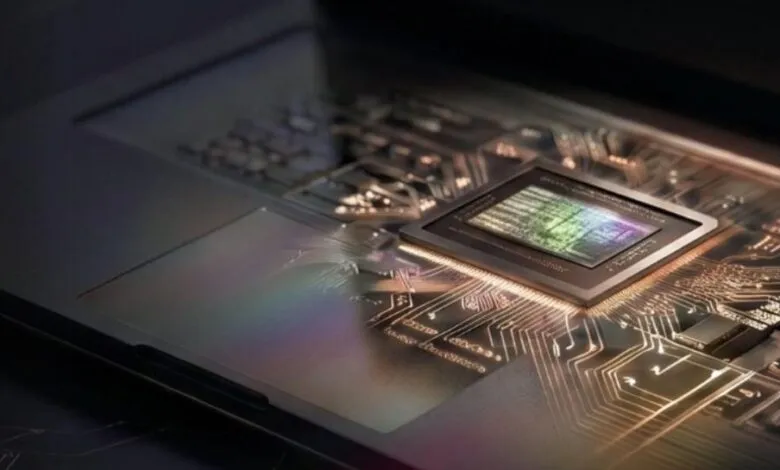
This fall, Nvidia is stepping into a new arena, joining the ranks of Intel, AMD, Apple, and Qualcomm by placing a complete computing chip,not just graphics hardware,at the core of laptops and mini-PCs. After months of speculation, the company has officially announced the RTX Spark, the first in a chip family that it claims will match or surpass the most powerful thin-and-light Windows machines ever made.
“This is the most efficient PC chip ever built,” asserts Mark Aevermann, Nvidia’s senior director of product management, though he offered no statistics or charts to support the statement.
The RTX Spark is essentially the same GB10 chip found inside the DGX Spark, Nvidia’s tiny “personal AI supercomputer” released last year. The flagship version appears identical in specs, featuring 20 CPU cores, 6,144 GPU cores, and 128GB of LPDDR5X memory. Nvidia confirms that lower-tier versions with as little as 16GB of RAM will follow, targeting more affordable price points.
Like the chips from Apple and Qualcomm, this Arm-based silicon means legacy Windows software built for Intel and AMD’s x86 processors must run through an emulation layer, which can reduce performance. However, Microsoft has spent years refining Windows and its Prism emulator for Qualcomm and now Nvidia chips. Nvidia believes its graphics and AI expertise will push the concept further than ever before.
With the RTX Spark, Nvidia claims users can render a 90GB 3D scene, edit 12K resolution video, or play graphically demanding titles like Indiana Jones and the Great Circle at a smooth 100fps at 1440p resolution,all from a 14mm thick laptop running on battery power. With up to 128GB of unified memory, matching AMD’s previous-gen Strix Halo parts, an RTX Spark system can also host 120-billion-parameter AI agents. Microsoft appears enthusiastic about this capability for Windows, planning to showcase “new Windows security and containment primitives” at its Build conference, which, combined with Nvidia’s OpenShell runtime, “allows personal agents to run safely and under full user control.”
Nvidia envisions this as “a new personal computing paradigm where AI is the UX,” suggesting users will no longer need to master complicated app interfaces, instead simply talking to their PCs. For example, an esports streamer could instruct their machine to automatically turn off lights, mute the microphone, and switch broadcasting modes when stepping away. A designer could ask Adobe to turn a sketch into a full image, render a 3D model, and create an AI video. A developer could monitor GitHub projects and autonomously fix QA issues, with the AI agent taking over the keyboard and mouse for repetitive tasks. Nvidia emphasizes that local AI processing keeps data private and avoids burning through tokens.
While it’s unclear if Nvidia has truly created a Star Trek-level computer, the company has secured broad industry support. Almost every major laptop vendor is on board, with eight specific models confirmed for this fall: Asus ProArt P14 and P16, Dell XPS 16, HP OmniBook X14 and Ultra 16, Lenovo Yoga Pro 9N, Microsoft Surface Laptop Ultra, and MSI Prestige N16 Flip AI. Microsoft’s Surface boss Andrew Hill calls the new Surface Laptop Ultra “the most powerful thing we’ve ever made.”
These machines are just the beginning. Aevermann says partners are already developing over 30 laptops and over 10 desktops, with Acer, Asus, Dell, Gigabyte, HP, MSI, and Lenovo all participating. “RTX Spark is going to be a family of products that are going to attack a lot of different price points,” he promises. “The overall market opportunity that we see is quite large.”
A wide range of Windows developers are also embracing Arm. Nvidia notes that “Blender, DaVinci Resolve, Maxon Cinema4D, Maxon Redshift, Topaz Photo, CapCut, Cubase, Bitwig Studio, Affinity by Canva and more all run natively on Arm today.” Adobe is on board with special optimizations for Premiere and Photoshop. Even games with anti-cheat systems that previously rejected Linux and the Steam Deck are now supporting Windows on Arm. Riot Games is bringing League of Legends and Valorant, Krafton is bringing PUBG, and Nvidia is working with developers using Easy Anti-Cheat, BattlEye, and Denuvo. Aevermann claims “all the top games will run on RTX Spark and provide a great experience.”
Many questions remain unanswered. Neither Nvidia nor Microsoft provided clear pricing, though the first batch this fall is “targeting the more premium price points.” On battery life, Aevermann says to “expect it to be much better than anything you’ve seen before on RTX laptops,” adding that “you won’t need a charger” for light workloads. The chip scales from “low, low single-digit” wattage up to 80 watts, which could theoretically drain larger laptop batteries in about an hour at full power.
Nvidia offered no performance statistics or comparisons against Intel, AMD, Apple, or Qualcomm, promising more details closer to launch. However, Aevermann indicated that the chip has roughly the graphical power of an RTX 5070 mobile GPU and that the CPU portion should be “competitive with anything else out there in the Windows space.” The company declined to comment on whether these chips, made on the TSMC 3 process in partnership with MediaTek, are manufactured in the US or abroad. It also wouldn’t discuss Linux driver support or the possibility of putting the Spark in gaming handhelds. Notably, Nvidia confirmed that the RTX Spark will not be paired with additional discrete GPUs, potentially limiting its desktop potential in the same way Apple’s Mac Pro was constrained.
Perhaps it doesn’t matter that Nvidia is withholding proof. In 2020, Apple offered no evidence when announcing Apple Silicon, but the M1 chip arrived and fundamentally reshaped laptop performance expectations.
(Source: The Verge)