Syntiant files for US IPO, betting edge AI will lure public markets
▼ Summary
– Syntiant, a chipmaker specializing in low-power edge AI processors that run on devices rather than in the cloud, filed for an IPO on July 6 to list on the Nasdaq under the ticker SYTN.
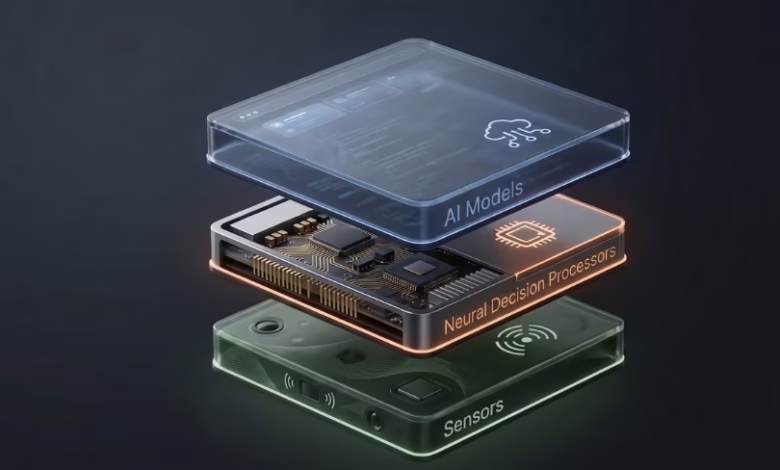
– The company’s “physical AI” platform integrates processors, sensors, and software to enable real-time sensing and decision-making on battery-powered devices like earbuds, cars, and robots, reducing latency and privacy risks.
– For the first quarter of fiscal 2026, Syntiant reported revenue of $64.5 million, down from $66.6 million year-over-year, and a net loss widening to $26.2 million from $16.8 million.
– Syntiant has raised $311 million to date, with major backers including Intel, Microsoft, and the Amazon Alexa Fund, and recently acquired Knowles’ MEMS microphone business for vertical integration.
– The IPO terms are undisclosed, with proceeds potentially used for debt repayment or acquisitions, and founders will retain majority voting power through Class B shares.
Syntiant, a chipmaker specializing in low-power processors that run artificial intelligence directly on devices instead of in the cloud, has filed for a U.S. initial public offering. The Irvine, California-based company submitted its Form S-1 to the Securities and Exchange Commission on July 6, with plans to list Class A shares on the Nasdaq Global Market under the ticker SYTN. This move positions Syntiant to test public market appetite for edge AI technology, a niche within the semiconductor industry focused on enabling real-time, on-device intelligence.
The company operates in the edge AI segment of the semiconductor business, designing tiny, always-on chips alongside the software needed to operate them. Its processors are embedded in earbuds, wearables, cars, drones, robots, and industrial machinery, where they sense surroundings and act locally without sending data to a remote data center. Syntiant describes this as “physical AI,” a full-stack platform of processors, sensors, and software built to sense, decide, and act in real time on battery power. Keeping voice and vision workloads on the device reduces power consumption and latency while avoiding some privacy concerns tied to streaming audio to a server.
The terms of the offering remain undecided. Syntiant has not disclosed how many shares it will sell or a price range, noting that the size and timing depend on market conditions and SEC review. The company has not indicated how much it hopes to raise, and a listing is expected later this year, though no date is set.
The filing reveals revenue of $64.5 million for the first quarter of fiscal 2026, down from $66.6 million a year earlier. Net loss widened to $26.2 million over the same three months, compared to $16.8 million, though a separate line cited a narrower loss of $20.9 million attributable to the company after minority interests.
Syntiant enters a crowded field. Competitors like Qualcomm, Ambarella, and a wave of startups are chasing the same low-power inference market, where demand for silicon that keeps AI on the device rather than in a data center has become a major industry theme.
The company has raised $311 million to date, most recently in December 2024 at a valuation of roughly $646 million. Microsoft led a $35 million round in the startup back in 2020. Its largest holders, each with 5% or more, include Intel, Microsoft, and Knowles, with a broader backer list including Intel Capital, Microsoft’s M12, the Amazon Alexa Fund, Bosch Ventures, and Applied Ventures.
In December, Syntiant closed a $150 million purchase of Knowles’ consumer MEMS microphone business, a deal that added audio-sensing hardware to its platform and brought factories in China and Malaysia. This acquisition gave Syntiant its own microphones to pair with its inference chips, a rare instance of vertical integration in a market where most rivals buy their sensors externally. The company says more than 100 million of its processors have shipped across consumer, industrial, and automotive products.
Recent weeks have brought fresh partnerships, including a tie-up with sensor maker Partron on on-sensor AI for healthcare, robotics, and automotive uses, part of a push to embed its chips deeper into hardware supply chains. Syntiant counts consumer-electronics brands and carmakers among its customers, though it has named few of them publicly.
Citigroup, BofA Securities, and UBS Investment Bank are joint lead book-running managers, with Needham, Stifel, Cantor, and KeyBanc among the additional bookrunners. Syntiant said it may use proceeds to repay debt, fund further acquisitions, and for general corporate purposes.
Founders will retain majority voting power after the float through super-voting Class B stock, led by chief executive Kurt Busch, who co-founded the firm in 2017. The filing arrives as chip and AI names crowd the IPO queue, with memory maker SK hynix seeking $28 billion the same day, humanoid robot builder EngineAI heading for Hong Kong, and Cerebras already trading.
(Source: The Next Web)