Nearfield Instruments lands record $380M chip funding
▼ Summary
– Nearfield Instruments raised $380mn in a Series D round at a $1.6bn valuation, the largest deep-tech round in Dutch history.
– The company builds atomic force microscopes that inspect chips at the atomic scale, measuring nanometre-level features without damaging the chip.
– Sovereign wealth funds, including Singapore’s Temasek and the Qatar Investment Authority, participated in the round, signaling a strategic bet on critical semiconductor infrastructure.
– Nearfield is part of a growing Dutch chip cluster anchored by ASML, with other startups like Axelera AI and Invisix attacking different layers of chip production.
– The funding will be used to expand production capacity, support centers, and joint R&D, as demand for nanometre-scale metrology grows with AI-driven chip complexity.
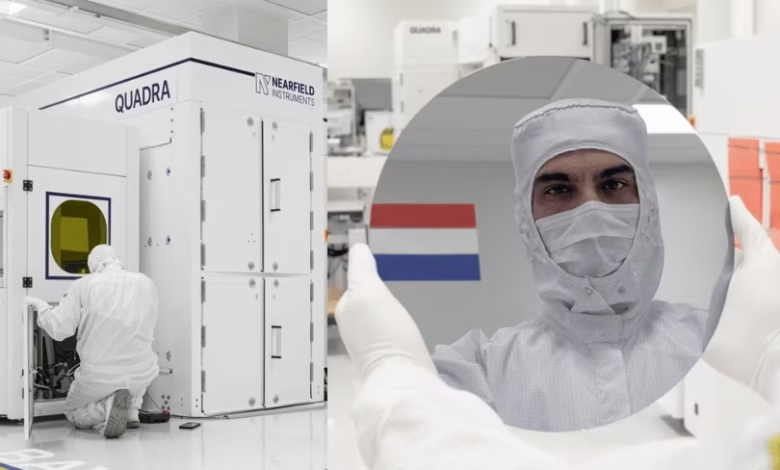
A Rotterdam-based company that builds atomic-scale inspection tools for semiconductors has just closed what is now the largest deep-tech funding round in Dutch history, raising $380 million at a $1.6 billion valuation. Sovereign wealth funds from Singapore and Qatar are among the investors, signaling that this is not just a financial bet but a strategic play for critical chip infrastructure.
The global AI chip boom has familiar titans: Nvidia designs the processors, TSMC manufactures them, and ASML provides the lithography machines. Nearfield Instruments, however, operates in a less visible but increasingly vital niche. The firm specializes in atomic force microscopy, a metrology technique where a fine probe drags across a chip’s surface to measure features only a few atoms tall. It is the semiconductor equivalent of a needle reading a vinyl record, but at a scale where precision means the difference between a working processor and a defective one.
As chips grow more complex, with High-NA EUV lithography, gate-all-around transistors, and 3D-stacked architectures, the ability to inspect these structures at volume has become a bottleneck. Nearfield’s QUADRA platform can image deep trenches and layered stacks that traditional optical and electron-beam tools struggle to resolve without damaging the silicon. This capability is why the company’s Series D round was oversubscribed.
The investor list reads like a who’s who of sovereign and strategic capital. Fidelity led the round, joined by Singapore’s Temasek, the Qatar Investment Authority, Walden Catalyst Ventures, Innovation Industries, M&G Investments, and the Dutch state fund Invest-NL. Sovereign wealth funds rarely cluster around an early-stage company by accident. Their presence reflects a bet on infrastructure that is becoming as critical as the chip itself.
One detail underscores the stakes: Walden Catalyst is the firm where Intel CEO Lip-Bu Tan serves as a founding managing partner.
Nearfield is not an isolated success. It sits within a fast-growing Dutch semiconductor cluster anchored by ASML. Around the lithography giant, a wave of startups is attacking different layers of the supply chain. Axelera AI builds low-power edge AI chips. Invisix, an ASML spinout, uses soft X-rays to spot manufacturing defects. Together, they resemble an emerging industrial strategy rather than scattered bets.
Many of these companies trace their origins to TNO, the national research institute that spun out Nearfield in 2016. That pipeline from lab to company is something most of Europe struggles to replicate.
The timing of this funding is no coincidence. As AI scaling demands ever more complex chips, the metrology market was worth roughly $10.3 billion in 2025 and could reach $15 billion by 2031, according to one estimate. Nearfield’s tools directly support the cutting edge. Its larger rival, KLA, dominates the market today, but the new funding will go toward production capacity, support centers, and joint R&D with chipmakers.
Nearfield now employs about 450 people across Taiwan, South Korea, Japan, Singapore, the United States, and Belgium. Just a year ago, it raised $148 million. This round more than doubles that.
The open question is whether Dutch challengers can hold their lead against larger American and Asian incumbents. But a $380 million round anchored by sovereign funds and aimed at a chip-inspection firm in Rotterdam is not a coincidence. It is part of Europe’s broader push for semiconductor sovereignty.
(Source: The Next Web)