Flagright secures $12.5M to fight financial crime with AI
▼ Summary
– Flagright was founded by Baran Ozkan after he failed to find or build a single tool to catch money laundering and fraud at a bank; the startup has raised a $12.5mn Series A led by Infinity Ventures.
– Flagright’s platform combines transaction monitoring, watchlist screening, risk scoring, case management, and investigations into one AI system, replacing legacy bank systems and separate tools.
– The AI is “explainable,” with auditable agents and human oversight, to meet regulatory requirements; clients report up to 93% fewer false positives.
– Banks face rising transaction volumes and AI-driven fraud, with global losses estimated at $442bn by Interpol, driving investment in compliance AI.
– Flagright, with ~40 staff and over 100 clients, competes with incumbents like NICE Actimize, betting its generative AI-first approach gives it an edge as older players bolt AI onto legacy systems.
Baran Ozkan spent 15 months searching for a piece of software that simply did not exist. As head of financial-crime product at a European bank, he needed a single tool capable of detecting both money laundering and fraud. Vendors made grand promises they could not keep. His own employer attempted to build the solution in-house and ultimately failed.
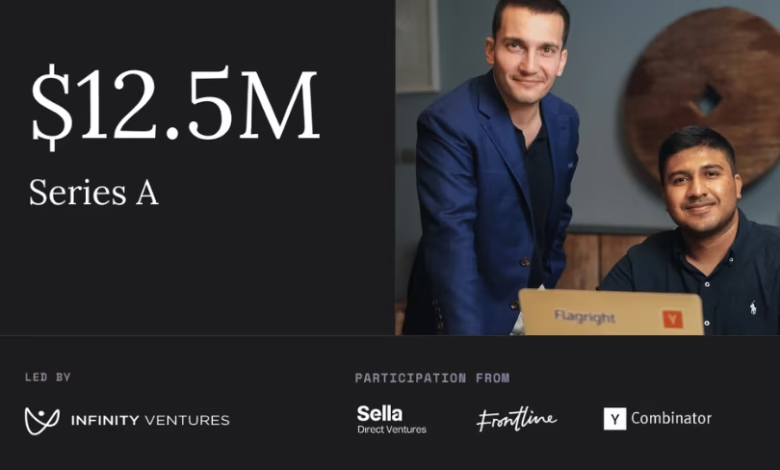
So he decided to build it himself. His company, Flagright, has now secured a $12.5 million Series A funding round led by Infinity Ventures, a San Francisco-based fund whose partners previously managed deals at PayPal. Sella Direct Ventures joined as a new investor, alongside existing supporters Frontline Ventures and Y Combinator.
Flagright positions itself as the AI operating system for financial-crime compliance. In simpler terms, it aims to replace two things at once: the legacy systems that banks have relied on for years and the disjointed collection of separate tools layered on top of them.
The platform consolidates transaction monitoring, watchlist screening, risk scoring, case management, and investigations into a single system. When a payment moves through a customer’s infrastructure, Flagright checks it in real time for signs of fraud, money laundering, and sanctions risk. It then delivers a result that compliance teams can clearly explain to regulators.
That final point is crucial. Banks will not deploy a black box. Flagright emphasizes “explainable” AI, using auditable agents and keeping human oversight in the loop. Clients who replace older tools report up to 93 percent fewer false positives, according to the company.
The timing works in Flagright’s favor. Banks face pressure from two directions: a rising volume of transactions to monitor and criminals using AI to industrialize fraud. Interpol estimates global fraud losses at $442 billion and notes that AI makes the crime far more profitable. Defenders are now fighting back with their own AI, and investors are pouring money into the space. Recent examples include Behavox’s $175 million raise and a wave of startups automating regulated back-office tasks. The financial-crime compliance market was valued at roughly $26.5 billion in 2025 and could nearly triple by 2034, according to one projection.
Flagright remains a small player: about 40 employees, offices in London, San Francisco, and Singapore, and more than 100 banks and fintechs across over 30 countries. It competes against deep-pocketed incumbents such as NICE Actimize, Feedzai, and ComplyAdvantage.
Ozkan’s argument hinges on timing. Older players are bolting generative AI onto outdated systems, he contends, while Flagright was built on the technology from day one. “We are the oldest company for generative AI technology in financial crime,” he claims. It is an unusual boast for a three-year-old startup, but it captures just how slowly the industry moved before now.
The fresh funding will go toward sharpening the AI and expanding into the U. S. market. The real challenge is whether a 40-person startup can set the standard before the giants catch up.
(Source: The Next Web)