Barcelona’s THEKER raises €73M for AI robots that learn on the job
▼ Summary
– THEKER raised €73 million in Series A funding led by CRV, with participation from Samsung and LVMH, marking their first investments in a Spanish startup.
– The company builds AI-native, generalist factory robots that adapt in real time without manual reprogramming, deploying in days and learning continuously in production.
– The robots are already operating in European manufacturing, logistics, and retail environments, aiming to increase throughput and reduce labor shortages.
– The funding will deepen THEKER’s proprietary AI and robotics stack and expand its team across software, electronics, and engineering.
– The round follows Spain’s largest-ever seed round and signals growing European robotics investment, with THEKER focusing on real commercial deployment rather than lab pilots.
Barcelona-based THEKER has secured €73 million ($85 million) in Series A funding to scale its AI-native factory robots that learn and adapt on the job across industrial environments. The round was led by CRV, with notable participation from Samsung, LVMH, Cathay Innovation, 20VC, Henkel Ventures, Korelya, and Bright Pixel Capital. This investment marks several firsts: Samsung’s initial foray into a Spanish company, LVMH’s first bet on Spain’s startup ecosystem, and CRV’s debut investment in the country.
The funding arrives less than a year after THEKER closed Spain’s largest-ever seed round at €18 million. The rapid progression from seed to Series A underscores what the company describes as genuine commercial deployment momentum, moving beyond mere laboratory demonstrations.
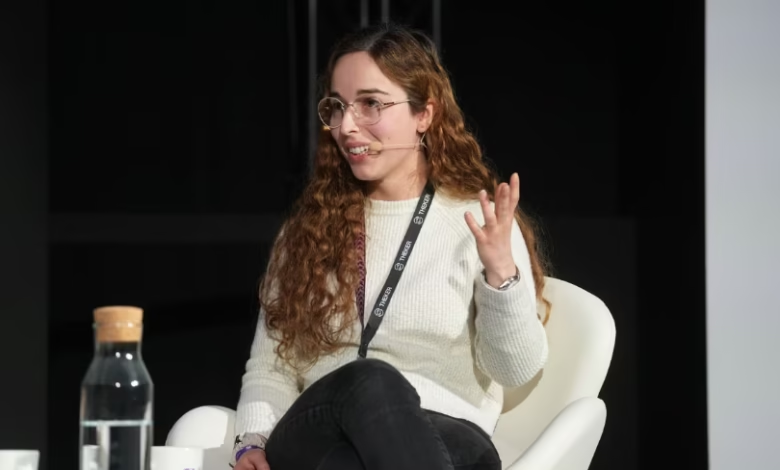
“We didn’t build THEKER to run pilots,” said co-founder Carla Gómez Cano. “We built it to ship robots that work the day they arrive and continue improving every day after.”
THEKER’s core innovation is a new category of industrial robot: AI-native, generalist machines that adapt in real time to changing environments, mixed SKUs, irregular shapes, and operational variability without requiring manual reprogramming. In contrast to traditional industrial robots, which are rigid and costly to reconfigure, THEKER claims its systems can be deployed in days and continuously learn while in production.
These robots are already operating within live production environments across Europe, targeting sectors like manufacturing, logistics, and retail. The company reports they help operators boost throughput, cut downtime, and address persistent labor shortages.
Founded by Gómez Cano and Jiaqiang Ye Zhu, THEKER integrates advanced vision, control systems, and large language models into robots that function without pre-programmed instructions. The new funding will be used to deepen its proprietary AI and robotics stack, as well as expand the team across software, electronics, mechanical engineering, and deployment roles.
“What Carla, Jiaqiang and the team have built is exceptionally rare, a deeply technical platform paired with real commercial deployment momentum,” said Reid Christian, general partner at CRV. “We believe THEKER has the potential to become one of the defining robotics companies of this generation.”
This round aligns with a broader wave of European robotics funding in 2026. Germany’s RobCo raised €100 million for modular AI-driven manufacturing systems, Stuttgart-based Sereact secured €93 million to scale its physical AI platform into the US, and NEURA Robotics attracted up to $1.4 billion in the largest full-stack robotics round ever. While THEKER’s raise is smaller, it carries a distinctive signal: Samsung and LVMH, two of the world’s largest industrial and luxury conglomerates, are making their first Spanish startup investments in a robotics company rather than a software firm.
The gap between research demonstrations and robots that function reliably in real factories is where most robotics companies stumble. THEKER claims to have bridged that divide. Whether its robots perform as advertised at scale, across diverse industries and geographies, is the question the €73 million is designed to answer. Factory trials in Germany by Siemens and Nvidia have shown that industrial deployment is achievable. THEKER is betting Barcelona can lead the charge.
(Source: The Next Web)