Anthropic President Dismisses AI Return Doubts Ahead of IPO
▼ Summary
– Anthropic has confidentially filed for an IPO after its $65 billion private fundraise at a $965 billion valuation was oversubscribed due to strong investor demand.
– Co-founder Daniela Amodei cited the need for capital to cover high training and inference costs as the reason for pursuing a public listing.
– Anthropic’s annualized revenue grew to $47 billion in May, up from $9 billion at the end of 2025, though corporate AI spending may slow if returns prove unproductive.
– Amodei believes businesses are still early in adopting AI effectively, with use cases in coding, finance, legal, and healthcare expected to drive future value.
– Unlike rivals, Anthropic avoids building its own data centers to prevent overextending on compute, recently partnering with xAI for capacity at $1.25 billion per month.
Private investors have been scrambling for a stake in Anthropic as the AI developer experiences explosive growth. Multiple sources told TechCrunch that the company’s recent $65 billion funding round, announced last week at a staggering $965 billion valuation, was heavily oversubscribed. With private demand still surging, Anthropic has now confirmed it is moving toward a public listing, having filed confidentially for an IPO.
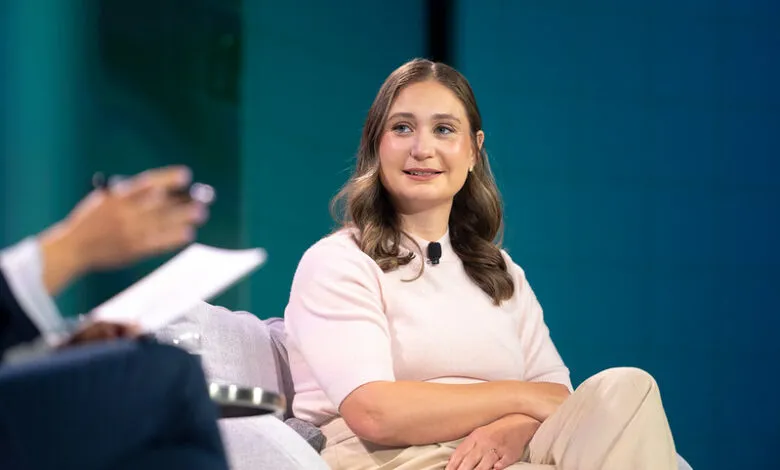
Co-founder Daniela Amodei, speaking at the Bloomberg Tech conference on Thursday, explained that the move is driven by capital needs. “It’s a really big upfront cost to train the models and to serve inference on them,” she said. “My guess is that over time, the sort of core set of companies that are working to advance the frontier are just going to need access to capital, and I think the public market is very well suited to that.”
Anthropic’s growth has been nothing short of remarkable. The company reported that annualized revenue crossed $47 billion in May, a dramatic leap from roughly $9 billion at the end of 2025. However, this trajectory faces a significant test. Companies like Uber have noted that while AI can generate returns, not all of their AI spending has been productive, raising concerns that corporations might start tightening those budgets and slowing sector-wide growth.
Amodei remains unfazed, arguing that businesses are still in the early stages of learning how to effectively deploy AI.
“The use cases today, I expect will continue to be the primary driver of efficiency or creativity, whether that’s coding, financial services, legal, [or] health care,” she said. “But as the business community gets more familiar with the tools, we’re all going to learn together. My hope is that over time it’ll be more incorporated into the day-to-day of how humans do our work, and there will actually be a lot more value realized.”
Amodei also addressed why Anthropic, unlike rivals OpenAI and Elon Musk’s xAI, is not building its own data centers to meet growing compute demands.
“Anthropic’s view has always been wanting to plan for the best outcome but not overextend ourselves such that we’re buying more compute than we could productively use,” she said. “It’s really hard to predict that perfectly. We would much prefer to be on the side of having a little bit more demand for the product than we’re able to serve than the inverse.”
Last month, the company surprised the AI industry by partnering with xAI for compute capacity. A deal later disclosed in SpaceX’s S-1 filing revealed that it will cost Anthropic $1.25 billion per month.
(Source: TechCrunch)