Vučić flies to Beijing for $1.1B deal as Belgrade protests escalate
▼ Summary
– China signed a $1.1 billion investment package with Serbia for AI, robotics, and EV manufacturing, days after 34,000 protesters in Belgrade demanded early elections and accountability for a deadly railway station collapse.
– The Serbian government, facing the largest protest movement in decades, is using the deal to demonstrate it has strategic options beyond the European Union.
– The investment shifts Chinese Belt and Road projects from infrastructure like highways to advanced technology, creating deep dependencies on Chinese hardware, software, and standards that are difficult to reverse.
– The EU has failed to develop a coherent response, with its accession framework and tech policies not applied to candidate-country technology partnerships with China.
– The Chinese investment strengthens patronage networks and reduces leverage for future reform, making the protesters’ domestic demands for rule of law harder to achieve.
Just days after more than 34,000 demonstrators flooded Belgrade demanding early elections and accountability for a deadly railway disaster, President Aleksandar Vučić was in Beijing signing a $1.1 billion Chinese investment package focused on AI, robotics, and electric vehicles. The timing sends a clear signal that Serbia’s strategic future does not hinge solely on Brussels.
The protest on Saturday saw an estimated 34,300 people fill the capital’s center, fueled by the November 2024 Novi Sad railway station collapse that killed 16 people. The country’s student movement, now 18 months into its campaign, is calling for an end to what it terms state capture. Riot police used pepper spray on demonstrators, and the state railway canceled all trains to and from Belgrade to prevent more protesters from arriving. Vučić responded by blaming “foreign powers.”
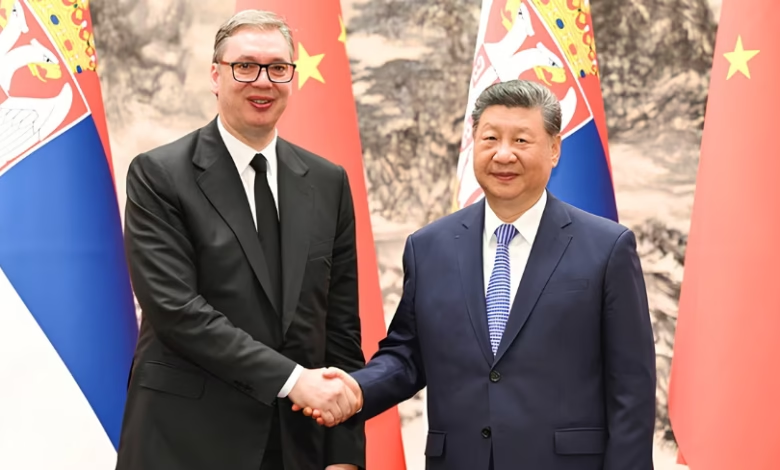
Three days later, he stood alongside Xi Jinping in Beijing, signing over 20 cooperation agreements. The centerpiece is a $1.1 billion Chinese investment covering artificial intelligence infrastructure, robotics joint ventures, and EV manufacturing capacity on Serbian soil. This builds on a $1.5 billion highway contract already underway with Shandong Hi-Speed Group, various defense-adjacent partnerships, and a Huawei telecoms footprint that has quietly embedded itself in Serbian state infrastructure for nearly a decade.
The sequence is deliberate. Facing the largest sustained protest movement in post-Milošević history, the government is using this moment to demonstrate that its options extend beyond the EU. Serbia is an official EU candidate state, and the accession framework gives Brussels formal leverage over judicial independence, media freedom, electoral integrity, and the kind of third-country technology dependency this deal creates. Yet those levers have produced a steady drift in the wrong direction.
The student movement’s grievances mirror what the European Commission’s own annual rule-of-law reports have flagged for years. The Sino-Serbian strategic corridor has been visibly forming since 2023. Brussels has noticed both trends and acted on neither.
What makes 2026 different from 2023 is the technology dimension. Earlier Belt and Road investments were mostly bricks: highways, ports, and power stations. This year’s package is silicon, sensors, and software. It aligns with Beijing’s policy focus on “new productive forces”, the deliberate consolidation of AI, robotics, EVs, and green-tech as the export-led growth bet for the rest of the decade. A Chinese-built data center in Serbia is not just a road. It is a deeply integrated infrastructure stack tied to Chinese hardware, software, standards, and eventually supply-chain governance. Once installed, it is not easily decoupled.
That appeal is obvious for Beijing, and it should be equally obvious for Brussels. Yet the EU’s response has been muted. Bloomberg reported last week that the Commission has been “quietly raising concerns” with Belgrade. That is the language of a diplomatic process that does not expect results. The EU’s Tech Sovereignty Package, published yesterday, says nothing about candidate-country technology partnerships. The bloc’s broader posture on Chinese technology, from chip-export controls to DMA enforcement, has not been extended into the enlargement space at all. Serbia sits in a regulatory gray zone, neither fully in nor out, and Brussels has not figured out how to handle a country using that ambiguity to entrench the very dependencies the EU is trying to reduce within its own borders.
The students in Belgrade understand the stakes better than the Commission appears to. Their demands are domestic: rule of law, accountability for the Novi Sad collapse, and fair elections. But they also know that every Chinese-financed data center and every Huawei-built telecoms upgrade makes those demands harder to win. Each project strengthens the patronage networks the protests are challenging and reduces the leverage a future reform government would have over critical infrastructure.
The $1.1 billion signed in Beijing this week is not just an economic transaction. It is a structural commitment that any post-Vučić government will inherit and find difficult to unwind.
The EU still has time to act. The accession framework, properly used, can attach real conditions to candidate-state technology partnerships with third countries. The Tech Sovereignty Package can be extended to cover enlargement-space dependencies. The Commission’s annual rule-of-law reports can be backed by financial conditionality on EU funds reaching Serbia. None of these things is being done with the urgency the situation requires.
The alternative is to watch the Sino-Serbian strategic corridor consolidate in real time and discover, when Serbia eventually accedes or formally drops out of the queue, that the country’s technology layer is integrated with Beijing’s stack rather than Brussels’s. By then, the question of whether Vučić remains in power will be the smaller of the two strategic problems facing Europe’s eastern frontier.
(Source: The Next Web)