FedEx partners for automation, not proprietary tech
▼ Summary
– FedEx has chosen a partnership strategy with robotics companies like Berkshire Grey to automate its warehouses, rather than developing all technology in-house.
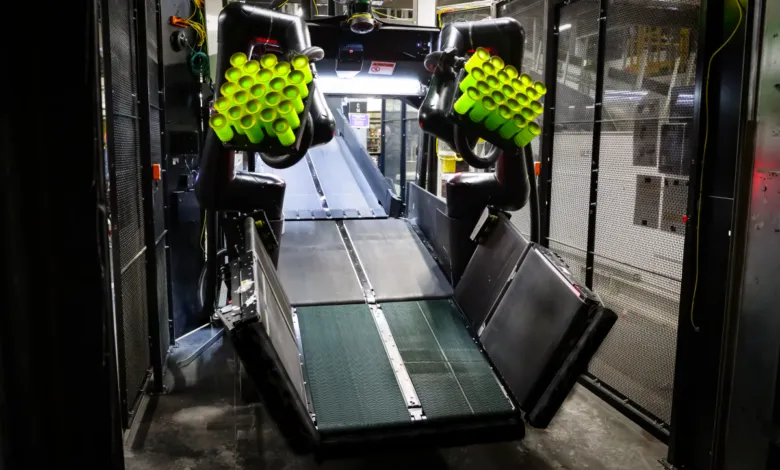
– Its new “Scoop” robot, developed with Berkshire Grey, is designed for the physically demanding task of bulk package unloading and will enter a pilot program this year.
– The company states that bulk unloading is a suitable first task for automation because it is repetitive and dangerous, but less complex than tasks like picking individual packages.
– FedEx has multiple automation partnerships, including with Dexterity and Nimble for warehouse tasks and with Aurora for autonomous trucking, while ending a last-mile delivery project with Nuro.
– Executives emphasize a calculated approach, prioritizing technology that solves specific business problems and works alongside employees, and currently see humanoid robots as not yet fit for their purpose.
The push to automate logistics operations is accelerating across the industry. Rather than building proprietary systems from scratch, FedEx is pursuing a distinct path, choosing to collaborate with specialized robotics firms. This partnership-driven strategy allows the $84 billion shipping giant to integrate advanced automation while focusing its internal resources on core logistics technology.
A prime example is the company’s multi-year collaboration with SoftBank-owned Berkshire Grey. Together, they developed a robot named Scoop, designed for the specific task of bulk package unloading. This process involves removing large bundles of parcels from a truck at once, a job FedEx identifies as one of the most physically demanding and unpredictable in its facilities. A pilot program for these robots is scheduled to begin later this year, with potential for wider scaling if successful.
According to Stephanie Cook, FedEx’s director of advanced technology and innovation for robotics, finding an off-the-shelf solution was impossible. “We knew it wasn’t something that we could just develop in a matter of months,” Cook stated, explaining that the complexity required a dedicated, multi-year partnership. O. P. Skaaksrud, vice president of advanced technology and innovation, noted that bulk unloading is an ideal starting point for automation. While the robots must make decisions, the task is less granular than picking individual items, making it a more feasible automation target.
The company’s philosophy is to first automate the most dangerous and repetitive roles, thereby allowing employees to shift to safer, higher-skilled work. This focus on human-robot collaboration is central to its approach.
While FedEx does develop certain technologies internally, such as its SenseAware sensor systems for tracking, leadership draws a clear line. “Developing robotics capabilities is next level,” Skaaksrud said. He argues that partnering with field experts allows for faster, more effective progress than attempting to build everything in-house. This belief is reflected in a broader portfolio of automation partnerships.
Within warehouses, FedEx also works with Dexterity, a robotics unicorn specializing in a human-like touch, and Nimble, which builds fully autonomous warehouse systems. For transportation, the company has an ongoing partnership with autonomous trucking startup Aurora Innovation, having completed thousands of autonomous hauls on defined routes. A past collaboration with last-mile robotics firm Nuro ended when that company shifted its business model.
The company has learned from its own ventures into proprietary robotics, such as the SameDay Bot for last-mile delivery, which was ultimately discontinued. These experiences reinforce the value of its selective partnership model.
Leadership emphasizes a pragmatic, business-led approach over chasing the latest technology trend. “Don’t be too focused only on the technology, because then we’re going to fail,” Skaaksrud cautioned. He describes the integration process as a complex game of “3D chess,” requiring solutions for numerous unglamorous components. The goal is to deploy productive technology that solves clear business problems with a tangible return on investment.
This calculated stance extends to areas like humanoid robots. While acknowledging long-term potential, Skaaksrud expressed skepticism about their current practicality in dynamic warehouse environments, citing the immense challenge of orchestrating multiple units in confined spaces. For now, FedEx remains focused on fit-for-purpose automation designed to work alongside its workforce, prioritizing safety and operational efficiency over hype.
(Source: TechCrunch)