Arinna Secures $4M Seed Funding for Space Power Solutions
▼ Summary
– Arinna, a startup founded by Stanford PhDs Koosha Nazif and Alex Shearer, raised a $4 million seed round to develop ultrathin solar panels for spacecraft.
– The company’s technology uses a new class of atomically thin semiconductors called transition metal dichalcogenides (TMDs), which are more efficient and durable than legacy space panels.
– Arinna plans to test its first photovoltaic products in orbit before the end of this year and aims to build a mass-production facility by 2028.
– The company claims its panels will be 32% more efficient, last 15 years in orbit, and be more flexible and cheaper than current options.
– Investors see advanced power solutions as a critical bottleneck for space ambitions, believing Arinna’s technology could unlock the next generation of space power needs.
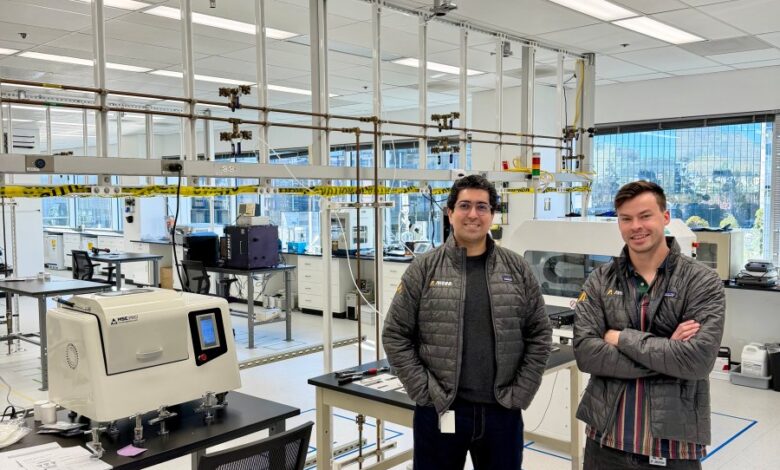
A new venture founded by Stanford researchers has secured significant backing to develop a novel class of ultrathin solar panels designed specifically for the harsh environment of space. Arinna, co-founded by CEO Koosha Nazif and CTO Alex Shearer, announced a $4 million seed funding round led by Spacecadet Ventures to commercialize a photovoltaic technology based on advanced two-dimensional semiconductors. This investment, with participation from Anorak Capital and Breakthrough Energy Foundation, will propel the company toward its goal of on-orbit testing before the end of this year.
The startup’s solution addresses a critical bottleneck in the modern space industry. As satellite constellations proliferate, the demand for affordable, durable, and efficient power has surged. Traditional space-grade panels, built with rare earth elements, are robust but prohibitively expensive for mass-produced spacecraft. Conversely, cheaper silicon panels degrade rapidly when exposed to cosmic radiation. Arinna aims to bridge this gap with its proprietary technology.
The core innovation lies in the use of transition metal dichalcogenides (TMDs), atomically thin semiconductors developed over recent decades. “We are building qualification panels to send to our first customers that will demonstrate that these two dimensional photovoltaics have the efficiency and the durability to survive space,” explained Shearer. The company claims its cells are not only more flexible and resilient than legacy options but also significantly cheaper to produce.
Following successful orbital qualification, Arinna plans to scale production aggressively, targeting a megawatt-scale manufacturing facility by 2028. The process refinement is already underway. “We’re going to prove that out at a larger scale over this next year, and in doing so, we are refining the processes necessary to make every single layer of our photovoltaic to produce these in a roll to roll fashion,” Shearer added.
Investors see the technology as a potential game-changer. “What I’ve seen from all of the space companies we’ve invested in is that power is a barrier, a bottleneck,” said Wiz Khuzai, a general partner at Spacecadet Ventures who led the investment. “[Arinna] are going to be the unlock for the next generation of power needs in space.” This sentiment is echoed by materials scientists familiar with the field, who note that Arinna’s approach represents a fundamental shift rather than an incremental improvement.
The partnership between the founders is rooted in complementary expertise developed during their doctoral studies at Stanford. Nazif focused on architecting new photovoltaic materials, while Shearer specialized in scalable manufacturing techniques. “Koosha was very much the architect, and I am construction,” Shearer joked. Together, they are targeting performance metrics that include a 32% increase in efficiency over traditional panels, a 15-year operational lifespan in orbit, and the elimination of protective coverings.
The company’s ambitious timeline hinges on a successful test campaign in space later this year. If the technology performs as expected, Arinna could provide a foundational power solution for next-generation spacecraft, enabling more ambitious missions and larger satellite networks. The startup, named for an ancient Hittite sun god, is now poised to bring a very modern form of solar power to the final frontier.
(Source: TechCrunch)