Ex-Big Tech Engineers Use AI to Navigate Trump Trade Chaos
▼ Summary
– Sam Basu left Google and co-founded Amari AI after discovering the customs brokerage industry’s heavy reliance on outdated, paper-based processes.
– The startup aims to modernize the industry by using AI to automate data entry and paperwork, allowing employees to focus on customer service and compliance.
– Amari AI has gained traction with over 30 customers, helped move over $15 billion in goods, and raised $4.5 million in funding from top venture firms.
– The company’s AI agents monitor trade rules in real-time, helping brokers quickly adapt to sudden policy changes that have increased industry importance and burnout.
– Early adopters like GHY International see the technology as a tool for growth and agility, not job replacement, in an industry now under constant spotlight.
The world of international trade, a complex web of regulations and paperwork, is undergoing a quiet revolution driven by artificial intelligence. Former Big Tech engineers are now applying their expertise to solve critical bottlenecks in global logistics, particularly as unpredictable trade policies create chaos for importers and exporters. This shift highlights how AI is moving beyond consumer applications to tackle foundational but overlooked industrial challenges.
Sam Basu left his senior engineering role at Google in early 2023, inspired by the potential of new AI tools. After exploring a few ideas, a conversation with a friend struggling with customs paperwork sparked his curiosity. He began calling brokers in Los Angeles and discovered an industry still heavily dependent on fax machines and physical documents. A pivotal moment came during a video call with a potential client, who gave him a tour of an office filled with towering stacks of manila folders. “That was the eye-opening moment,” Basu recalled. “I was both shocked and impressed. Shocked that this is how the industry runs, and impressed that everything around us is imported through this process.”
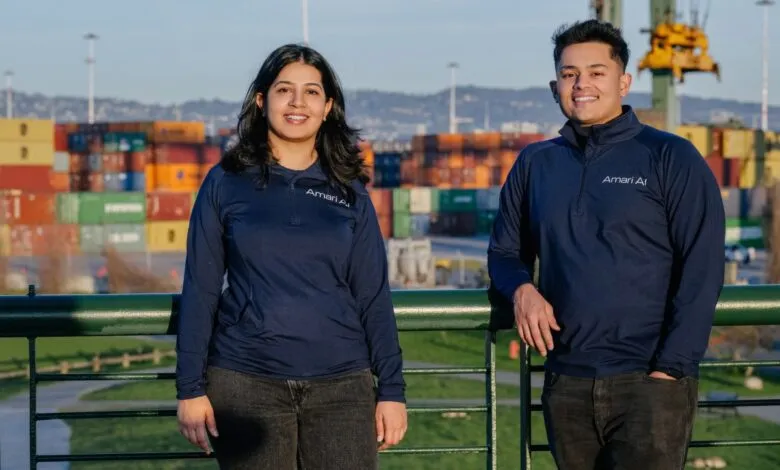
This insight led to the creation of Amari AI, a startup Basu co-founded with Arushi Vashist, a former senior software engineer from LinkedIn. The company has already attracted over thirty clients and facilitated the movement of more than $15 billion in goods. Operating in stealth until recently, Amari AI has secured $4.5 million in funding from top-tier early-stage investors First Round Capital and Pear VC.
Basu’s mission with Amari is twofold. First, the startup aims to modernize customs brokerage by automating data entry and cumbersome paperwork. Many brokers still use limited optical character recognition software, but Amari’s AI systems are designed to handle these tasks more robustly. This automation allows employees, who must be U.S.-based due to licensing laws, to focus on higher-value customer service and problem-solving.
The second goal addresses a pressing market need: navigating volatile trade policy. The chaotic trade environment under the Trump administration has dramatically increased the importance of customs brokers, according to Chris Bachinski, CEO of the 125-year-old firm GHY International. Bachinski, an early adopter of Amari, explained that many importers lack dedicated compliance staff. They rely entirely on brokers to interpret sudden policy shifts, especially for goods already in transit. This uncertainty has led to widespread industry burnout. With a tightly regulated workforce and licensing exam pass rates between 10% and 20%, Basu sees this as “a perfect fit for AI.”
“Experienced people are leaving the industry or taking early retirement,” Basu noted. “So we’re pitching ourselves as these extra set of hands that logistics companies can hire to augment human expertise.” Amari’s AI agents continuously monitor trade rules, updating their analysis instantly when policies change. This allows brokers to advise clients on impacts much faster than through traditional manual research.
The company builds its proprietary models by training on over one million documents from shipments it has helped clear. Basu emphasized that while they currently use some off-the-shelf models, client data privacy is paramount. Customers can opt out of training, and all data is anonymized before being fed into the AI systems. “We do not sell their data, and we make sure that their data is theirs,” he stated. “They’re very serious about these documents.”
Todd Jackson, a partner at First Round Capital, credited Amari’s early traction to Basu’s hands-on approach to understanding the industry. “He’s going to conferences, he’s going to trade shows, [and] the word of mouth starts to get very strong,” Jackson said. “It’s an old-school industry.” It was at a National Customs Brokers and Forwarders Association event that Basu’s presentation caught Bachinski’s eye.
For a mid-sized firm like GHY, staying competitive is a constant challenge. Bachinski acknowledged that initial employee concerns centered on potential job losses. However, he reassures his team that technology like Amari’s is a tool for growth, enabling them to concentrate on strengthening customer relationships and complex compliance work. “It’s an old industry, and technology is going to shift our industry faster than I think most customs brokers understand,” he observed.
With trade policy consistently in the headlines, agility is now non-negotiable for brokers. Bachinski quipped, “I make this joke that last year, for the first time in history, our families know what we do for a living. Because all of a sudden, customs brokers became very, very important.”
(Source: TechCrunch)