The ‘Vibe Coding’ Reality Check: Can AI Truly Turn Beginners into Developers?

Nvidia CEO Jensen Huang recently made a bold declaration: English is the new programming language. Armed with this blessing, the tech world has fully embraced “vibe coding”, the act of generating complex software simply by conversing with an AI agent. No syntax, no semicolons, just vibes.
But how much of this is marketing hype, and how much is reality?
Inspired by a recent hands-on deep dive by ZDNet’s Tiernan Ray, we at DigitrendZ decided to dissect the current state of vibe coding. The mission was simple: Can a total coding novice use the top AI developer tools to build a custom data analysis app from scratch? The results were thrilling, incredibly frustrating, and ultimately eye-opening.
Here is the DigitrendZ breakdown of the top vibe coding tools in 2026, and what happens when the vibe suddenly turns sour.
The Challenge
The goal wasn’t just to build a generic calculator or a simple weather app. The objective was to create a bespoke, local database analysis tool capable of ingesting thousands of word-processing documents and performing deep semantic searches, analyzing themes and historical contexts rather than just spitting out keyword matches.
To bring this to life, four heavyweights were put to the test: Cursor, Replit, Visual Studio, and Lovable.
The Contenders: A Mixed Bag of Magic and Headaches
1. Cursor: The Local Heartbreak
Cursor is arguably the biggest buzzword in AI coding right now. To a beginner, its ability to automatically set up file structures, connect databases, and install libraries feels like pure magic.
- The Vibe: Electrifying at first.
- The Reality Check: Cursor is a desktop app, and it frequently bounces users into the dreaded terminal window, a terrifying place for non-coders. Worse, in this trial, a simple restart caused the AI to wipe the entire chat history. In vibe coding, your chat history is your source code. Without reliable memory, the tool is a non-starter.
2. Replit: The Cloud Credit Crunch
Moving to the cloud, Replit removes the need for local installations. It set up a bare-bones app environment in 15 minutes.
- The Vibe: Fast and accessible.
- The Reality Check: Cloud computing isn’t free. Experimentation quickly burned through the free-tier compute credits. Furthermore, Replit struggled to parse proprietary file formats (like Apple’s .Pages), stalling the project in an endless loop of troubleshooting. Plus, forcing private data onto a cloud server can give any privacy-conscious creator serious anxiety.
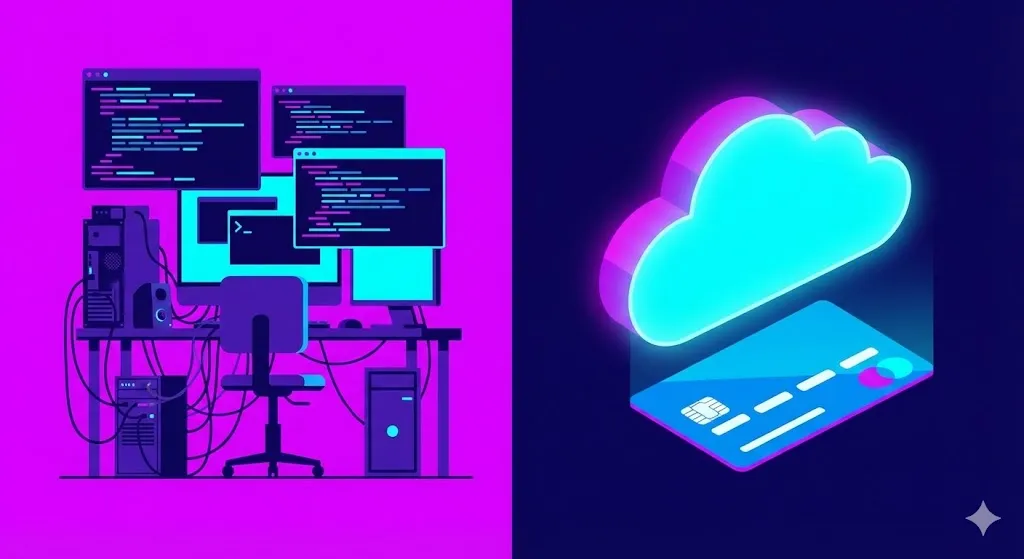
3. Visual Studio (with GitHub Copilot): The Terminal Trap
Microsoft’s flagship IDE comes packed with powerful AI assistance, but it still assumes you know your way around a codebase.
- The Vibe: Professional and robust.
- The Reality Check: Rather than automating everything, Copilot often generated snippets of code and expected the user to manually paste them into the command line. After hours of tedious trial-and-error, it only produced a rudimentary keyword-matching tool. It became glaringly obvious that knowing how to code is still required to tell the AI what to code.
4. Lovable: The Unexpected Hero
Tired of desktop terminals and buggy file parsers, the journey led to Lovable, a cloud-based AI platform that features an interface remarkably similar to ChatGPT or Google Gemini.
- The Vibe: User-friendly and results-oriented.
- The Reality Check: Lovable successfully abstracted away the terrifying code details. After burning through the free tier, a $25 Pro upgrade finally provided the juice needed to get things moving. By pivoting from local .Pages files to an XML cloud archive, and integrating Google Gemini for the heavy lifting of semantic analysis, Lovable finally produced a working Minimum Viable Product (MVP).
The DigitrendZ Verdict: Are Programmers Obsolete?
If you are a non-coder hoping to casually speak a multi-million-dollar SaaS product into existence by the weekend, you will be disappointed.
Vibe coding is an incredible power-up, but it exposes a hidden truth about software development: writing code is only 10% of the job. The other 90% is managing virtual environments, dealing with broken file parsers, navigating server constraints, and making critical product development decisions.
As it turns out, taking the human out of the syntax just leaves the human with all the architectural headaches. If you are a solo entrepreneur, you aren’t just the “vibe coder”; you are the IT department, the QA tester, and the product manager.
The Bottom Line: English might be the new programming language, but you still need a programmer’s mindset to speak it fluently. For now, human developers and product teams are safe, and arguably, more valuable than ever.