Robots Dominate RoboCup 2026, Eye Human World Cup Next
▼ Summary
– RoboCup 2026 in Incheon saw teams using robots from Beijing’s Booster Robotics sweep all three humanoid football divisions, winning gold, silver, and most podium places.
– Most leading teams now buy robot bodies off the shelf and focus on software, shifting the contest from building hardware to making robots smarter.
– RoboCup’s founding mission is for autonomous humanoid robots to beat the FIFA World Cup winners under normal rules by 2050.
– Booster Robotics is using its win to promote its platform, including Booster Studio and a new 3v3 robot football league, aiming to become the standard development environment.
– While robot football is still a research tool with a huge gap to human champions, the hardest problem has shifted from mechanics to intelligence, which is improving fastest.
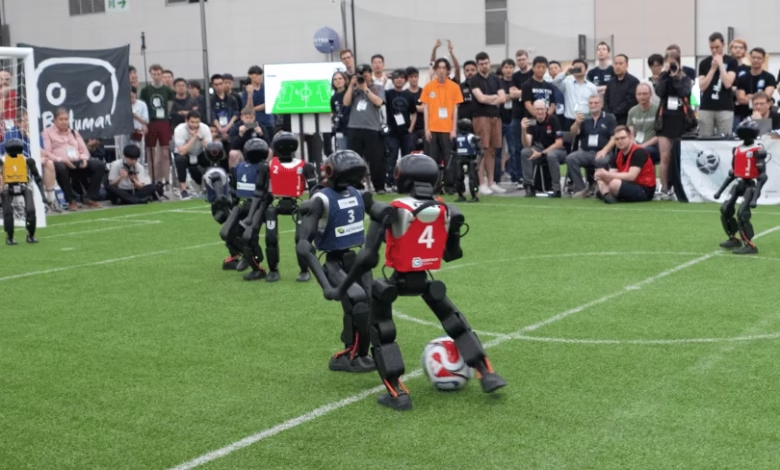
While the world was captivated by the human World Cup, a different kind of tournament unfolded in Incheon. RoboCup 2026 ran from 30 June to 6 July in Songdo, drawing teams from dozens of countries, but when the final whistle blew, one name was behind every winner.
Teams using robots from Beijing’s Booster Robotics swept all three humanoid football divisions. The numbers are stark: of the 59 teams in the humanoid leagues, 38 competed on Booster machines. They claimed gold, silver, and most of the podium spots across the Small, Middle, and Large divisions. Tsinghua University’s Hephaestus team won the Large division on the Booster T1, Germany’s B-Human took the Middle division on the K1, and a team called Invic won the Small division on the K1 Air.
This clean sweep signals a fundamental shift in the field. For years, each team built its own robot from scratch, pouring effort into mechanics, hardware, and simply teaching the machine to walk. That era is over. Most leading teams now buy the body off the shelf and focus entirely on software. They concentrate on perception, split-second decisions, and multi-robot coordination. Booster supplies the hardware and continuously improves the hard parts,running, sudden stops, and getting back up after a fall. The contest has moved from “who can build the robot” to “who can make it smarter.”
That split matters beyond football. Reliable legs and a stable body let researchers test complex “embodied intelligence” in the real world, not just in simulation. A robot that plays football is really a robot learning to see, balance, and react at speed.
The dream of beating human champions is not new. It is RoboCup’s founding mission, set back in 1997. The pledge is that by 2050, a team of autonomous humanoid robots will beat the reigning World Cup winners under normal FIFA rules. “Our team’s ultimate goal is that we will beat the FIFA champion in 2050,” one competitor told Reuters in Incheon.
The gap is still enormous, and the event was honest about it. RoboCup 2026 marked the first time two full teams of humanoid robots played 11 against 11 on real hardware. The scoreline was modest: B-Human beat fellow German side HTWK Robots 4:0. These are small, wobbly players, not Messi. Yet a decade ago even a steady walk was a struggle. Elsewhere, humanoids have already outrun a human record over a half-marathon.
Booster’s win is also a business move. The company is not just selling robots; it is trying to own the platform they run on. It recently launched Booster Studio, which it bills as the first full development environment for embodied intelligence. Engineers use it to program, simulate, and deploy robot behavior before touching real hardware. One of the youngest teams in Incheon came from a Macau middle school. Its students trained their code in the simulator, then loaded it onto real robots. Booster has also started its own 3v3 robot football league to attract more developers. The pitch is an open ecosystem, with Booster as the layer everyone builds on.
It fits a wider pattern. China shipped roughly 90% of the world’s humanoid robots last year, led by names like Unitree. The sector is crowded and not yet profitable for most, and Beijing has even started to register humanoids by ID. Winning a global contest is a cheap and vivid way to stand out.
A word of caution is fair. The flashy clips are heavily curated. A viral video showed a Booster T1 smashing a penalty clean through a wall,fun until you remember these machines share a pitch with people. Robots that kick that hard have already hurt bystanders at other events. For now, robot football is a research tool dressed up as a spectacle. The gap to a real World Cup side remains enormous, and 2050 is a long way off. But the direction of travel is clear. The hard problem is no longer the body. It is the brain, and that is exactly the part improving fastest.
(Source: The Next Web)