Google Messages’ Major Flaw: A Frustrating Reality
▼ Summary
– The author criticizes Google Messages for having a vastly inferior and feature-lacking experience on the web and tablets compared to its modern, well-designed Android app.
– Key features like sending voice messages and scheduling messages, which are standard on the mobile app, are completely absent from the web and tablet versions.
– The design of the web and tablet app is described as dated and inconsistent, lacking the modern Material 3 design and visual cues present in the Android version.
– The article contrasts this with other Google apps like Keep and Gmail, which maintain strong feature parity and a cohesive experience across different platforms.
– The author concludes that for Google Messages to truly compete with services like iMessage and WhatsApp, Google must prioritize fixing this feature and design disparity across devices.
The persistent shortcomings of Google Messages on non-mobile platforms create a jarring and frustrating experience for users who rely on seamless communication across all their devices. While the Android app has evolved into a polished and feature-rich messaging hub, its web and tablet counterparts feel like neglected afterthoughts, lacking the core functionality and modern design that define a cohesive ecosystem. This disparity undermines Google’s broader messaging ambitions and leaves a significant gap in its service portfolio.
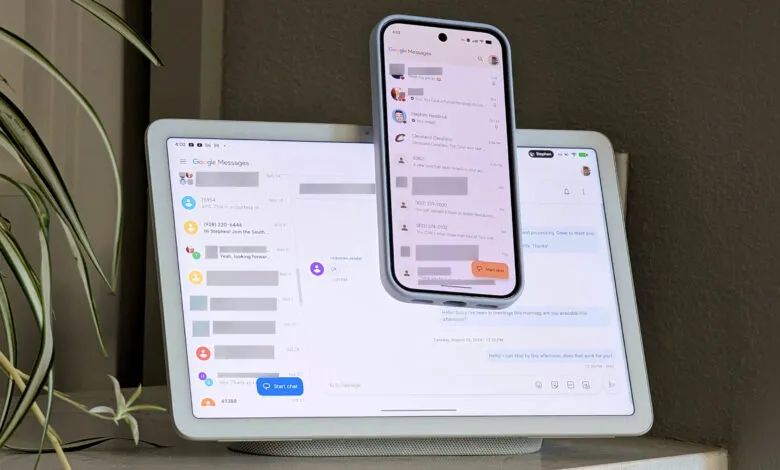
Messaging has fundamentally moved beyond the smartphone. People communicate from laptops during work and from tablets at home, expecting a consistent experience. Google Messages fails to deliver this cross-platform parity, creating a fragmented and inferior user experience on the web and tablets. The mobile app benefits from smooth animations, responsive interactions, and the full suite of Material 3 design principles, making it feel native and modern. Switch to another device, however, and the experience quickly unravels.
Basic functions like sending texts or attaching photos work, but the app immediately shows its limitations. A prime example is voice messaging. On Android, it’s a beautifully implemented feature with options for emojis, colors, and noise cancellation, accessible via a prominent button. On the web and tablet, this feature simply does not exist. Similarly, scheduling messages for later delivery, a standard capability on most modern platforms, is easily found in the mobile app but is completely absent elsewhere. These are not niche features; they are fundamental tools for modern communication.
The design inconsistency is perhaps the most glaring issue. The web and tablet versions of Google Messages look like relics from a different era. Sharp corners, a dated text box design, and the absence of visual cues like the RCS chat bubble make it hard to believe it’s from the same company that crafted the elegant Android app. Even personalization suffers, as your Material You theme from your phone does not sync across. The overall aesthetic feels disconnected from Google’s current design language.
This problem is especially puzzling because Google demonstrates it can do better. Apps like Google Keep, Gmail, and Calendar maintain strong feature parity and a consistent feel across phones, tablets, and the web. While design updates might roll out to different platforms at varying speeds, the core functionality remains intact everywhere. This makes the state of Messages seem less like a technical challenge and more like a matter of misplaced priorities.
As a core application that millions use daily, messaging deserves a higher level of attention. Google has made commendable progress with RCS and the mobile app, positioning Android messaging to compete with services like iMessage and WhatsApp. To truly succeed, the experience must be excellent everywhere. The company certainly has the resources; it’s now a question of commitment. Users are waiting for the day when Google Messages offers a unified, powerful, and polished experience regardless of the device in their hand or on their desk.
(Source: Android Authority)