Florida RS7’s First Drive Swarmed by Fellow Audis
▼ Summary
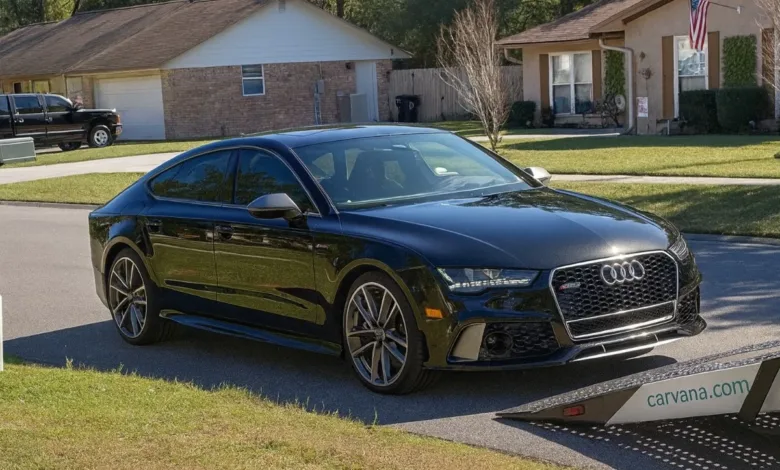
– A man bought an Audi RS7 Performance to stand out, but on his first drive in Jacksonville, Florida, he encountered three other identical models.
– He had believed his car was unique in his area, but data shows over 1,500 RS7 units were sold in the US in 2024, with at least four in his Florida locale.
– The Audi RS7, introduced in 2013, followed a logical naming era where ‘A7’ indicated size and ‘RS’ (RacingSport) denoted high performance.
– Modern car naming conventions have become less logical, with arbitrary model numbers and electric vehicles using ‘Turbo’ in their names.
– Audi’s ‘A’ naming system began in 1994, and as of 2025, all ‘A’ nameplates except the A2 remain in active production.
Imagine buying a car specifically for its exclusivity, only to find yourself in a spontaneous convoy of identical models on your very first drive. That’s exactly what happened to one Florida Audi owner, whose story highlights a surprising twist on automotive rarity. A content creator known as elijahifl recently shared his experience after purchasing an Audi RS7 Performance, believing it to be a unique sight in Jacksonville. His confidence came from never having seen one locally, making it a compelling choice for standing out. However, during his inaugural evening cruise, he was joined by not one, but three other RS7s, turning his dream of exclusivity into an unexpected group gathering.
While this anecdote might suggest the RS7 is common, the data tells a different story. Only about 1,500 units of the RS7 were sold across the entire United States in 2024, making it a genuinely rare vehicle. The owner’s experience seems to be a remarkable coincidence of geography, with at least four of these high-performance sedans congregating in the same Florida region. It serves as a humorous reminder that even with low production numbers, local clusters can form, especially around desirable models in affluent areas.
The RS7 name itself harks back to a more logical era in automotive branding. Introduced in 2013, the model followed Audi’s then-coherent naming strategy. The ‘A7’ designation identified it as the seventh-largest non-SUV in Audi’s lineup. The letters ‘S’ stood for Sport models, while RS represented the pinnacle RacingSport variants. This period embraced straightforward nomenclature, similar to how Ferrari’s 458 Italia denoted a 4.5-liter V8 engine, and Mercedes-AMG used ’55’ for models with a 5.5-liter powerplant.
Modern naming conventions have become considerably less intuitive. Many AMG models now feature arbitrary numbers unrelated to engine displacement, and Porsche applies the ‘Turbo’ badge to electric vehicles like the Macan EV, a term that is technically irrelevant without forced induction. This shift often creates confusion, though some manufacturers are recognizing the value of clarity and are cautiously returning to more descriptive systems. Yet, the industry’s trajectory suggests we might one day see an electric car bearing a wildly contradictory name like ‘Naturally Aspirated Turbo Manual V8.’
Audi’s ‘A’ model lineage has steadily evolved since its inception. The nameplate debuted in 1994 with the A4, A6, and A8, establishing a clear hierarchy. The range expanded with the A3 in 1996 and the innovative A2 in 1999. After an eight-year gap, the A5 coupe arrived in 2007, followed by the compact A1 and the sleek A7 in 2010, the latter slotting neatly between the A6 and A8 in size and prestige. Today, all these ‘A’ nameplates remain in active production except for the discontinued A2, demonstrating the enduring structure of Audi’s core model range.
(Source: Supercar Blondie)