Man’s ‘Gold’ Rock Is Actually a Rare Meteorite Worth Millions
▼ Summary
– David Hole discovered a heavy reddish rock in Australia’s Goldfields region in 2015, initially believing it contained gold.
– Despite using tools like a rock saw and acid, he couldn’t break it open, as it was later identified as a rare meteorite by Melbourne Museum geologists.
– The meteorite, named Maryborough, is 4.6 billion years old, weighs 17 kg, and is classified as an H5 ordinary chondrite with high iron content.
– Researchers suggest it likely originated from the asteroid belt between Mars and Jupiter and has been on Earth for 100 to 1,000 years.
– This meteorite is rarer than gold, being one of only 17 recorded in Victoria, and provides valuable scientific insights into the Solar System’s formation.
Back in 2015, a man named David Hole made an extraordinary find while metal detecting in Maryborough Regional Park near Melbourne, Australia. He spotted a reddish, unusually heavy stone lodged in yellow clay and brought it home, convinced it held a gold nugget inside. The area is part of the Goldfields region, famous for the 19th-century gold rush, so his assumption seemed reasonable. Determined to crack it open, Hole tried a rock saw, an angle grinder, a drill, and even poured acid over the object. When those failed, he resorted to a sledgehammer, but nothing made a dent. The reason for its toughness soon became clear: this was no ordinary stone but a rare and ancient meteorite.
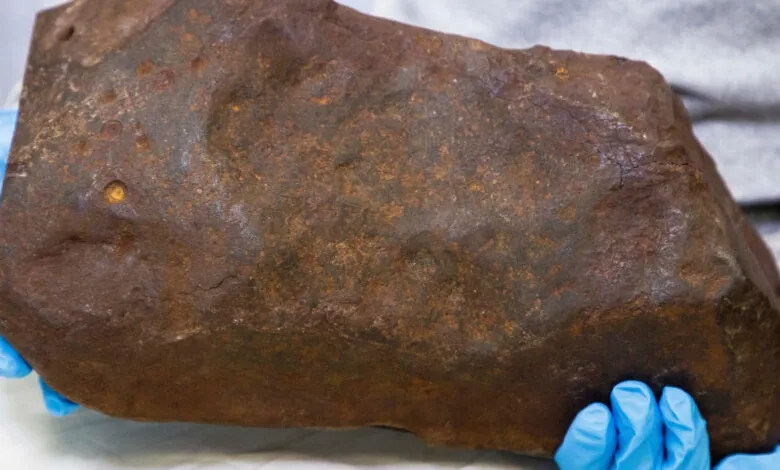
Years later, Hole brought the mysterious object to the Melbourne Museum for analysis. Geologist Dermot Henry noted its unique appearance, telling The Sydney Morning Herald, “It had this sculpted, dimpled look to it.” He explained that such features form when meteorites streak through the atmosphere, melting on the outside as air sculpts their surface. Henry, who has examined countless rocks brought in by hopeful collectors during his 37-year career, confirmed that only two had ever turned out to be genuine meteorites, and this was one of them.
Another geologist, Bill Birch, pointed out that the rock’s extreme weight was a dead giveaway. “If you saw a rock on Earth like this and you picked it up, it shouldn’t be that heavy,” he remarked. Weighing 17 kilograms (37.5 pounds), the meteorite, named Maryborough after the nearby town, required a diamond saw to slice off a small section. Inside, researchers identified a high iron content, classifying it as an H5 ordinary chondrite. Tiny crystallized droplets known as chondrules were also visible, offering clues to the early Solar System.
Henry emphasized the scientific value of such finds, noting, “Meteorites provide the cheapest form of space exploration. They transport us back in time, providing clues to the age, formation, and chemistry of our Solar System.” Some meteorites contain stardust older than the Solar System itself, revealing how stars form and produce elements. Others even include organic molecules like amino acids, considered the building blocks of life.
Though its precise origin remains uncertain, scientists believe the Maryborough meteorite likely came from the asteroid belt between Mars and Jupiter. A collision may have dislodged it, sending it on a trajectory that ended with impact on Earth. Carbon dating indicates it landed here between 100 and 1,000 years ago, and records of meteor sightings from 1889 to 1951 could align with its arrival.
In terms of rarity, this space rock surpasses gold. Only 17 meteorites have ever been recorded in Victoria, and the Maryborough specimen is the second-largest chondritic mass found there, after a 55-kilogram meteorite identified in 2003. Henry observed, “Looking at the chain of events, it’s quite, you might say, astronomical it being discovered at all.”
Delayed identifications are not unheard of in the world of meteorites. One famous example, covered by ScienceAlert in 2018, involved a space rock that served as a doorstop for decades before being recognized. Recent studies have now traced the origins of more than 90 percent of known meteorites, shedding new light on their journeys through space.
So if you happen to come across a strangely heavy, nearly indestructible rock, take a closer look, it might just be a scientific treasure.
(Source: Science Alert)