From Manifold Garden to Hotel Infinity: A VR Origin Story
▼ Summary
– Hotel Infinity is a highly acclaimed VR game from Studio Chyr, praised by critics as essential for understanding VR’s potential.
– The game was developed by a small Chicago-based team that previously created the puzzle game Manifold Garden in 2019.
– Studio Chyr abandoned adapting Manifold Garden for VR after finding its mechanics didn’t translate well, instead focusing on creating impossible spaces unique to VR.
– The biggest design challenge involved creating coherent, large-feeling environments within a 2m x 2m space using looping architecture and careful motion planning to prevent discomfort.
– The team is currently focused on post-release patches and recently launched a different title called Strata for the new Board console, with no plans to add hand tracking.
For anyone seeking a truly breathtaking virtual reality journey, Hotel Infinity stands out as an essential experience. Crafted by the same team behind the acclaimed Manifold Garden, this room-scale VR title has already earned high praise. One reviewer described it as a must-own for anyone interested in understanding the potential of this medium, while another prominent developer noted they played through the entire game in a single session, calling it highly recommended.
The creative force is Studio Chyr, a small independent studio based in Chicago and led by William Chyr. Their previous project, Manifold Garden, launched in 2019 to widespread acclaim for its mind-bending, Escher-esque world of impossible architecture. That game built a strong, loyal fanbase, making it a logical starting point for the team’s first foray into virtual reality.
However, the developers quickly discovered that the core gameplay of Manifold Garden didn’t translate well into the VR space. Mechanics like gravity-shifting and repeatedly falling through space felt neither special nor comfortable when experienced in a headset. This realization prompted a fundamental shift in their approach. They returned to their original inspiration, the pure desire to experience spaces that cannot exist in reality, and asked what it would truly be like to navigate such impossible architecture in virtual reality.
This philosophical pivot gave birth to Hotel Infinity. We connected with Studio Chyr to learn more about the development process and the thinking behind their impressive achievement.
Who is behind the creation of Hotel Infinity?
Hotel Infinity was developed by Studio Chyr. Our core team consists of seven people, though we regularly collaborated with specialists throughout the project. At the peak of production, around twenty people were working on the game. If you include everyone from platform partners and external QA testers to interns and consultants, the total number of contributors is closer to seventy.
Early prototyping began in 2021 while we were still porting Manifold Garden to new platforms. Full-scale production started in early 2023, so the entire development cycle spanned approximately three years.
What led to the decision to focus exclusively on room-scale VR?
Our initial plan was to adapt Manifold Garden for VR, but we soon realized its mechanics didn’t translate in a meaningful or innovative way. For instance, implementing gravity changes via teleportation felt underwhelming, and the frequent falling sequences were uncomfortable in a VR context.
Instead of forcing an adaptation, we went back to our foundational inspiration: the desire to experience impossible space. We asked ourselves what that would feel like in VR. This led us to create an entirely new project, Hotel Infinity. We chose to fully embrace VR’s unique strengths, particularly its ability to create a powerful sense of presence and immersion. Natural locomotion became a central pillar of the design, as it allows players to navigate impossible spaces in a way no other medium can offer.
What was the single greatest design challenge you faced?
Without a doubt, the biggest challenge was level design and movement. Our goal was to make the world feel vast and coherent while confining the player to a two-meter by two-meter physical space.
To achieve this, we designed environments that loop and fold back on themselves. We created hallways that bend in ways defying real-world physics, something only VR can make you feel. This required overcoming significant technical hurdles, including building a robust portal system and ensuring lighting blended seamlessly across those portals. I am incredibly proud of what our team accomplished here.
We also devoted considerable effort to physical comfort. Too many turns in one direction can induce motion sickness, so we constantly balanced the player’s movement. You don’t need to walk great distances, but you need to see a great deal. A massive part of our work involved crafting the illusion of large, continuous spaces. We used subtle environmental cues, like furniture placement and railings, to guide players naturally without shattering their immersion.
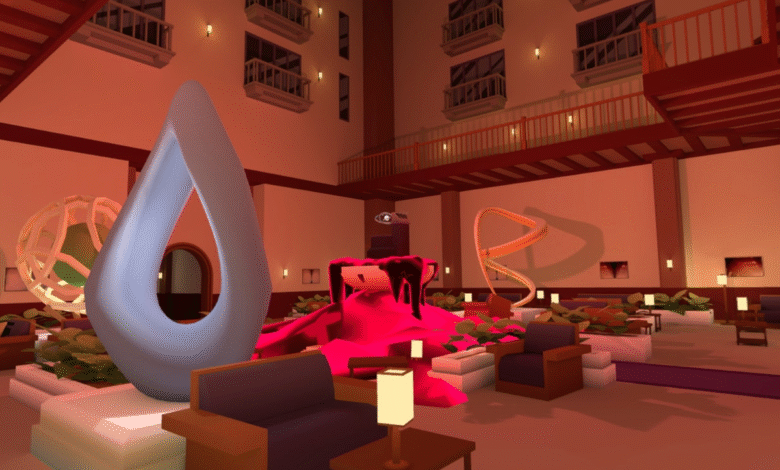
We had to completely rethink spatial perception. The opening lobby is a prime example; it went through numerous iterations to perfect the flow. We paid meticulous attention to the sequence and size of left and right turns, ensuring each upcoming area was subtly foreshadowed to make movement through the space feel completely cohesive.
What is the team working on now?
Currently, we are focused on releasing patches to address key issues players have identified. We’ve added a visual indicator to show if a player’s guardian boundary is too small and how much it needs to be expanded. We’ve also implemented improvements to reduce visual flickering and fix various bugs. Separately, we recently released a game called Strata for a new console named Board. It’s a very different title that involves playing with physical pieces on a digital surface.
Are there any plans to introduce controller-free hand tracking?
At this time, we do not have plans to add controller-free hand tracking.
(Source: Upload VR)

