Bose QC Ultra vs. Sony XM6 vs. AirPods Max: Which to Buy?
▼ Summary
– The Sony XM6 headphones offer superior battery life (up to 40 hours) and faster quick charging compared to the Bose QC Ultra Headphones (Gen 2).
– Bose QC Ultra Headphones (Gen 2) provide class-leading active noise cancellation that effectively blocks out most ambient sounds, even in noisy environments.
– Sony XM6 headphones deliver excellent sound quality with robust bass, crisp mids, and high-resolution audio support, while Bose QC Ultra excels in spatial audio that works with all stereo content.
– The Sony XM6 headphones offer more features and functionality, including extensive controls and audio technologies, whereas the Bose QC Ultra are more platform-friendly with better connectivity options.
– The Bose QC Ultra Headphones (Gen 2) are recommended over the Apple AirPods Max due to better noise cancellation, battery life, and modern specs, while Sony XM6 provide the best overall value for the price.
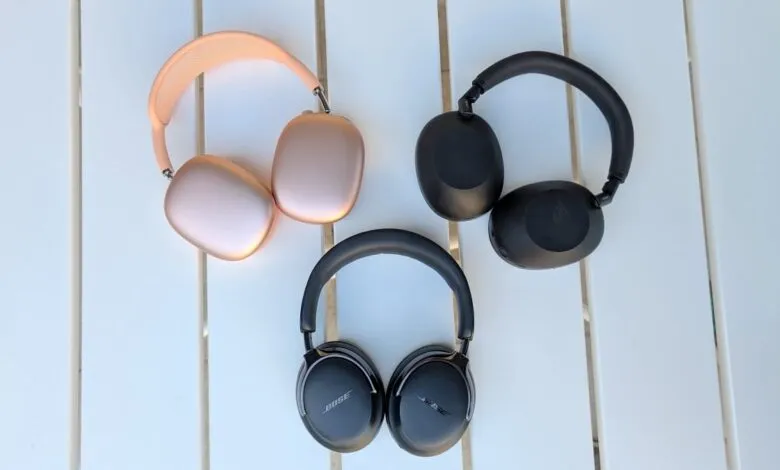
Choosing the right premium headphones often comes down to three major contenders: the Bose QuietComfort Ultra Headphones (Gen 2), the Sony WH-1000XM6, and the Apple AirPods Max. Each model brings distinct strengths to the table, making the decision far from straightforward. After extensive testing, it’s clear that your ideal choice depends heavily on which features matter most to you, whether it’s class-leading noise cancellation, all-around versatility, or seamless ecosystem integration.
Bose QC Ultra Headphones (Gen 2) vs. Sony XM6 Headphones
When comparing the Bose QC Ultra and Sony XM6, both represent incremental but meaningful updates over their predecessors. The battle between them is fierce, with each excelling in different areas.
Battery life clearly favors the Sony XM6, which delivers up to 40 hours of playtime on a single charge. Engaging active noise cancellation reduces this to 30 hours, and using spatial audio trims another five hours. Sony also leads in quick charging, just three minutes plugged in provides three hours of listening. The Bose QC Ultra sees a welcome battery improvement, now offering 30 hours, though enabling spatial audio cuts that by six to eight hours. Bose’s quick charging requires 15 minutes for 2.5 hours of playback, which feels sluggish next to Sony’s solution.
In noise cancellation, both models perform exceptionally, but the Bose QC Ultra holds a slight edge. Thanks to its upgraded ActiveSense algorithm, the QC Ultra neutralizes ambient noise with remarkable precision, making everything from office chatter to street commotion virtually disappear. High-frequency sounds like sirens may remain faintly audible, but they rarely break concentration. The Sony XM6 also impresses, effortlessly blocking out construction noise, bird songs, and loud conversations. Its standout feature is a 20-level adjustable transparency mode, which allowed me to clearly hear people talking across the street.
Sound performance is another close contest. The Sony XM6 produces rich, powerful bass right out of the box, supported by crisp mids and sparkling highs. Features like DSEE upscaling, LDAC support for high-resolution audio on Android, and 360 Reality Audio create an immersive, detailed listening experience. The built-in EQ includes multiple well-tuned presets. The Bose QC Ultra counters with its own strengths: improved clarity, support for Qualcomm’s aptX Adaptive codec, and USB-C lossless playback, a feature missing on the XM6. Bose’s Immersive Audio is a true game-changer, delivering spatial sound with any stereo content, not just Dolby Atmos tracks.
Usability is strong for both, with each supporting Bluetooth 5.4 and dual-device pairing. Sony offers more control options, including touch, gesture, physical button, and voice commands, all working flawlessly. The QC Ultra includes a responsive capacitive volume slider and reliable voice activation, though its multifunction buttons can be inconsistent. Sony also provides a richer set of special features, from a 10-band EQ to auto volume adjustment. Bose keeps it simpler, focusing on multiple ANC profiles and a useful sidetone setting for calls.
Which should you buy? At the same $449 price, the Sony XM6 delivers greater overall value with longer battery life, faster charging, and more features. However, if you prioritize crystal-clear call quality, top-tier spatial audio, and marginally better noise cancellation, the Bose QC Ultra is an excellent alternative.
Bose QC Ultra Headphones (Gen 2) vs. Apple AirPods Max
The competition between the Bose QC Ultra and Apple AirPods Max highlights differences in battery life, noise cancellation, and platform compatibility.
Battery life is a clear win for Bose. The QC Ultra lasts up to 30 hours, while the AirPods Max remain at 20 hours, regardless of ANC use. Apple does offer faster quick charging, five minutes for 1.5 hours of playback, compared to Bose’s 15 minutes for 2.5 hours.
Noise cancellation sees the QC Ultra pulling ahead again. Its refined digital signal processing eliminates nearly 90% of unwanted noise, maintaining Bose’s reputation for best-in-class ANC. The AirPods Max still handle low and mid-frequency sounds well but struggle with higher pitches. Apple’s Transparency Mode remains excellent for ambient awareness, though it lacks newer features like Conversation Boost available on recent AirPods Pro models.
Sound performance is satisfying on both, with each offering adaptive sound personalization, spatial audio, and USB-C lossless playback. The QC Ultra delivers a richer, more full-bodied sonic presence, aided by Bose’s CustomTune technology, which adjusts output based on your ear shape and minimizes distortion. Apple’s Personalized Spatial Audio creates a precise, theater-like soundstage, but Bose’s Immersive Mode works with all stereo content, not just specially encoded tracks.
Usability favors the QC Ultra for cross-platform users. It connects easily to both Apple and Android devices, with Google Fast Pair support on Android. Bluetooth 5.4 and dual-device pairing add to its flexibility. The AirPods Max offer seamless pairing with Apple devices, but connecting to Android is less intuitive. Apple’s Digital Crown provides precise volume and playback control, and “Hey Siri” voice commands work flawlessly.
Which should you buy? The Bose QC Ultra is the smarter choice for most buyers. It costs less than the AirPods Max and outperforms it in noise cancellation, battery life, connectivity, and sound versatility. With modern specs that ensure relevance for years, the QC Ultra feels more future-proof, while the AirPods Max show their age in several key areas.
Final Verdict
So, are the Bose QC Ultra Headphones (Gen 2) worth buying? Yes, if you want the best noise cancellation and spatial audio available. For those on a tighter budget, excellent options under $100 exist, though they can’t match the premium performance of these flagship models. In summary, the Bose QC Ultra stands out for ANC and immersive sound, the Sony XM6 offers unmatched value and features, and the AirPods Max are best skipped unless you’re deeply embedded in the Apple ecosystem and prioritize design over specs.
(Source: Mashable)